

More news on this day
Hundreds of travelers across Japan are facing unexpected delays and missed connections as a wave of schedule disruptions affects flights operated by ANA, Japan Airlines, Korean Air, Singapore Airlines, Cathay Pacific, Air China, and other regional carriers serving key hubs including Tokyo, Osaka, Fukuoka, Okinawa, and Hokkaidō.
Get the latest news straight to your inbox!
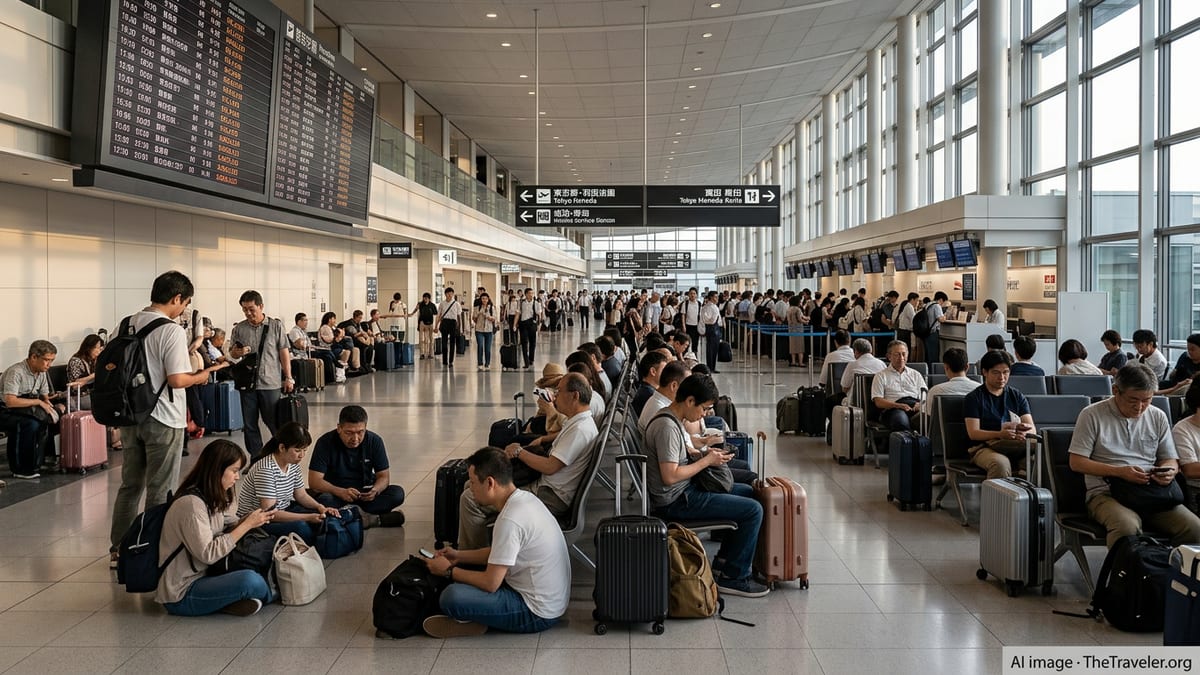
Wave of Disruptions Hits Japan’s Busiest Air Corridors
Publicly available flight-tracking data and airline notices show a growing pattern of delays and cancellations across major Japanese airports, with services in and out of Tokyo’s Haneda and Narita, Osaka’s Kansai and Itami, Fukuoka, Naha in Okinawa, and Sapporo’s New Chitose particularly affected. Travelers report long queues at check in, crowded departure halls, and a scramble to secure alternative routings as aircraft rotations fall behind schedule.
The impact is especially acute on high-density domestic corridors such as Tokyo to Sapporo and Tokyo to Fukuoka, where ANA and Japan Airlines typically operate near-shuttle frequencies. When one or two rotations are disrupted, the knock-on effect can reverberate across the rest of the day, compounding minor schedule changes into lengthy delays and missed onward connections for both domestic and international passengers.
Regional and long haul links have also been affected as aircraft and crews arrive late into Japan, pushing back departure times for services operated by Korean Air, Singapore Airlines, Cathay Pacific, Air China, and other Asian carriers that rely on tight turnaround windows at Japanese gateways.
According to published coverage, recent schedule adjustments and operational constraints are coinciding with strong seasonal demand, leaving less slack in the system to absorb even small disruptions. As a result, stranded passengers are increasingly visible in terminal seating areas and airline customer service lines across the country.
International Carriers Caught in Cascading Delays
International airlines serving Japan are facing their own set of challenges as they attempt to keep complex Asia Pacific networks running on time. Flights from Seoul, Shanghai, Hong Kong, and Singapore into Tokyo, Osaka, Fukuoka, and Sapporo are tightly timed to meet onward connections, and any delay on one leg can quickly cascade into missed links for travelers headed to North America, Europe, or other parts of Asia.
Publicly available information shows that Korean Air and other South Korean carriers operate dense schedules into Japanese cities such as Fukuoka, Osaka, and Sapporo, while Cathay Pacific and Singapore Airlines anchor key long haul connections through Tokyo and Osaka. When arrival slots are constrained or aircraft arrive late from previous sectors, ground times can lengthen, leading to rolling delays on subsequent departures.
Travelers connecting from these international flights onto domestic services with ANA or Japan Airlines are particularly exposed, as many itineraries rely on relatively narrow transfer windows. Even a delay of under an hour can be enough to force rebookings, especially when domestic flights are already running near capacity.
In several cases highlighted in recent travel forums and news coverage, passengers report being reprotected on later flights or rerouted through alternative hubs within Japan, adding hours to total journey times and further stressing airport infrastructure already under pressure.
Domestic Networks Under Strain From Tight Schedules
Japan’s domestic aviation market is among the busiest in the world, with dense traffic on core routes linking Tokyo to Sapporo, Fukuoka, and Okinawa, as well as strong flows between Osaka, Nagoya, and key regional cities. ANA and Japan Airlines have both announced schedule plans designed to match robust demand, particularly during peak travel periods, but such tightly optimized operations can leave limited margin for disruption.
Recent schedule documents and airport planning releases indicate that airlines have been fine-tuning frequencies on routes connecting Osaka to Okinawa and Hokkaidō, and Fukuoka to Sapporo, among others. On high-volume routes where departures can be spaced as little as 15 to 30 minutes apart in peak periods, the late arrival of an aircraft can quickly force adjustments down the line.
When several flights in a row face minor delays, airports can experience temporary gate shortages and congestion at runways and taxiways. This in turn leads to further airborne holding or ground waits, extending disruption for passengers who may already be cutting connections close.
Travelers on domestic-only itineraries are also feeling the effects, with some reporting same-day cancellations that require overnight stays in hub cities such as Tokyo or Osaka when alternative seats are unavailable until the following morning.
Traveler Experiences: Missed Connections and Overflowing Terminals
Accounts shared on travel and aviation forums depict a patchwork of traveler experiences across Japan’s airport network. Some passengers describe relatively smooth handling, with airlines issuing meal vouchers and same-day rebookings, while others report extended waits in customer service lines and limited real-time updates about new departure times.
At Tokyo’s airports, late-evening banked departures create particular challenges when disruptions occur late in the day. If flights bound for regional destinations such as Fukuoka, Naha, or Sapporo are cancelled or significantly delayed, options may quickly narrow as the last scheduled services of the night depart, leaving travelers to seek overnight accommodation at short notice.
In Osaka and Fukuoka, where international and domestic operations share facilities, misaligned arrival and departure waves can temporarily overwhelm security checkpoints and immigration halls. Travelers arriving from abroad and attempting to connect onward within Japan may face tight time pressures even in normal conditions, and current irregularities are magnifying those stresses.
Families, tour groups, and independent travelers all feature in recent reports, with some noting that language barriers and unfamiliarity with domestic rebooking procedures add to the difficulty of navigating sudden changes to complex itineraries.
What Passengers Can Do If Their Japan Flights Are Disrupted
With multiple airlines and airports affected, travel experts recommend that passengers build additional buffer time into itineraries involving Japanese hubs, particularly when connecting between different carriers or switching from international to domestic segments. Longer layovers can provide critical insurance against rolling delays that might otherwise cause missed flights.
Publicly available guidance from airlines and consumer advocates also emphasizes the importance of monitoring flight status frequently on the day of travel. Many carriers update departure information in their apps or through airport displays well before boarding begins, allowing passengers to adjust plans, notify hotels, or modify ground transport arrangements as needed.
Travelers stranded overnight may find that some airlines provide accommodation or transport assistance in cases of severe disruption, although policies vary by carrier and the underlying cause of the delay. Having travel insurance that covers missed connections and additional hotel nights can offer an added layer of financial protection, especially during periods of system-wide irregular operations.
As Japanese airlines and their regional partners continue to adjust schedules and work through operational bottlenecks, passengers planning trips through Tokyo, Osaka, Fukuoka, Okinawa, and Hokkaidō are being encouraged by publicly available guidance to keep itineraries flexible, maintain up-to-date contact information with airlines, and allow extra time to navigate increasingly crowded terminals.