

More news on this day
Hundreds of travelers were stranded at Raleigh–Durham International Airport in North Carolina on Monday as 43 flights were delayed and 118 cancelled, snarling schedules for American Airlines, Delta Air Lines, Southwest, United Airlines and other major carriers across Raleigh, Durham and key US hubs.
Heavy Disruptions Ripple Through RDU and Beyond
The disruption at Raleigh–Durham International Airport, known by its code RDU, unfolded as airlines across the United States struggled to manage a fresh wave of operational challenges and weather-related complications. Flight-tracking data showed an unusually high number of schedule changes for a single day at the airport, which typically handles several hundred flights serving destinations from Atlanta and New York to Chicago and Miami.
With 43 services delayed and 118 cancelled, the interruption far exceeded an average day’s disruption level at RDU. Passengers who had planned early-morning departures found boarding times repeatedly pushed back or scrubbed altogether, while arriving flights were diverted or cancelled at short notice, leaving inbound travelers scrambling to rebook connections.
The impact quickly spread beyond North Carolina. As aircraft and crews failed to reach their next scheduled legs, knock-on delays emerged at major hubs including New York, Chicago, Washington and Florida gateways. Airlines were forced to reshuffle aircraft routings and crew assignments in real time, amid growing congestion at gates and on the tarmac.
The widespread disruption came against the backdrop of a broader air travel strain in the United States, where storms in the Northeast and Mid-Atlantic have triggered thousands of cancellations and delays over the past 48 hours, pushing airline and airport operations to the limit.
Major Airlines Hit as Crews and Aircraft Fall Out of Position
American Airlines, Delta Air Lines, Southwest Airlines and United Airlines were among the hardest hit at RDU, alongside regional partners such as Republic Airways and Endeavor Air that operate flights under major-carrier brands. Many of the cancelled flights were short-haul services feeding into large connecting hubs, amplifying the effect of each individual cancellation.
American and Delta, both key players in the Raleigh–Durham market, saw multiple departures to New York, Boston, Washington, Chicago and Atlanta affected. Southwest and United faced interruptions on popular domestic routes, with some services to Midwestern and East Coast cities delayed for hours as aircraft remained out of position.
Operational experts noted that the problem was not confined to any single carrier. Once weather and air traffic control constraints begin to reduce capacity on the network, airlines must contend with a cascading series of challenges: pilots and cabin crew timing out under strict duty limits, aircraft stranded at airports far from their next scheduled departure, and gate space stretched by extended ground times.
Regional carriers bearing the brands of major airlines often shoulder a disproportionate share of cancellations, as airlines work to protect long-haul and high-demand routes. That pattern appeared to play out at RDU, where a significant proportion of cancellations were on regional jets linking the Research Triangle region to New York, Boston, Washington and other key business markets.
Scenes of Crowded Terminals and Frustrated Passengers
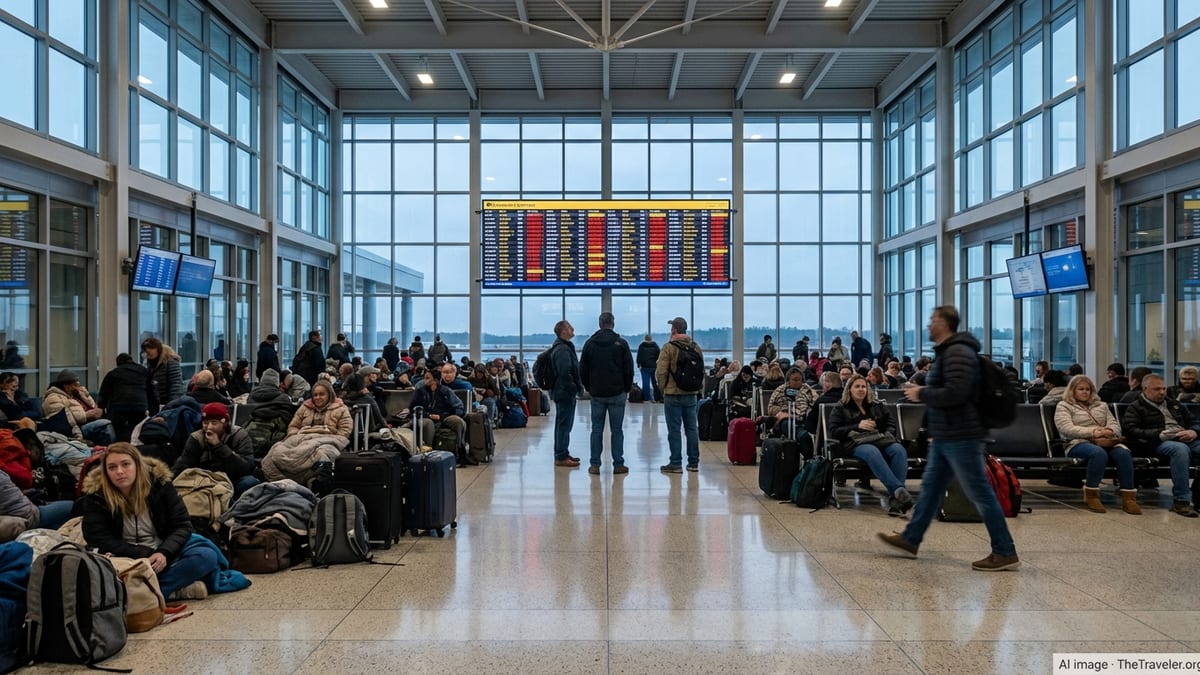
Inside the terminals at RDU, passengers described long lines at check-in counters, crowded gate areas and departure boards filled with red and yellow status notices. Families returning from school breaks, business travelers aiming for Monday meetings and international passengers with tight connections all found themselves navigating a maze of changing information.
Some travelers reported waiting hours to speak with airline agents in person as hold times on customer service phone lines stretched. Airline mobile apps and text alerts became essential tools, although frequent schedule updates sometimes added to the confusion as departure times shifted multiple times before a final cancellation.
Airport staff moved through the concourses assisting with crowd control and directing passengers to rebooking points, while concessions did brisk business as stranded travelers sought food and a place to sit. Many passengers attempted to rebook via nearby hubs such as Charlotte, Atlanta or Washington, only to find limited remaining seats as the broader US network filled up.
With hotels near the airport quickly reaching capacity, some stranded passengers faced the prospect of overnight stays on terminal benches or waiting areas, particularly those unable to secure replacement flights until later in the week.
Weather and Network Strain Drive a Wider US Travel Meltdown
The trouble at RDU coincided with a powerful winter storm system sweeping across the northeastern United States, dropping heavy snow on major aviation hubs and disrupting air traffic control operations. Flight-tracking services reported thousands of cancellations and delays nationwide, with New York, Boston, Philadelphia and Washington among the most affected cities.
As storm-related restrictions reduced runway and airspace capacity, airlines implemented preemptive cancellations across their networks to avoid aircraft and crews becoming trapped at overloaded airports. While this strategy can limit last-minute chaos in the worst-affected cities, it inevitably spreads disruption to secondary hubs and regional airports such as Raleigh–Durham.
Industry analysts noted that US carriers are operating with tighter margins on spare aircraft and crews than in previous years, which can magnify the impact of a large-scale weather event. Once widespread cancellations begin, the process of resetting the system and restoring normal schedules can take several days, even after the weather has improved.
Rail and road networks in the Northeast also felt the strain, limiting alternative travel options for passengers trying to bypass grounded flights. With some states urging drivers to avoid non-essential travel, many stranded airline passengers at RDU and other airports had little choice but to wait for the air system to recover.
What Travelers Can Do if Their Flight Is Affected
Travel experts advise passengers booked through Raleigh–Durham and other affected airports to act as early as possible if they suspect their flights may be disrupted. Checking flight status frequently on airline websites or mobile apps, enabling push notifications and monitoring airport departure boards can provide crucial lead time to explore alternatives.
When large numbers of cancellations hit, airlines often issue travel waivers that allow customers to change flights without additional fees, subject to seat availability. Travelers are encouraged to search for open seats to smaller or alternative airports within driving distance of their final destination, where possible, and to consider early-morning departures, which tend to be less affected by the day’s accumulating delays.
Arriving at the airport well ahead of departure remains important during periods of disruption. Longer lines at security and check-in, along with the possibility of gate changes and tighter boarding windows, mean that the usual two-hour domestic and three-hour international arrival guidelines may be a minimum rather than a maximum.
For those already stranded, securing accommodation quickly and keeping receipts for meals, transport and lodging is recommended, as some costs may later be reimbursable depending on airline policy and the nature of the disruption. With RDU and other airports working to restore normal operations over the coming days, passengers are being urged to remain patient and flexible as airlines rebuild their schedules.