

More news on this day
A rapidly intensifying nor’easter slamming the U.S. Northeast has brought flight operations at Bradley International Airport near Hartford to a near standstill, with 147 cancellations and several delays rippling across JetBlue, Southwest, Delta and American Airlines networks and stranding passengers from Windsor Locks and New Haven to New York, Boston, Chicago and other major cities.
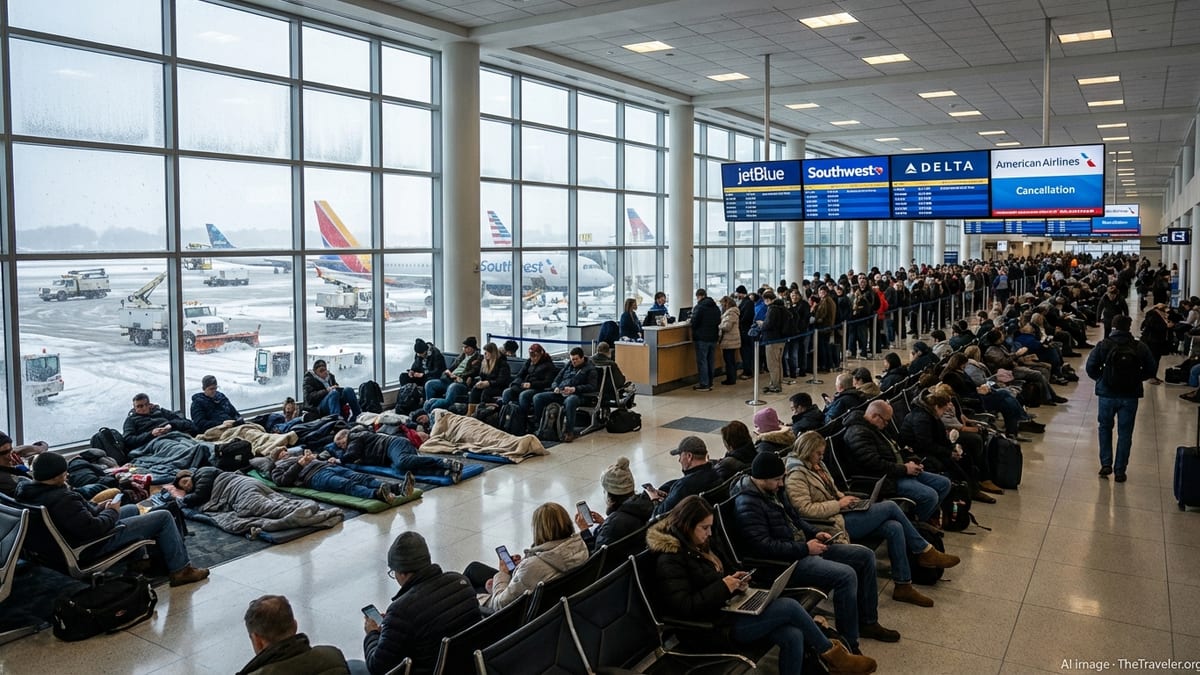
Bradley International Brought to a Standstill
Bradley International Airport in Windsor Locks, Connecticut, is experiencing one of its most severe days of disruption in recent years as a powerful winter storm sweeps through the region. Flight-tracking data on Monday shows 147 flights cancelled and a handful delayed at the airport, which serves the Greater Hartford area and much of central New England. The cancellations span both arrivals and departures, touching nearly every major domestic route served from Bradley.
The wave of cancellations has particularly affected operations for JetBlue, Southwest, Delta Air Lines and American Airlines, all of which rely on Bradley as a key spoke in their national networks. With aircraft and crews out of position across the Northeast, schedules built around tightly timed connections have quickly unraveled. What began as early morning adjustments has developed into a daylong shutdown-style scenario for many routes, with airlines warning customers that normal operations may not resume until well into Tuesday.
For travelers, the disruption has translated into hours-long lines at ticket counters and customer service desks, crowded terminal seating areas and scarce last-minute hotel rooms. Many passengers who had planned to fly in or out of Bradley for business meetings, family events or school vacations have instead found themselves camped out in departure halls, anxiously refreshing airline apps and watching departure boards fill with red "cancelled" notices.
Airport officials said they were working closely with airlines and federal aviation authorities to manage the reduced schedule safely. While runways remained technically open for much of the day, the combination of deteriorating weather conditions, de-icing backlogs and systemwide constraints at major East Coast hubs left little room for Bradley-based flights to operate as planned.
Storm-Hit Northeast Chokes the Airline Network
The problems at Bradley do not exist in isolation. The same nor’easter causing whiteout conditions and heavy snow bands across Connecticut has wreaked havoc at some of the country’s busiest airports, including New York’s John F. Kennedy, LaGuardia and Newark Liberty, Boston Logan and Philadelphia International. Airlines have proactively grounded thousands of flights across these hubs, effectively closing off key nodes in the national aviation system.
With New York and Boston functioning as critical connecting points for transcontinental and regional traffic, disruptions there cascade rapidly through smaller airports like Bradley. Even when conditions at Windsor Locks allow for safe operations, flights often cannot depart without assurance that they can land, turn around and continue onward from shuttered or badly congested hubs. As those constraints stack up, carriers increasingly resort to en masse cancellations to prevent aircraft and crews from becoming stranded in the wrong places.
Analysts note that nor’easter-style storms are particularly challenging because they often combine heavy snowfall with high winds and coastal flooding, affecting multiple states and air corridors simultaneously. De-icing requirements slow ground handling, while low visibility and strong crosswinds reduce runway capacity. In this event, the corridor from Washington to Boston has seen widespread flight disruption, and Bradley’s position within that corridor has made it especially vulnerable.
Although airlines now routinely announce weather waivers in advance to encourage travelers to rebook outside the worst of a storm, the scale of Monday’s cancellations has exceeded the contingency plans of many passengers. Those with nonflexible commitments, such as international connections or time-sensitive work travel, have faced the toughest choices as seats on later flights quickly sell out.
Passengers in Hartford, Windsor and New Haven Left Stranded
The human impact of the cancellations has been most visible in and around Hartford, Windsor Locks and New Haven, where residents often rely on Bradley for both domestic and international connections. Early morning commuters arriving from the Hartford suburbs described scenes of confusion as departure screens showed wave after wave of cancelled flights and airline staff scrambled to rebook entire planeloads of travelers.
Families heading out for winter vacations to Florida and the Caribbean have been among the hardest hit. Many booked multi-leg itineraries on JetBlue, Delta or American via New York, Boston or Charlotte, only to see their initial legs from Bradley wiped from the schedule. For those coming from cities like New Haven, Meriden or Middletown by early train or shuttle, the realization that alternative flights might not be available for days has been particularly dispiriting.
Bus and rail stations in Hartford and New Haven have seen a surge in demand as thwarted air travelers look for other ways to reach cities along the Northeast Corridor. Some passengers bound for New York or Boston have elected to abandon their flights altogether in favor of intercity trains, while others have tried to position themselves closer to major hubs in the hope of catching one of the limited flights still operating.
Local hotels around Windsor Locks and along the Interstate 91 corridor have reported spikes in last-minute bookings. With airlines issuing hotel vouchers in only a fraction of cases, many stranded travelers have shouldered unexpected accommodation and meal costs. For people who had planned short weekend visits or one-day business trips, the expenses and lost time have quickly added up.
Ripple Effects Reach Stamford and Cities Across the United States
The storm’s impact has extended well beyond central Connecticut. Stamford, a major business hub in the state’s southwest corner, has felt the knock-on effects as corporate travelers find themselves unable to reach meetings in Chicago, Atlanta, Dallas and other commercial centers. While Stamford residents often fly from New York-area airports, many who opted for Bradley to avoid congestion at LaGuardia or JFK now find that bet did not pay off.
Across the United States, passengers scheduled to connect through Bradley are also feeling the disruption. Travelers originating in Midwestern and Southern cities whose itineraries included a leg to Windsor Locks have seen entire trips unspool as airlines preemptively cancel flights into the storm zone. In some cases, passengers in places as far-flung as Denver, Houston and Phoenix have found that although weather at their home airports is clear, their journeys are infeasible because their Bradley-bound flights no longer exist.
Business travelers have reported missed client meetings and postponed site visits in Hartford and surrounding communities, as out-of-state visitors are simply unable to get into Connecticut. Event organizers in the region, including conference planners and sports tournament coordinators, have scrambled to adjust schedules or pivot to hybrid formats after key participants alerted them that they could not travel.
For the airlines themselves, the widespread nature of the storm complicates recovery. Getting passengers home is not merely a matter of resuming flights at Bradley once the snow stops; it also requires restoring normal operations and available seats at dozens of origin and destination airports connected to Bradley’s network. Until major hubs across the Northeast return to regular capacity, smaller airports like Bradley will feel the effects.
Major Carriers Face Operational and Customer-Service Strain
JetBlue, Southwest, Delta and American, the headline carriers in Monday’s disruption at Bradley, are balancing operational constraints with intense customer-service demands. Each airline has activated its irregular operations playbook, which typically includes weather waivers allowing travelers to change itineraries without fees, systemwide rebooking tools and improvements to call-center staffing. Despite those measures, many passengers report long hold times, app crashes and limited rebooking options.
JetBlue, which has a strong presence in the Northeast, has had to curtail a significant share of its schedule into and out of storm-affected cities. Southwest, which generally focuses on point-to-point service rather than a classic hub-and-spoke system, has nevertheless experienced cascading effects wherever its aircraft were scheduled to connect through the Northeast. Delta and American, both giants at East Coast hubs, are juggling extensive banked schedules that have been sliced apart by runway closures and de-icing delays.
Industry experts point out that large-scale cancellations are often used by airlines as a deliberate strategy to protect safety and preserve longer-term reliability. By grounding flights early and in bulk, carriers can avoid scenarios where passengers become stranded on tarmacs or aircraft get stuck in airports with limited ground support. The trade-off, however, is a sharp and very visible spike in same-day cancellations such as those observed at Bradley.
Airlines are also contending with crew duty-time limits and aircraft maintenance windows, which restrict how quickly they can bounce back once the storm passes. Even if weather clears by Tuesday, some early-morning departures from Bradley may remain cancelled or delayed because crews and planes are still out of position after Monday’s collapse in the schedule.
Ground Operations Battle Snow, Ice and Congestion
On the airfield at Bradley, ground crews have spent much of the day engaged in an ongoing battle against snow accumulation and ice buildup. Plows and sweepers have cycled up and down runways and taxiways, while de-icing trucks tend to the limited number of aircraft still scheduled to depart. Airport officials have stressed that safety remains the paramount concern, and that no flight will be released without meeting all de-icing and runway-condition requirements.
The pace of de-icing operations can dramatically affect how many flights an airport can handle, especially during peak storm conditions. Each aircraft may require multiple passes of de-icing fluid, and treatment windows are limited before snow and ice can again compromise critical surfaces. With temperatures hovering around freezing and winds whipping snow across open tarmac, ground crews at Bradley have worked in difficult conditions for prolonged shifts.
Inside the terminal, concessions, retail outlets and rental car counters have faced their own version of congestion. Food vendors have seen brisk business as passengers wait for updates, while car rental agencies have quickly run low on one-way vehicles as travelers seek to drive to destinations in New York, New Jersey, Massachusetts or Pennsylvania. Local taxi services and rideshare drivers have also reported surging demand as people abandon cancelled flights in favor of overland routes.
Security and customer-relations staff have been deployed throughout the concourses to help redirect travelers and answer questions. While tempers have occasionally flared amid long waits and disappointing news, most interactions have remained orderly, according to airport personnel, who say years of pandemic-era travel disruption have left many passengers somewhat more resigned to the possibility of last-minute changes.
Economic and Tourism Fallout for Connecticut
Beyond the immediate travel chaos, Monday’s shutdown at Bradley poses broader economic challenges for Connecticut. As the state’s primary commercial airport, Bradley plays a central role in supporting tourism to destinations ranging from Hartford’s museums and theaters to coastal attractions along Long Island Sound and the historic towns of the Connecticut River Valley. Prolonged disruptions risk dampening demand from visitors who may already perceive winter travel to New England as unpredictable.
Local tourism officials have expressed concern that recurring winter storms and highly publicized cancellation numbers could push some leisure travelers to choose alternative destinations with milder climates or more robust air-service redundancy. Hospitality businesses that rely on regular weekend and holiday traffic, including hotels, restaurants and entertainment venues, are particularly sensitive to last-minute trip cancellations.
The storm-related shutdown also affects business recruitment and retention efforts in the Hartford region, where companies often cite reliable air access as a key factor in deciding whether to locate or expand. When prospective investors or relocating employees face significant obstacles flying into the area, it can complicate marketing efforts that position Connecticut as an accessible, well-connected base for regional operations.
Economists caution, however, that a single day of extreme disruption is unlikely to have a lasting impact on its own. Much depends on how quickly airlines can restore schedules at Bradley and how often similar large-scale interruptions occur over the remainder of the winter season. If this nor’easter proves to be an isolated event rather than part of a recurring pattern, its long-term effect on travel behavior may be limited.
What Travelers Can Do as Disruptions Continue
With cancellation numbers at Bradley already high and the storm still affecting key East Coast hubs, travel experts say passengers should prepare for continued disruptions into Tuesday. They advise travelers scheduled to depart or arrive through Bradley to monitor their airline apps and text alerts closely, as flight status can change rapidly in response to evolving weather and operational conditions.
Customers whose flights have already been cancelled are typically encouraged to rebook through digital channels rather than standing in airport lines wherever possible. Many airlines serving Bradley have temporarily waived change fees and fare differences for affected dates, though available seats later in the week may be limited on popular routes. Travelers with flexible plans may find better options by shifting itineraries to off-peak days or alternative airports once normal operations resume.
For those who must travel urgently, experts recommend considering a mix of modes. Trains and intercity buses along the Northeast Corridor can sometimes offer more predictable service during winter storms, particularly for trips between cities such as Hartford, New Haven, Stamford, New York and Boston. Driving remains an option for some, though state transportation departments have warned of hazardous road conditions and urged motorists to avoid nonessential travel while the storm is at its peak.
In the meantime, Bradley International Airport has urged passengers to arrive early, stay in close contact with their airlines and be prepared for lengthy waits. While the day’s 147 cancellations and multiple delays have rattled travel plans for thousands, officials emphasize that safety remains the overriding priority as the region weathers one of its most disruptive winter storms in recent memory.