

More news on this day
A new round of travel turmoil is rippling across U.S. airspace today, with more than 1,700 flights cancelled and at least 1,287 delayed, as a sprawling storm system and ongoing operational strains batter major hubs in Florida, Illinois, and New York.
Get the latest news straight to your inbox!
Storm System and Staffing Strains Collide
Publicly available tracking data from services such as FlightAware indicate that cancellations and delays began to spike overnight and intensified through the Monday morning rush, as a powerful storm complex affecting parts of the Midwest, Southeast, and Northeast intersected with already tight airline staffing and congested schedules.
Weather outlooks show heavy rain, strong winds, and embedded thunderstorms from the Lower Mississippi Valley into the Mid-Atlantic and Northeast, with a separate zone of winter weather across the Upper Midwest. These conditions are disrupting arrival and departure “flows” into several of the nation’s busiest hubs and forcing aircraft to wait out storms on the ground.
Aviation analysts note that today’s disruption is part of a broader pattern seen throughout early 2026, as airlines continue to operate aggressive schedules in a period of volatile weather. Federal aviation statistics from recent years show that while total cancellations have eased compared with the pandemic era, the system remains vulnerable when major hubs are hit simultaneously by adverse conditions.
Air traffic management practices also play a role. When storms move over dense air corridors, traffic managers implement flow restrictions that slow the rate at which aircraft can land and depart. These measures are designed for safety but can quickly cascade into widespread delays when large hub airports are affected during peak hours.
Florida Tourism Corridors Hit Hard
In Florida, disruptions are centered on Orlando, Tampa, Miami, and Fort Lauderdale, according to live airport status boards and media coverage. Orlando International Airport, a critical gateway for theme park visitors and cruise passengers, is reporting waves of cancellations and rolling departure delays as storms move across the peninsula and connecting flights from other regions arrive late or not at all.
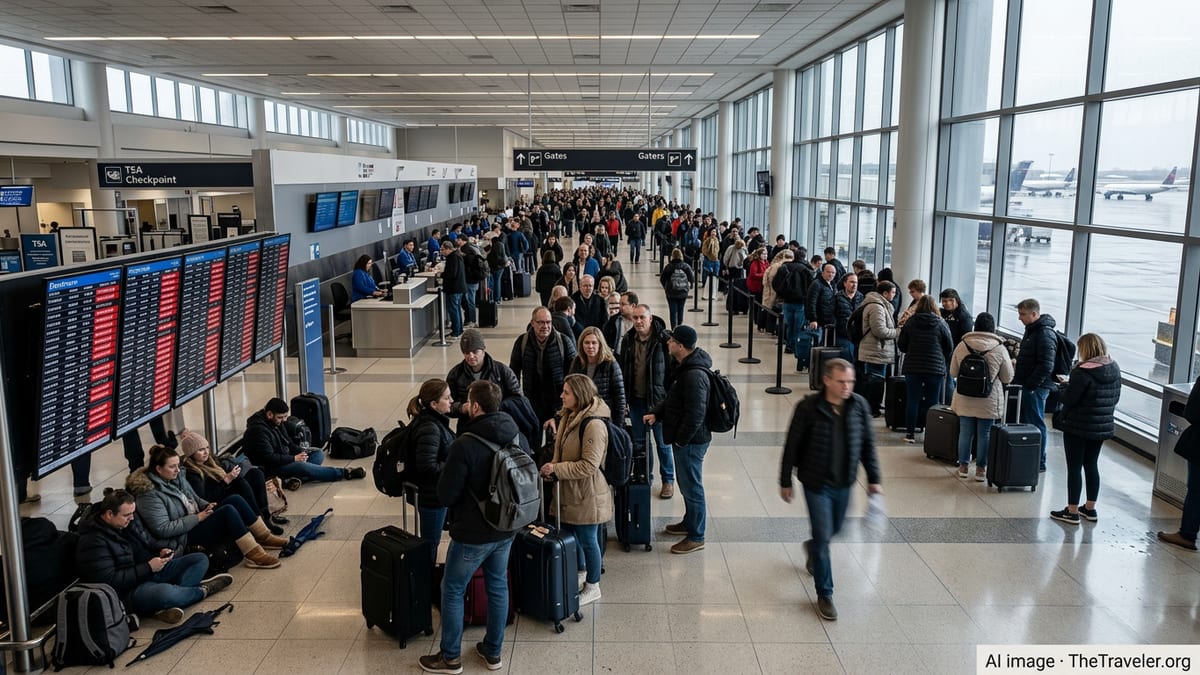
Travelers in Orlando describe concourses crowded with stranded passengers and long rebooking lines as carriers work through backlogs created over the weekend. Similar scenes are being reported at South Florida airports, where thunderstorms and congested airspace frequently lead to ground stops and holding patterns for arrivals.
Data visualizations of U.S. flight operations in recent years have repeatedly highlighted Florida as one of the most disruption-prone regions, due in part to heavy leisure demand, frequent convective storms, and the state’s role as a junction point between the Eastern Seaboard, the Caribbean, and Latin America. Today’s problems appear to be following that familiar pattern, with knock-on effects radiating along popular north-south routes.
Published analyses of 2020 to 2024 performance show that several Florida airports rank near the top for delay minutes per passenger, underscoring how quickly operations can unravel when weather and peak-season traffic converge.
Chicago and New York Hubs Struggle to Recover
Illinois and New York are experiencing some of the heaviest impacts, with Chicago O’Hare, Chicago Midway, New York LaGuardia, John F. Kennedy, and Newark Liberty all reporting elevated levels of cancellations and delays today. These airports are major connecting hubs, so disruptions there reverberate across the national network.
Chicago has been dealing with a combination of lingering winter conditions, low clouds, and gusty winds that limit runway capacity. In recent weeks, large storms crossing the Upper Midwest have repeatedly forced airlines to thin out schedules at O’Hare and Midway, and today’s event is continuing that trend, with some carriers preemptively cancelling flights rather than risk extended tarmac waits.
In the New York region, thunderstorms and constrained airspace are adding to well-documented congestion issues. Government analyses of LaGuardia and other New York airports indicate some of the highest average delay minutes per passenger in the country, reflecting how little slack exists in normal operations. When storms approach, traffic managers often reduce arrival rates sharply, which can push already tight schedules into gridlock.
Social media posts and traveler forums show passengers at New York and Chicago airports facing multi-hour delays, missed connections, and unexpected overnight stays, particularly on evening bank flights that rely on aircraft cycling in from already affected cities.
How Airlines Are Responding Today
Major U.S. carriers are responding with a familiar toolkit: proactive cancellations, flexible travel waivers, and targeted schedule adjustments in and out of the hardest-hit hubs. According to airline advisories and customer updates published on carrier websites and apps, several large airlines have issued change-fee waivers for passengers traveling through parts of the East Coast and Midwest, including New York and Chicago, allowing customers to rebook within a specified window without additional charges.
Some carriers are focusing on “resetting” operations by cancelling a block of flights early in the day to reposition crews and aircraft. Publicly available performance data from past storms indicates that this strategy, while painful in the short term, can help airlines restore more reliable schedules by the following day, rather than allowing rolling delays to compound deep into the night.
Airlines are also urging travelers to use mobile apps and digital tools instead of airport customer-service counters whenever possible. Industry experience during previous major disruptions shows that inventory for alternative flights appears in booking systems before it can be manually processed at crowded gate or ticket desks, giving app users an advantage in securing remaining seats.
At the same time, some regional routes are seeing especially tight capacity. With aircraft assigned to longer-haul segments that are harder to reschedule, smaller markets connected through hubs in Florida, Illinois, and New York may face longer interruptions before normal frequencies resume.
What Today’s Woes Mean for Travelers
For passengers still planning to fly today, travel experts consistently recommend checking flight status frequently, arriving at airports earlier than usual, and considering carry-on-only travel to allow for more flexible rebooking. Because cancellations are clustered at key hubs, travelers with nonessential trips through Orlando, Chicago, or New York may find it worthwhile to explore alternative dates or routings where airlines make that option available without additional cost.
Historic data from the U.S. Department of Transportation and the Federal Aviation Administration suggests that the ripple effects of a day with more than 1,700 cancellations can persist for 24 to 48 hours, as aircraft and crews are repositioned and stranded passengers are gradually re-accommodated. That means some disruption is likely to spill into tomorrow’s schedule, even if weather improves.
Passengers already mid-journey are contending with missed connections, unplanned overnights, and uncertainty around checked baggage. Consumer advisories from federal regulators emphasize that when a flight is cancelled for reasons within an airline’s control, travelers are generally entitled to a refund if they choose not to travel, although policies vary by carrier and circumstance.
As airlines and airports work through today’s disruption, the episode underscores how exposed the U.S. aviation system remains to shocks that hit multiple major hubs at once. With demand for spring travel building and a historically active pattern of late-winter storms still unfolding, travelers across the country may continue to face bumpy skies in the days ahead.