

More news on this day
Thousands of air travelers across the United States are facing long lines, missed connections, and last-minute cancellations today as hundreds of flights are being scrapped or severely delayed at major hubs in Chicago, Boston, Atlanta, and Miami, according to live flight-tracking data and airline status dashboards.
Get the latest news straight to your inbox!
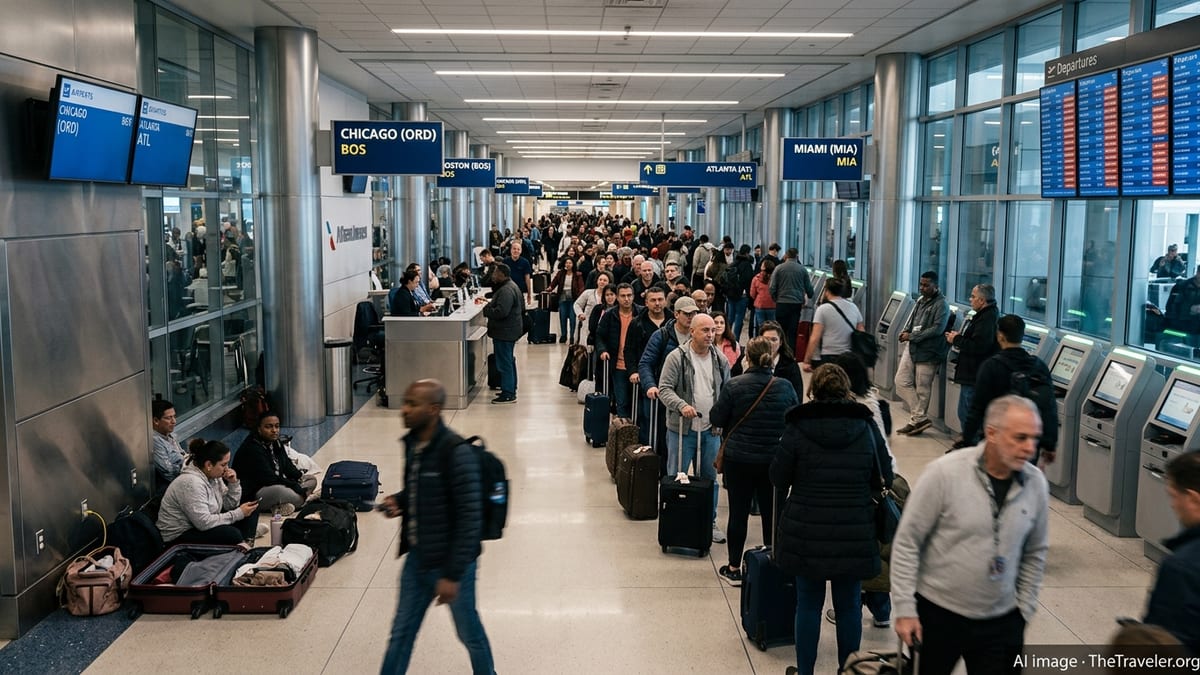
Hundreds of Cancellations and Delays Concentrated at Four Major Hubs
Publicly available flight-tracking data for today indicate that roughly 623 flights have been cancelled across the United States, with around 729 more experiencing significant delays. A sizable share of those disruptions is clustering around four key airports that anchor the national network: Chicago O’Hare and Midway, Boston Logan, Hartsfield-Jackson Atlanta, and Miami International. The combined impact is rippling through domestic and international routes, stranding passengers not only in those cities but at secondary airports that depend on them for connections.
Data dashboards from services that aggregate airline status information point to Chicago and Atlanta as two of the hardest-hit hubs by raw volume, reflecting their roles as critical transfer points for multiple major carriers. Boston and Miami are seeing lower absolute numbers but still notable disruption relative to their daily schedules, particularly on routes up and down the East Coast and to Latin America and the Caribbean.
The pattern suggests that even travelers whose tickets do not list these cities may still be affected if their aircraft, crew, or inbound segments are tied to one of the four hubs. That knock-on effect is a defining feature of the current situation, as delays and cancellations at a few busy airports cascade through the wider system.
Weather, Congestion, and Recovery From Recent Storms
Reports from meteorological services and recent coverage of nationwide conditions show that today’s disruptions are unfolding against the backdrop of an exceptionally active late-winter and early-spring pattern. In recent weeks, a series of powerful winter storms and severe weather outbreaks have swept through the Midwest, Northeast, and Southeast, repeatedly affecting the same set of airports and leaving airlines with little margin to recover their schedules before the next system arrives.
Chicago’s current challenges follow repeated bouts of heavy snow, high winds, and thunderstorms that have triggered ground stops and runway configuration changes in recent days. Industry commentary notes that O’Hare in particular is vulnerable when winds or crosswinds force traffic onto fewer runways, sharply reducing capacity and forcing airlines to trim flights or stretch out departure and arrival times.
Atlanta and Miami, pivotal for traffic across the Southeast and to the Caribbean and South America, are also contending with unsettled weather and lingering operational strain from earlier storms. Boston Logan, still emerging from a winter marked by severe blizzards and coastal storms, is seeing renewed pressure as airlines work to reposition aircraft and crews that were displaced during earlier disruptions.
Operational analysis from airline and airport observers emphasizes that such conditions do not need to be extreme in every affected city at once. When aircraft and crew are already out of place from previous storms, even moderate weather and airspace congestion can push a fragile system back into widespread delay.
Which Airlines Are Most Affected Today
Based on live status boards and aggregated cancellation tallies, the greatest impact appears to be concentrated among the largest network carriers and their regional affiliates that rely heavily on the affected hubs. Airlines with major operations at O’Hare and Midway are experiencing elevated cancellation and delay rates, while those that dominate Atlanta and Miami are reporting long lines at customer service desks and tight seat availability on later flights.
Industry trackers note that regional operators flying under the brands of the big carriers are often among the first to see flights cut when capacity must be reduced quickly because these routes are shorter and can sometimes be consolidated. That has led to multiple cancellations on feeder routes into Chicago, Boston, Atlanta, and Miami, further complicating travel for passengers trying to make onward connections.
Low-cost and ultra-low-cost carriers with point-to-point networks are also feeling the strain, particularly on popular leisure routes into Florida and the Caribbean. However, because many of these airlines operate fewer complex banked connections than the legacy carriers, the structure of their networks can sometimes limit the spread of delays beyond a handful of key airports.
Historical performance data compiled by government and independent analysts show that the four affected hubs already rank among the nation’s most delay-prone airports in heavy travel periods. Today’s figures are amplifying those tendencies, with on-time rates dipping as schedules absorb the shock of cancellations and extended ground times.
What Travelers Need to Know If Flying Through the Affected Airports
For passengers with tickets touching Chicago, Boston, Atlanta, or Miami today, publicly available airline alerts and airport advisories point to one consistent message: assume that schedules are fluid and build in extra time. Many carriers are actively adjusting departure times, swapping aircraft, or rerouting passengers to alternative hubs as conditions evolve. That increases the likelihood of last-minute gate changes and tighter-than-expected connection windows.
Travelers are being encouraged by airlines through their apps and status tools to monitor their itineraries frequently rather than relying only on printed boarding passes or early-morning information. In several cases, flights that initially showed modest delays have been pushed back multiple times or ultimately cancelled as congestion builds and aircraft miss their planned arrival slots.
For those who have not yet departed, same-day changes and rebooking options may be available, especially when disruptions are linked to widespread weather or airspace restrictions. Change-fee waivers and flexible travel policies are frequently published on airline websites during such events, although seat availability on alternative flights can be limited around peak times.
Travel experts who analyze operational data also highlight the importance of paying close attention to connection times through these hubs. When possible, choosing longer layovers or earlier departures can provide a buffer if the first leg of a trip is delayed, reducing the odds of an overnight stay or an extended airport wait.
Broader Implications for the Spring Travel Season
The scale and concentration of today’s disruptions are reinforcing concerns among aviation analysts that the national air travel system remains highly sensitive to weather shocks and staffing constraints at a small number of key nodes. Chicago, Boston, Atlanta, and Miami all serve as critical transfer points for millions of travelers each month, and data from previous seasons show that high volumes combined with complex runway and airspace configurations can quickly lead to widespread delays.
As airlines prepare for the busier spring and summer travel period, performance during this late-winter stretch is being closely watched by consumer groups and policymakers who have already raised questions about reliability, passenger protections, and the resilience of airline networks. Recent government and industry reports have documented how even modest increases in schedule padding and buffer aircraft can meaningfully improve on-time performance, but implementing those changes can be challenging when demand is strong.
The events unfolding today may also influence how travelers plan trips in the coming months. Some frequent flyers are already shifting toward earlier departures, longer connection times, and travel days with historically lighter loads to reduce exposure to cascading delays. Others are paying closer attention to airline track records at specific hubs, weighing factors such as average delay duration and cancellation rates when choosing carriers or routings.
With more unsettled weather likely in the weeks ahead and demand for leisure travel rising toward spring break and summer, today’s wave of cancellations and delays at Chicago, Boston, Atlanta, and Miami underscores how quickly conditions at a few critical hubs can disrupt journeys for thousands of passengers nationwide.