

More news on this day
Malawi, long known to safari insiders and overland travelers as the “Warm Heart of Africa,” is beginning to attract a new wave of visitors: paragliding pilots lured by uncrowded skies, highland thermals and sweeping lake views that position the country as one of Africa’s most intriguing emerging free-flight destinations.
Get the latest news straight to your inbox!
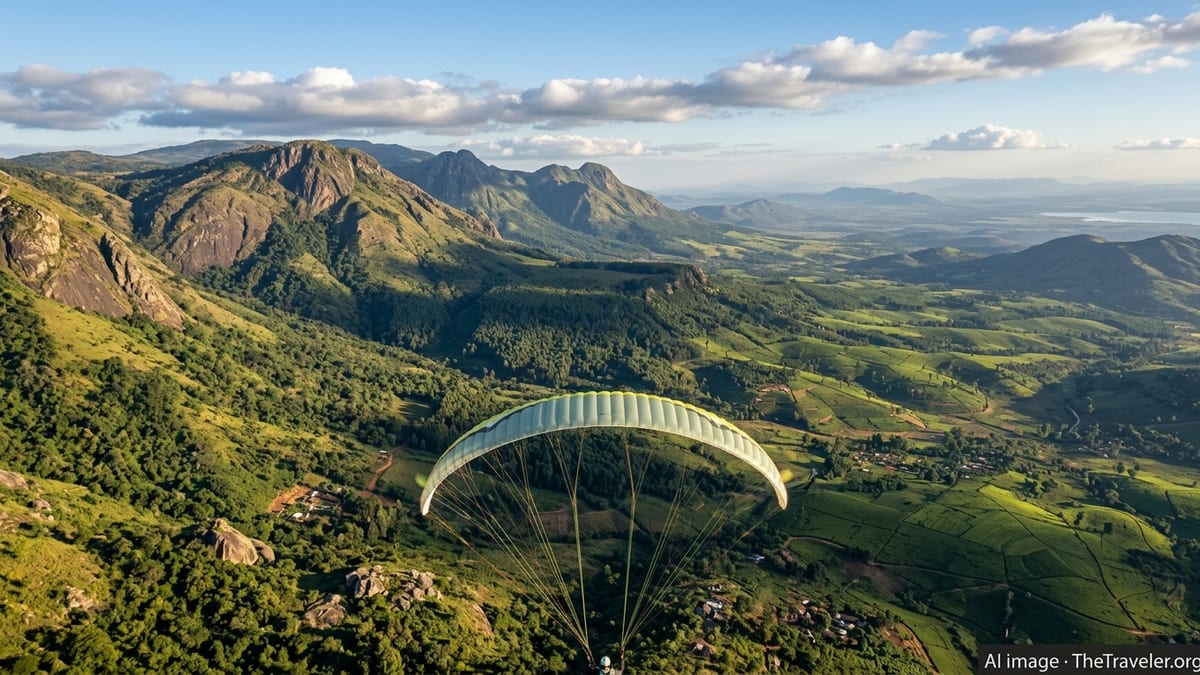
A High-Altitude Playground Above the Warm Heart of Africa
Recent coverage from regional travel outlets highlights how Malawi’s southern highlands are becoming a focus for adventure operators testing new paragliding routes, particularly around Mount Mulanje and the Zomba Plateau. Mount Mulanje, now recognized with UNESCO World Heritage status, rises to more than 3,000 meters and dominates the landscape of southern Malawi, offering dramatic granite faces, steep ridges and broad plateaus that appeal to experienced pilots seeking technical launches and strong thermals.
Mulanje’s massif is ringed by tea estates and villages, with access tracks and mountain huts originally developed for trekking and rock climbing. These existing trails and accommodations are now being repurposed by specialist tour companies experimenting with guided paragliding weeks, using the huts as base camps for early morning hike-and-fly missions. Reports from pilot groups indicate that during the dry season, cool nights and clear mornings can deliver predictable cycles and long soaring windows along the cliffs and spurs of the massif.
To the north, the Zomba Plateau adds another dimension to Malawi’s growing paragliding profile. The plateau sits at nearly 1,800 meters, with forested uplands that drop abruptly to the surrounding plains. Hiking guides describe extensive viewpoints and sheer escarpments looking toward Lake Chilwa and, on clear days, even to distant Lake Malawi. Operators exploring the area point to these escarpments and open meadows as promising launch zones, while the broad plains below offer ample landing options, an attractive safety factor for visiting pilots.
This combination of altitude, varied terrain and relatively low air traffic sets Malawi apart from more established paragliding destinations elsewhere in Africa. For traveling pilots who have already sampled the busy launch sites of South Africa or the festival-style scenes in parts of West Africa, Malawi’s quieter, exploratory atmosphere presents a compelling alternative.
Lake Views, Empty Skies and a New Cross-Country Frontier
Beyond the highlands, Malawi’s lakeshore topography is also beginning to draw free-flight attention. Lake Malawi, one of Africa’s largest freshwater lakes, stretches along the country’s eastern flank and is lined in places with low cliffs, headlands and hills that capture lake breezes. Resort activity sheets for lakeside lodges already list water sports such as kayaking, sailing and kite-based activities, and there are early signs that coastal bluffs and hills are being evaluated for ridge-soaring potential.
Specialist paragliding schools from Europe have recently started advertising exploratory tours in Malawi, positioning the country as a new cross-country frontier. Promotional material for 2026 itinerary offerings describes test flights around Mulanje and nearby highlands, with ambitions to establish local distance records along routes that run from mountain foothills toward the Shire Highlands and beyond. These early expeditions have tended to prioritize safety and conservative route planning, but organizers signal clear intent to push longer cross-country lines as experience with local meteorology grows.
The appeal for pilots is not only the potential for distance. Reports from visiting groups emphasize the sensation of flying over largely undeveloped landscapes, where villages, tea estates and forest reserves replace large urban sprawl. On clear days, thermalling above Mulanje or Zomba can deliver extended views across southern Malawi and into neighboring Mozambique, highlighting forests, river valleys and distant sections of the Rift Valley escarpment.
At lower elevations, hills around towns such as Zomba and Blantyre are also being scouted as after-work or warm-up sites for visiting pilots. While information remains limited and conditions are still being mapped, these smaller hills could offer accessible, lower-risk options for less experienced pilots traveling with more advanced companions.
Adventure Tourism Momentum After Mulanje’s UNESCO Recognition
The push to open new paragliding sites in Malawi coincides with broader momentum in the country’s adventure tourism sector. Travel industry reports note that the 2025 UNESCO World Heritage designation for Mount Mulanje has sharpened international focus on Malawi’s highlands, encouraging investment in hiking, climbing and eco-tourism infrastructure. This elevated profile is now intersecting with the interests of niche adventure operators who see an opportunity to fold paragliding into multi-activity itineraries.
Recent analysis in regional tourism publications describes Mulanje and the surrounding highlands as a world-class trekking and nature destination, citing established networks of mountain huts, maintained trails and community-run guiding services. Paragliding outfitters are leveraging this groundwork, collaborating informally with local guides who know the terrain, wind patterns and seasonal weather shifts. Publicly available information from tour brochures suggests that pilot groups often combine flying days with hikes to waterfalls, forest walks and summit attempts.
Elsewhere in southern Malawi, conservation success stories such as Majete Wildlife Reserve and Liwonde National Park have cemented the country’s reputation for compact, high-impact safaris. Safari planners increasingly market Malawi as an easy blend of bush and beach, with short charter flights connecting parks to the lakeshore. The emergence of paragliding adds another layer to this mix, positioning Malawi as a destination where travelers can combine morning game drives with highland flights or lakeside water sports within the same itinerary.
Industry observers note that this diversification aligns with global trends in adventure travel, where visitors seek itineraries that combine adrenaline experiences with cultural encounters and conservation-focused stays. In Malawi, that might mean pairing a few days of guided paragliding on Mulanje’s slopes with visits to tea estates, community tourism projects or cultural centers, before unwinding at a lakeshore lodge.
Practicalities, Safety and Seasonality for Visiting Pilots
As with any emerging paragliding destination, reliable information on conditions, access and regulations in Malawi remains limited and somewhat fragmented. Experienced pilots writing in online forums and travel blogs encourage thorough preparation, suggesting that visitors travel with their own gear, research local operators carefully and approach flying days with a cautious, exploratory mindset. Some operators emphasize that they are still refining launch sites, landing zones and retrieve routes, particularly around the more remote corners of Mulanje.
Seasonality is another key consideration. Published travel guides and trekking programs indicate that the dry, cooler months from roughly May to August tend to offer the clearest skies and most comfortable temperatures for mountain activities in southern Malawi. During this period, visibility on Mulanje and Zomba Plateau is often at its best, with crisp mornings and stable conditions that suit both hiking and paragliding. The build-up to the rainy season, typically in the hotter months that follow, can bring stronger convection, higher temperatures and more unpredictable storms, factors that pilots need to evaluate conservatively.
Access to launch areas generally starts in major hubs such as Blantyre or Zomba, with road transfers into the highlands. Trekking companies that already service Mount Mulanje and the Zomba Plateau often provide transport to trailheads, porters and hut bookings, and some adventure operators package these services with paragliding support such as guiding, weather briefings and retrieval. Pilots are advised to check whether operators hold relevant insurance, maintain communication equipment and have clear contingency plans for weather changes or route adjustments.
On the regulatory side, Malawi’s skies remain relatively quiet, but pilots still need to be aware of controlled airspace around airports and military installations. Paragliding tour descriptions indicate that operations are currently focused in rural and mountainous regions away from commercial flight paths. Even so, best practice guidelines promoted within the free-flight community encourage visiting pilots to log their plans with local contacts, respect local communities near launch and landing zones, and prioritize conservative decision-making in remote terrain.
Why Malawi Belongs on the Adventure Traveler’s Radar
For adventure travelers, the attraction of Malawi’s new paragliding scene lies in its blend of discovery and accessibility. This is not yet a mass-market free-flight destination with fully mapped sites and competition circuits. Instead, it offers a chance to explore relatively untouched terrain in the company of specialist operators and local guides, with each season adding new knowledge about routes, thermals and optimal sites.
At the same time, Malawi’s compact geography and improving tourism infrastructure make it practical to combine paragliding with a broader trip across the country. Within a few days, visitors can move from flights off granite ridges to snorkeling among Lake Malawi’s cichlid fish, or from tea estate hikes to wildlife viewing in protected reserves. Charter connections and upgraded road networks, highlighted in recent safari and tour planning materials, reduce transfer times and open up creative itineraries.
For pilots and adventure travelers willing to trade fully developed infrastructure for pioneering experiences, Malawi now ranks among Africa’s most intriguing new frontiers. With UNESCO recognition boosting Mulanje’s profile, regional operators mapping highland skies and lakeshore breezes providing new playgrounds, this small southern African nation is steadily making its case as the continent’s next standout paragliding and adventure travel stop.