

More news on this day
Thousands of travelers across Malaysia and the Middle East are scrambling to rebook journeys this weekend as sudden airspace closures and escalating tensions force airlines to cancel or divert flights on key routes, with officials warning that disruption could deepen in the coming days.
Malaysia Airlines Cuts Key Routes as Tensions Escalate
Malaysia Airlines has moved swiftly to suspend multiple services between Kuala Lumpur and major Middle Eastern gateways after fresh strikes involving the United States, Israel and Iran triggered cascading airspace restrictions across the region. Flights linking the Malaysian capital with Doha, Jeddah and Madinah between 28 February and 1 March have been cancelled or turned back mid-route following updated risk assessments over conflict-affected corridors.
According to airline statements cited by Malaysian media, services MH160, MH156 and MH158 from Kuala Lumpur on 28 February were among the first to be halted, with return legs including MH159 from Madinah and MH161 from Doha also scrubbed. Additional rotations scheduled for 1 March, such as MH164 and MH165 between Kuala Lumpur and Doha and MH157 from Jeddah, have since been added to the growing list of cancellations.
Some aircraft already en route were forced to divert. One Kuala Lumpur to Doha service turned back to the Malaysian capital, while a Jeddah-bound flight diverted to Chennai after receiving mid-flight advisories about heightened airspace risk. The carrier has stressed that safety remains the overriding priority and that affected customers are being contacted directly with options to rebook, reroute or request refunds.
Despite the turmoil on Middle Eastern routes, Malaysia Airlines is maintaining services to London and Paris, albeit on revised routings that avoid the most sensitive zones. Long-haul flights to Europe are currently being sent on more northerly tracks, adding flight time but keeping operations clear of areas subject to temporary closures or military activity.
KLIA Stays Calm as Regional Airspace Locks Down
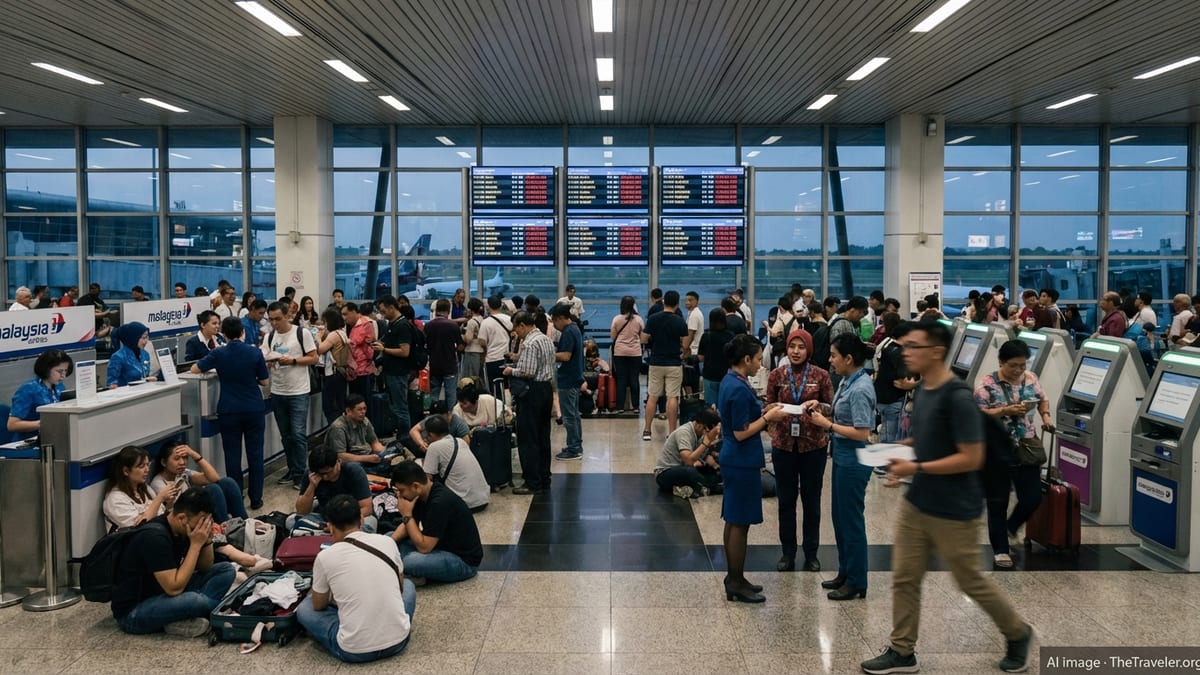
On the ground, Kuala Lumpur International Airport has largely avoided the chaotic scenes reported at some Gulf hubs, even as flight boards reflect a rising tally of cancellations and delays tied to Middle East operations. Airport operator Malaysia Airports Holdings has confirmed that terminals remain orderly, with additional staff deployed to assist stranded passengers and to manage queues at airline counters.
Officials note that the most acute disruption is felt by travelers whose journeys rely on Middle Eastern hubs for onward connections to Europe, Africa and the Americas. With airlines in Qatar, the United Arab Emirates, Bahrain and Kuwait scaling back operations after their airspace was restricted or temporarily closed, connecting itineraries built around Doha, Dubai, Abu Dhabi and other Gulf gateways have been thrown into disarray.
Industry data compiled for regional tourism and aviation analysts indicates that nearly a quarter of scheduled inbound flights to key Middle Eastern markets were cancelled on 28 February alone, with total cancellations, including outbound services, surpassing 1,800 sectors in a single day. Analysts warn that these figures are likely to climb if airspace closures are extended or expanded in scope.
Malaysia’s aviation regulators have reminded carriers of their obligation to conduct real-time risk assessments and comply promptly with Notices to Airmen concerning conflict zones. While similar closures have occurred during previous flare-ups in the region, the speed and breadth of the current measures are placing exceptional strain on schedules, aircraft rotations and crew availability.
Malaysians Stranded Abroad as Government Steps In
As cancellations mounted, Malaysia’s Foreign Ministry, Wisma Putra, activated consular support mechanisms across several Middle Eastern capitals to assist citizens stranded in transit or unable to depart. Diplomatic missions in Doha, Riyadh, Jeddah and other affected cities have been instructed to prioritize cases involving vulnerable travelers, including families, students and pilgrims returning from religious trips.
Officials say they are coordinating closely with airlines and local authorities to secure alternative routings where possible, though options remain limited while key air corridors are restricted. In some cases, Malaysians have been advised to remain in place with guaranteed accommodation provided either by carriers under passenger rights obligations or by local partners until safe onward travel can be arranged.
Travel agents in Kuala Lumpur report a surge in calls from worried customers, particularly those booked on upcoming umrah and business travel to Gulf destinations. Several agencies say they are proactively reviewing March departures and warning clients that itineraries may change at short notice, with the prospect of longer, more circuitous routings via South Asia, Central Asia or Europe as airlines seek to skirt closed airspace.
The Malaysian Association of Tour and Travel Agents has urged travelers to stay closely in touch with airlines, agents and official government advisories, avoid speculative social media reports and be prepared for schedule changes even after check in. The association is also pressing carriers to communicate more transparently on rebooking and refund rules to ease uncertainty for affected passengers.
Regional Ripple Effect Extends Far Beyond the Gulf
The shockwaves from the latest round of strikes and airspace closures are being felt well beyond the immediate conflict zone. Gulf and Levant hubs, central to global long-haul connectivity, are facing network-wide disruptions that have prompted airlines as far away as Central Asia and Europe to cancel or reroute services touching the Middle East.
Low cost and full service carriers alike have suspended or sharply reduced flights into Dubai, Abu Dhabi, Doha and key Saudi gateways as they reassess safety protocols. Some European and Asian airlines have paused services altogether on certain city pairs, while others are operating with significant delays as aircraft divert around closed sectors or wait for clearance to transit specific corridors.
The knock on effect is highly visible in South and Southeast Asia. Airports in India and Sri Lanka are reporting clusters of stranded passengers after Middle East bound flights were grounded, while some airports have announced temporary measures such as free short term visa extensions to accommodate travelers unable to depart on schedule. Travel data providers are tracking sharp spikes in fares on remaining open routes as demand is funneled through a shrinking set of viable connections.
Aviation analysts caution that route planners are now juggling multiple constraints at once: staying clear of conflict zones, managing fuel burn on longer detours, securing overflight permissions from alternative states and ensuring that aircraft and crew remain in the right places to maintain broader schedules. The result, they say, is a patchwork of cancellations, diversions and last minute swaps that may persist even after some airspace is technically reopened.
What Travelers Should Do Now
With conditions shifting by the hour, travel experts are urging anyone booked to or via the Middle East in the coming days to act quickly and stay flexible. Passengers are being advised to confirm the status of every flight segment directly with their airline or booking agent before heading to the airport, and to sign up for real time alerts where available.
For Malaysians, this includes monitoring official advisories from aviation regulators and the Foreign Ministry, particularly for trips involving Doha, Jeddah, Madinah, Dubai, Abu Dhabi and other Gulf hubs. Where flights are still operating, travelers should be prepared for longer flying times as aircraft detour around restricted airspace and for the possibility of last minute gate or schedule changes.
Travel agents recommend that affected passengers keep all receipts for unexpected expenses and familiarize themselves with airline policies on rebooking, refunds and duty of care, as well as any applicable travel insurance coverage. Those with non-essential travel are being encouraged to consider postponement or rerouting through alternative regions until the situation stabilizes and normal traffic patterns resume.
For now, the overriding message from carriers and authorities is to prioritize safety over speed. While the sudden wave of cancellations between Malaysia and the Middle East has upended carefully laid travel plans, officials stress that keeping aircraft out of contested skies is the only responsible choice until clearer signals emerge on the trajectory of the current crisis.