

Choosing between Malaysia and Indonesia can feel like an impossible decision. Both are vast, diverse and deeply rewarding, yet they offer very different travel experiences in terms of culture, logistics, budget, and crowd levels. Understanding those nuances is the key to deciding which suits your style, time frame and comfort zone best.
Big Picture: How Malaysia and Indonesia Feel to Travel
At first glance, Malaysia and Indonesia appear similar: multicultural, tropical nations straddling the equator, rich with beaches, rainforests and modern cities. On the ground, however, they feel quite different. Malaysia is more compact and urbanized, with excellent highways, widely spoken English in major hubs, and a sense of easy, orderly movement between destinations. Indonesia, spread across more than 17,000 islands, feels larger, wilder and more fragmented, often demanding more time and flexibility from travelers.
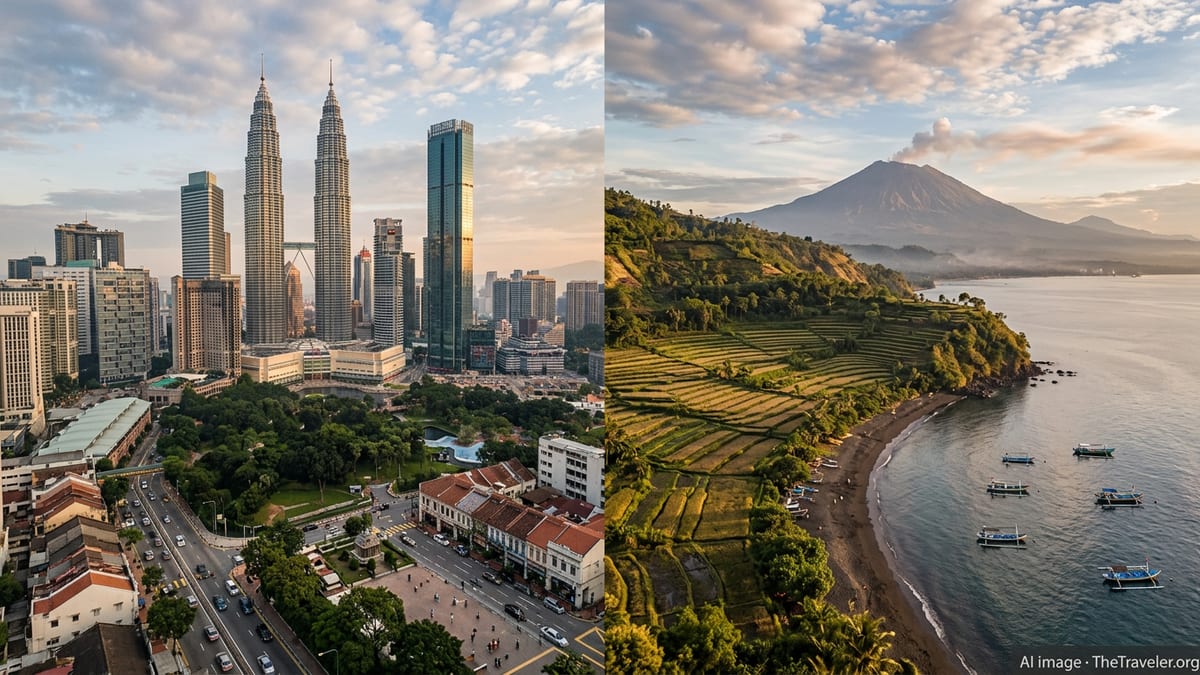
For many visitors, Malaysia comes across as an accessible introduction to Southeast Asia. Kuala Lumpur’s skyline of glass towers and shopping malls sits comfortably alongside old shophouses, night markets and hawker centers. Most first-time itineraries connect KL with Penang, Langkawi, Borneo or the Cameron Highlands, and those routes are straightforward to organize with domestic flights or buses. Indonesia’s iconic island of Bali, by contrast, can feel like its own tourism ecosystem, and travelers who push beyond it to Java, Sumatra, Flores or Sulawesi experience striking regional contrasts and dramatic landscapes, but also more challenging logistics.
In terms of tourism volume, both countries are firmly back on the global map. Malaysia has again passed the 20 million annual visitor mark and is pushing toward pre-pandemic levels, while Indonesia’s arrivals have been climbing strongly with Bali still accounting for a large share. That growth brings benefits in infrastructure and choice, but also pockets of overtourism, especially in Bali’s busiest corners. Travelers today are more likely to factor in crowding, environmental impact and authenticity when choosing between the two.
Ultimately, Malaysia tends to reward those who want variety with minimal stress, while Indonesia rewards those willing to slow down, take occasional travel hiccups in stride and seek out islands and regions that remain well off the classic tourist trail.
Cities, Islands and Landscapes: Where Each Country Shines
Malaysia offers one of Southeast Asia’s most convenient combinations of modern city life, accessible beaches and primary rainforest. Kuala Lumpur is the obvious entry point, with its mix of skyscrapers, historic mosques, Chinese temples and Little India districts. Penang’s George Town adds photogenic shophouses, street art and a UNESCO-listed old town, while Malacca offers a compact riverside core of colonial and Peranakan heritage. For nature, the Bornean states of Sabah and Sarawak stand out with orangutan sanctuaries, caves and longhouse cultures, while the Cameron Highlands and Taman Negara provide cooler air and jungle trekking on the peninsula.
Malaysia’s beach destinations, particularly Langkawi and the east coast islands such as the Perhentians, Redang and Tioman, appeal to those seeking soft sand, good mid-range accommodation and relatively calm waters in the right season. They are smaller and quieter than Bali, with fewer nightlife hubs but more of an easygoing resort atmosphere. For divers and snorkelers, Sipadan and nearby islands in Sabah are among the region’s top underwater destinations, although they require more advance planning and often higher budgets.
Indonesia, by contrast, is almost overwhelming in geographic scale. Bali alone offers black-sand surf beaches, emerald rice terraces and temple-dotted hills, yet it is only one piece of the puzzle. Java packs in the capital Jakarta, the historic cities of Yogyakarta and Solo, and volcanic icons like Bromo and Ijen. Flores is the jumping-off point for Komodo National Park, home to dragon-spotting cruises and superb diving, while Lombok and the Gili Islands offer an alternative to Bali with quieter beaches and more laid-back villages. Sumatra’s Lake Toba, orangutan-rich Gunung Leuser National Park and the Mentawai surf breaks further highlight Indonesia’s diversity.
If your priority is stitching together very different landscapes in a relatively short trip, Indonesia arguably has the edge. Within a couple of weeks, you can combine volcano sunrises, traditional villages, surf breaks and coral reefs without leaving the country’s borders. If you prefer to base yourself in a few key hubs and take easier day trips or short hops, Malaysia’s more concentrated geography can feel much more manageable.
Culture, Religion and Everyday Etiquette
Both Malaysia and Indonesia are Muslim-majority nations with deep Islamic traditions, yet they present very different cultural tapestries. Malaysia’s modern identity is built around three main communities: Malay, Chinese and Indian. That mix is instantly visible in city neighborhoods, religious architecture and festivals. A single Kuala Lumpur street might contain a mosque, a Hindu temple and a Chinese clan house within a few minutes’ walk, and visitors quickly become familiar with multi-lingual signboards and overlapping food cultures.
Indonesia, meanwhile, is dominated by ethnic Javanese but includes hundreds of distinct groups across the archipelago. While the national ideology emphasizes religious diversity, most Indonesians are Muslim, especially in Java, Sumatra and much of Sulawesi. However, Bali remains predominantly Hindu, parts of eastern Indonesia are largely Christian, and local belief systems remain influential in rural communities. That patchwork means etiquette and social norms can shift noticeably from one island to the next, and travelers need to pay attention to local expectations regarding dress, alcohol, and behavior at religious sites.
In practice, everyday etiquette in both countries centers on modest dress away from beaches, removing shoes before entering homes and many temples or mosques, and avoiding public displays of affection. During Ramadan, Muslim-majority neighborhoods may be quieter in the daytime with more late-night activity and special bazaars after sunset. Visitors are generally welcome to observe or even join festivities respectfully, but should be sensitive about eating and drinking in very public areas when many locals are fasting.
English is widely spoken in major Malaysian cities and tourist centers and is used in business, education and government. In Indonesia, English is common in tourist zones such as Bali and parts of Java, but less so in rural areas and smaller islands. Travelers with no local language will find day-to-day interactions easier in Malaysia overall, while Indonesia rewards those willing to learn some basic Bahasa Indonesia for transport, markets and homestays.
Food, Nightlife and Daily Travel Costs
Food is one of the strongest arguments in favor of both destinations, yet the experience is subtly different. Malaysian cuisine is famously shaped by Malay, Chinese and Indian influences, producing a street-food culture where nasi lemak, char kway teow, roti canai and banana leaf rice can share the same block. Penang, in particular, is often cited as one of Asia’s top food cities, with hawker centers and kopitiam coffee shops offering excellent meals at modest prices. Halal options are abundant, and vegetarians can usually find Indian and Chinese dishes without meat.
Indonesia’s culinary strengths shine in regional specialties: nasi padang in West Sumatra, sate and gudeg in Java, babi guling and lawar in Bali, and fresh seafood along many coasts. Street food is abundant and often even cheaper than in Malaysia, though hygiene standards vary more by location. In very rural areas, menus might feel repetitive, focusing on rice, noodles and fried dishes, while more developed islands offer a growing range of cafes, vegan outlets and international restaurants, particularly in Bali’s Canggu, Ubud and Seminyak.
Daily travel costs remain moderate in both countries by international standards. Budget travelers in Malaysia can still get by on a modest daily budget if they rely on simple guesthouses, public buses or trains, and hawker food. Mid-range hotels and nicer restaurants will increase expenses, especially in central Kuala Lumpur or on the most popular islands. Indonesia tends to be slightly cheaper on average for food and basic accommodation, but prices in tourist hotspots such as southern Bali or premium dive destinations can climb quickly, sometimes matching or exceeding Malaysian rates.
Nightlife in Malaysia is most developed in Kuala Lumpur, where rooftop bars and clubs stay open late, and in certain beach destinations with resort bars. Alcohol is legal but relatively expensive compared with neighboring countries, due to taxes and religious sensitivities. In Indonesia, nightlife varies greatly by island: Bali has an extensive bar and club scene, especially in areas like Kuta, Seminyak and Canggu, while heavily Muslim regions may be very quiet after dark and have restricted alcohol sales. Travelers seeking vibrant nightlife will gravitate toward Bali and central Kuala Lumpur; those preferring quiet evenings will have no trouble avoiding party zones in either country.
Practicalities: Visas, Transport and Safety
From a practical standpoint, both Malaysia and Indonesia have continued to simplify entry procedures for many nationalities, often allowing visa-free or visa-on-arrival entry for short stays, though rules are reviewed and adjusted from time to time. Long-stay remote workers are increasingly catered for: Malaysia has introduced a targeted digital nomad program focusing on tech and online professionals, while Indonesia has discussed more ambitious long-term remote work visas, although details and implementation can shift. Travelers should always confirm the latest rules with official government sources before booking flights.
Getting around within Malaysia is generally straightforward. The peninsula has a good network of buses and highways, a growing intercity rail system, and plentiful low-cost flights linking Kuala Lumpur with Penang, Langkawi, East Malaysia and secondary cities. Urban transport ranges from efficient rail lines in Kuala Lumpur to ride-hailing services that are widely available and inexpensive in most cities. In Borneo, distances are longer and infrastructure more limited, but core routes between major towns and national parks are well established.
Indonesia’s internal transport is more complex simply because of the vast distances and the sheer number of islands. Domestic flights link major hubs, but schedules can change and smaller routes are prone to delays or cancellations, particularly in bad weather. Ferries, speedboats and local buses fill in the gaps, which can create memorable overland journeys but also require flexible timing and realistic expectations. Ride-hailing is common in big cities and Bali, yet less reliable or absent in remote areas. Travelers with limited time are often better off focusing on one or two islands rather than trying to “do” Indonesia in a single trip.
On safety, both countries are broadly considered safe for tourists, with common-sense precautions recommended. Petty crime such as bag snatching and pickpocketing can occur in busy urban or nightlife areas, and road safety can be a concern where traffic is chaotic or infrastructure strained. Indonesia’s more extensive exposure to natural hazards, including active volcanoes and occasional earthquakes, adds a dimension of risk, although tourist areas are accustomed to managing alerts and closures. Women and solo travelers routinely visit both countries; modest dress, situational awareness and choosing reputable transport and accommodation providers help reduce unwanted attention or scams.
Overtourism, Sustainability and Crowd Levels
As travel rebounds, questions around overtourism and sustainability have become central to comparing Malaysia and Indonesia. Nowhere illustrates the issue more than Bali, where visitor numbers have exceeded pre-pandemic peaks and concerns about congestion, waste, water use and disrespectful behavior at sacred sites are widely discussed in local and international media. Authorities have experimented with taxes, behavior guidelines and enforcement campaigns aimed at encouraging more responsible tourism and curbing the worst excesses of party culture, with mixed but ongoing efforts.
Beyond Bali, many Indonesian islands remain relatively lightly visited, and local governments are promoting alternative destinations, from Labuan Bajo to Lake Toba and eastern islands, to spread tourism benefits more widely. These emerging areas often offer a more traditional feel and closer contact with local communities, but infrastructure and environmental management systems are sometimes catching up with demand. Travelers who choose less-visited regions may enjoy more authentic experiences while also contributing to more balanced tourism growth, so long as they respect local customs and ecosystems.
Malaysia’s approach has leaned heavily on marketing campaigns and investment in infrastructure, while also seeking to avoid extreme crowding in any single destination. Popular spots such as Langkawi, Penang’s heritage core and certain national parks receive significant visitor numbers, yet they rarely feel as saturated as Bali’s most touristy districts. Environmental pressures certainly exist, particularly on coral reefs, coastal mangroves and highland ecosystems, and authorities have periodically introduced measures such as visitor caps on sensitive islands or stricter rules around marine parks.
For sustainability-minded travelers, both countries offer opportunities to engage with community-based tourism projects, conservation programs and eco-lodges. In Malaysian Borneo, for instance, visitors can support orangutan rehabilitation centers and community forest initiatives. In Indonesia, responsible dive operators, village homestay schemes and agro-tourism in rice-farming communities aim to ensure that tourist spending reaches local families and encourages preservation of traditional livelihoods. Asking questions about ownership, staff treatment and environmental practices remains one of the most effective ways travelers can make more thoughtful choices.
Who Each Destination Suits Best
Because Malaysia and Indonesia are so varied internally, any sweeping generalization will miss nuance, but certain patterns do emerge. Malaysia tends to suit first-time visitors to Southeast Asia, families, travelers on a moderate schedule and those who want a balance of culture, nature and city comfort without constant logistical problem-solving. Its relative ease of transport, higher average English proficiency and broad range of mid-range accommodation make it attractive to travelers who value convenience alongside discovery.
Indonesia tends to attract those with a bit more time and appetite for adventure. Surfers, divers, trekkers and independent travelers who are willing to navigate ferry schedules, longer bus rides or remote airstrips gain access to some of the region’s most dramatic experiences, from volcano trekking at dawn to snorkeling with manta rays or encountering traditional villages little changed by mass tourism. Bali remains a comfortable soft landing for many, but the most rewarding trips often branch off toward lesser-known islands and provinces.
Budget also plays a role in the decision. Shoestring backpackers can thrive in either country, but very low daily budgets may stretch further in Indonesia, especially outside heavily touristed areas. Conversely, travelers who prefer a slightly higher level of comfort, predictable standards and easy domestic connections may find that Malaysia offers better value in the mid-range segment, particularly in cities and established resort islands.
Finally, personal interests should guide the choice. If you are passionate about food and multicultural city life with day trips into rainforest and coast, Malaysia is hard to beat. If your dream trip revolves around island-hopping, surfing, diving and watching lava fields or crater lakes at sunrise, Indonesia’s archipelago will likely capture your imagination more fully.
The Takeaway
Deciding between Malaysia and Indonesia is less about choosing a “better” country and more about matching a destination to your travel style, time frame and comfort with complexity. Malaysia offers a compact, approachable blend of multicultural cities, accessible beaches and rainforests, with solid infrastructure and relatively smooth logistics. It is a strong fit for first-time visitors to the region, families and anyone who values variety without constant hard work in planning and improvisation.
Indonesia, by comparison, is a sprawling canvas of islands and experiences. Bali alone can fill an entire holiday, yet it is only an introduction to the volcanoes of Java, the dragons and reefs of Komodo, the distant islands of eastern Indonesia and the forests and lakes of Sumatra and Sulawesi. Reaching these places often involves more moving parts, but the payoff in terms of diversity and sense of discovery can be immense for those willing to invest the time.
Both countries are evolving quickly as they respond to surging arrivals, environmental concerns and the growing influence of remote workers and long-stay visitors. Entry rules, taxes and local regulations are fine-tuned regularly, especially in heavily visited areas. Before you go, it is wise to verify practical details directly with official sources and to seek out the latest local perspectives on crowding, sustainability and respectful behavior.
For many travelers, the ideal solution is not “Malaysia or Indonesia” but “Malaysia and Indonesia” at different stages of their travel journey. Starting with Malaysia can provide an accessible, confidence-building introduction to the region, while a later, longer trip to Indonesia can offer deeper, more offbeat adventures. Whichever you pick first, approaching it with cultural sensitivity, realistic expectations and a willingness to explore beyond the most obvious hotspots will reward you with rich, memorable experiences.
FAQ
Q1. Which is better for first-time visitors to Southeast Asia, Malaysia or Indonesia?
For many first-timers, Malaysia feels easier thanks to compact geography, good English proficiency and straightforward transport. Indonesia is very rewarding but usually more complex to navigate beyond Bali.
Q2. Is Malaysia or Indonesia cheaper for budget travelers?
Daily costs can be low in both countries, but simple food and basic guesthouses are often slightly cheaper in Indonesia, especially outside major tourist hotspots. Malaysia may offer better value in the mid-range segment.
Q3. Which country has better beaches, Malaysia or Indonesia?
Indonesia has more variety, from Bali and Lombok to the Gili and Komodo islands. Malaysia’s Langkawi and east coast islands have beautiful, often quieter beaches that are easier to reach on a shorter itinerary.
Q4. How safe are Malaysia and Indonesia for solo female travelers?
Both countries are generally safe for solo women who take normal precautions, dress modestly away from beaches, avoid poorly lit areas at night and use reputable transport and accommodation.
Q5. Is English widely spoken in Malaysia and Indonesia?
English is widely spoken in Malaysian cities and tourist areas and used in many official contexts. In Indonesia, English is common in Bali and major hubs but less prevalent in rural regions, where basic Bahasa Indonesia helps a lot.
Q6. How many days do I need to experience Malaysia properly?
In about 10 to 14 days you can comfortably visit Kuala Lumpur, Penang or Malacca, and one or two island or highland destinations, without feeling rushed. Longer stays unlock Borneo and more remote areas.
Q7. How long should I plan for a first trip to Indonesia?
A focused 10 to 14 day trip works well for Bali and perhaps one nearby island. To combine Java’s cultural highlights with islands like Flores or Lombok, many travelers prefer three weeks or more.
Q8. Which destination is better for digital nomads?
Bali has the most established coworking and nomad community, especially in Canggu and Ubud. Malaysia is increasingly attractive for remote workers seeking big-city infrastructure and more formalized long-stay options.
Q9. Are there strict dress codes for tourists in Malaysia and Indonesia?
At beaches and resort areas, casual clothing is fine. In cities, villages and religious sites, modest clothing that covers shoulders and knees is appreciated in both countries, especially in Muslim-majority areas.
Q10. Can I combine Malaysia and Indonesia in one trip?
Yes, many travelers fly into Kuala Lumpur and continue on to Bali or Jakarta. To avoid spreading yourself too thin, focus on one country as the core of your itinerary and treat the other as a shorter add-on.