

More news on this day
The Maldives is entering a new phase of aviation growth, with rising private jet movements and a wave of expanded international routes combining to significantly strengthen the island nation’s global travel connectivity.
Get the latest news straight to your inbox!
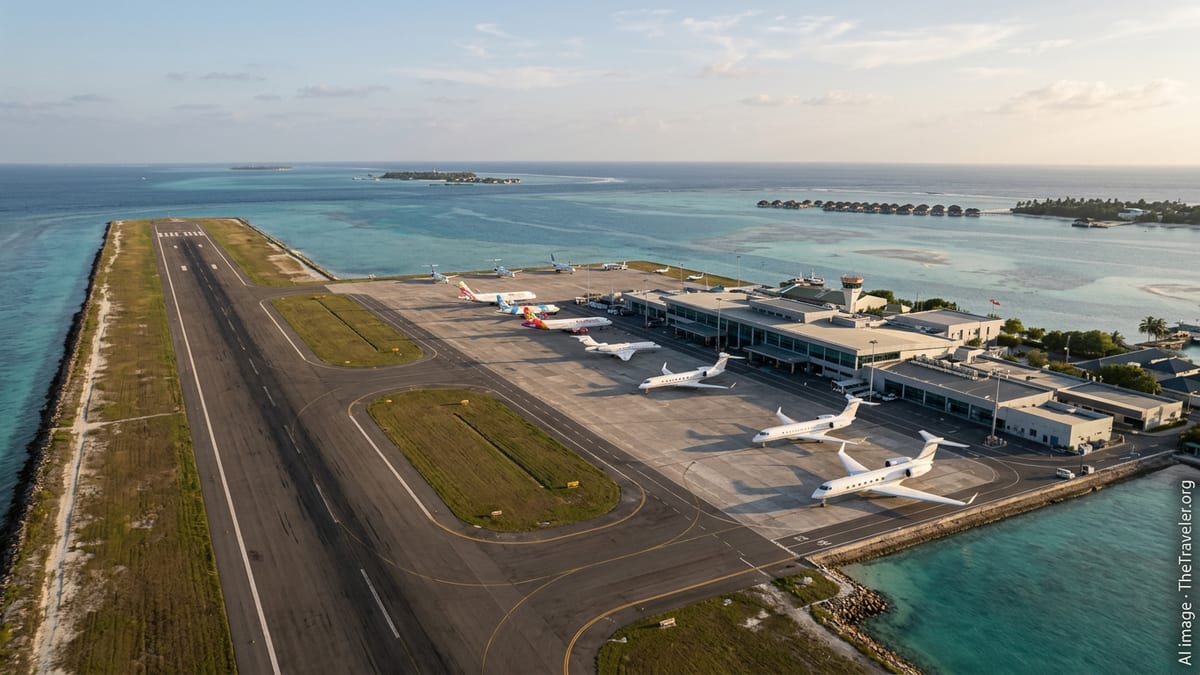
Private Jet Movements Surge at Velana International Airport
Recent traffic data shows a marked rise in private jet operations at Velana International Airport, reflecting the Maldives’ continued appeal among ultra‑high‑net‑worth and luxury travelers. Publicly available figures from Maldives Airports Company indicate that private jet movements reached more than 2,300 operations by late December 2024, representing around a 10 percent increase compared with the previous year and underscoring robust demand across the peak festive season.
Seasonal patterns remain pronounced, with aircraft activity peaking around Christmas and New Year as resort occupancy hits annual highs. Airport briefings and local media coverage note that dozens of business jets can be parked on the apron simultaneously during the year-end holidays, supported by dedicated parking zones that collectively offer space for more than 60 private aircraft. The rising volume of non-scheduled flights is prompting continued focus on apron management, ground services, and premium passenger handling.
The growth in private aviation traffic is closely tied to the Maldives’ positioning as a secluded, high-spend destination where travelers often combine multi-island itineraries with charter or resort-operated seaplanes. Industry observers say the expansion of luxury villa inventory and new ultra-premium resort openings are helping sustain demand for direct, point-to-point private jet access, particularly from Europe, the Middle East, and Asia.
Record Air Traffic Underscores Expanding Connectivity
Beyond private jets, overall air traffic through Velana International Airport continues to trend upward, reinforcing the Maldives’ role as one of South Asia’s busiest leisure gateways. Official traffic statistics for 2025 indicate that the airport handled around 8 million passengers for the year, a rise of roughly 7 percent compared with 2024, alongside an 8 percent increase in total aircraft movements.
International sectors make up the bulk of this activity. Central bank and tourism data for 2024 showed more than 13,600 international flight movements between January and October of that year, with scheduled commercial services accounting for the vast majority. Charter and private flights formed a significant niche component of the total, underlining how non-scheduled traffic complements scheduled airline capacity in feeding resort islands and liveaboard operators.
Operationally, Velana International Airport has also notched a series of single-day records, including periods when more than 1,000 aircraft movements were handled in 24 hours during peak seasons. These milestones highlight the importance of ongoing infrastructure upgrades, including a new terminal project and expanded runway-based services, in supporting future growth in both commercial and private aviation.
Airlines Add Capacity and New Long-Haul Horizons
The Maldives’ strengthened connectivity is also being driven by airlines enlarging their international route networks to and through Malé. In March 2026, Air India introduced additional capacity connecting Delhi with the Maldives as part of a broader package of 78 extra international flights designed to offer alternatives amid disruptions in Middle Eastern air corridors. The temporary move increases seat availability for both Indian outbound travelers and global passengers using Indian hubs to reach the Maldives.
National carrier Maldivian is simultaneously reshaping its role in long-haul markets. The airline introduced its first Airbus A330-200 widebody aircraft in January 2025, a step that supports planned expansion to major Chinese cities such as Beijing, Shanghai, and Chengdu. Company statements and sector analysis indicate that these routes are expected to carry tens of thousands of additional passengers annually into the Maldives, diversifying source markets and strengthening direct links with East Asia.
Looking further ahead, Maldivian has publicly discussed ambitions to add destinations in Europe, Africa, and additional points in Asia, leveraging a growing widebody fleet that could eventually include a second A330 and a Boeing 787-8. Industry coverage suggests that this strategy is intended to reduce reliance on foreign carriers and regional hubs, creating more non-stop or one‑stop options for travelers from long-haul markets.
Regional Hubs and New Corridors Support Global Access
The archipelago’s connectivity is increasingly shaped by regional hub strategies. Bangkok, Colombo, and various Indian cities act as key waypoints for travelers heading to Malé from Europe, the Middle East, and Asia-Pacific, and airlines are adjusting their networks accordingly. In late February 2026, Maldivian launched a new route linking Bangkok and Xi’an, creating an additional corridor that connects Chinese travelers to the Maldives via Thailand’s main international gateway.
Bangkok’s role as a multi-directional hub enables itineraries that combine European or Australasian long-haul flights with shorter regional sectors into Maldives-focused networks. Aviation analysts note that such two-step routings are becoming more important as some traditional long-haul connections via Middle Eastern hubs face temporary constraints or capacity shifts. The emerging China–Thailand–Maldives corridor is seen as one example of how carriers are re-routing flows while maintaining access for high-value tourist segments.
Closer to home, the resumption and expansion of routes linking Hanimaadhoo International Airport in the north of the Maldives with cities in southern India, along with extra school-holiday flights to Indian destinations, are improving regional access for both leisure and visiting-friends-and-relatives traffic. This layered network of domestic and short-haul international routes feeds into Malé, where passengers connect on to resort islands by seaplane or speedboat.
Luxury Tourism and Infrastructure Investment Move in Tandem
The rise in private jet activity and enlarged airline networks is unfolding alongside substantial investment in tourism and aviation infrastructure. New and upgraded resort projects across multiple atolls are adding capacity at the luxury and ultra-luxury tiers, reinforcing the Maldives’ image as a premium destination that justifies bespoke travel arrangements by charter jet or first and business class.
At the same time, the continued development of Velana International Airport, including terminal expansion and enhanced apron and seaplane facilities, is designed to handle higher passenger volumes and more diverse aircraft types. Industry reports describe these upgrades as essential to accommodating growth in both scheduled widebody services and the concentration of private jets that arrive during peak holiday periods.
Observers note that the interplay between aviation expansion and tourism development is likely to shape the Maldives’ next phase of growth. As airlines open new corridors and private jet operators respond to sustained demand for discreet, point-to-point access, the island nation is consolidating its status as a globally connected destination that can be reached via an increasingly varied mix of premium and mainstream travel options.