

More news on this day
Maldivian Airlines is accelerating its push into the Chinese market with new direct routes, expanded sales channels and wide-body operations, reshaping how Chinese travelers reach the Indian Ocean archipelago and signaling a new phase for Maldives tourism and regional aviation connectivity.
Get the latest news straight to your inbox!
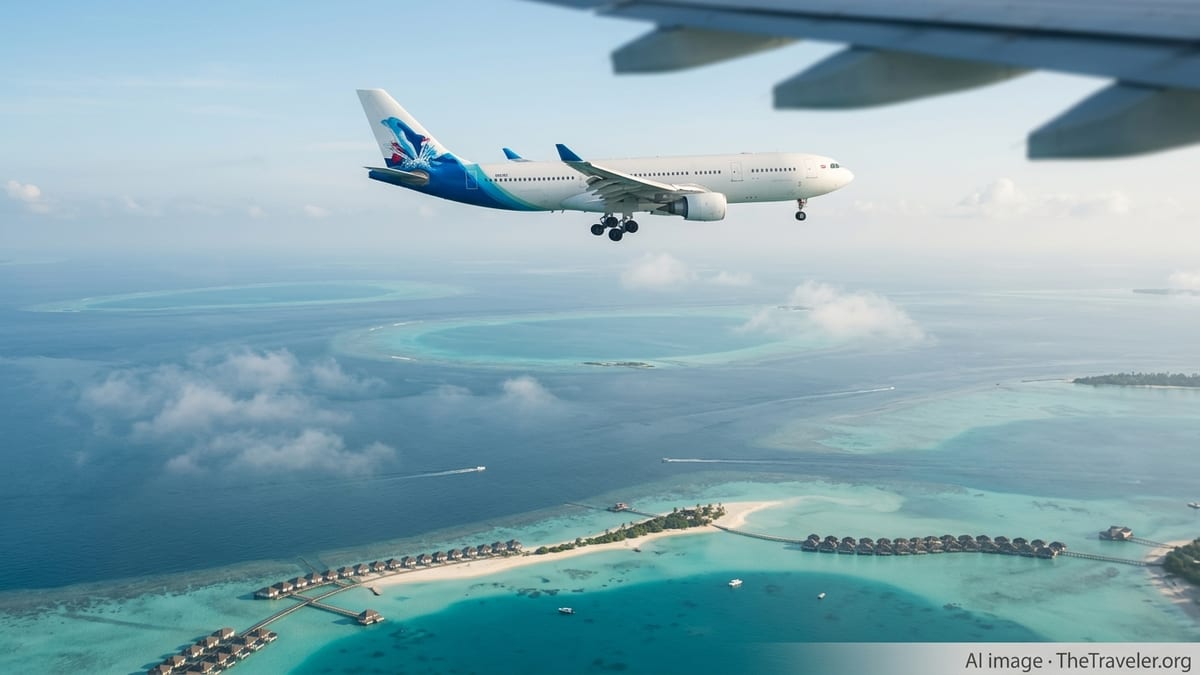
Wide-Body Expansion Puts China at the Center of Growth
Maldivian Airlines has placed China at the heart of its long-haul strategy, using newly introduced wide-body aircraft to connect Malé directly with key Chinese cities. Publicly available information shows that the flag carrier brought its first Airbus A330-200 into service in early 2025, enabling nonstop flights from Velana International Airport to Chengdu, Beijing and Shanghai.
The wide-body aircraft, configured in multiple cabin classes, has allowed the airline to tap into rising demand from Chinese holidaymakers who increasingly favor non-stop routes to resort destinations. Reports indicate that initial services began with weekly frequencies, with schedules designed around peak outbound travel periods from major Chinese hubs. This shift marks a significant evolution for a carrier historically focused on domestic and short regional operations.
Coverage in Maldivian aviation and tourism outlets describes the expansion as part of a broader fleet strategy that includes plans for a second A330 and possible additional long-haul aircraft. By pairing larger capacity with targeted routes into China, Maldivian is positioning itself to compete more directly with foreign airlines that have long dominated Maldives-bound traffic from East Asia.
The strengthened China network also raises the airline’s profile as a connector linking international long-haul arrivals to domestic seaplane and turboprop services. This linkage is central to the Maldives tourism model, where many high-end resorts are accessible only via onward flights from Malé.
Chinese Visitor Numbers Reshape the Tourism Landscape
Tourism statistics released in 2025 and early 2026 highlight the scale of China’s resurgence as a source market for the Maldives. According to official figures reported by tourism-focused publications, China has returned to the top position among visitor markets, accounting for roughly 14 to 17 percent of total arrivals and exceeding 300,000 tourists in 2025 alone.([tourismmaldivesonline.com](https://www.tourismmaldivesonline.com/2026/01/12/maldives-tourism-shatters-records-in-2025-with-historic-visitor-numbers-and-revenue-surge/?utm_source=openai))
These volumes are particularly notable given that Chinese outbound travel to the Maldives dropped sharply during the pandemic years. The recovery has coincided with the restoration of direct air links and the launch of Maldivian’s own services, reinforcing the feedback loop between aviation capacity and tourism demand. Industry coverage notes that the Maldives set new arrival records in 2025, with more than 2.2 million visitors, and that China was the single largest contributor to that growth.([hoteliermaldives.com](https://hoteliermaldives.com/maldives-records-2-25-million-tourist-arrivals-in-2025/?utm_source=openai))
The shift in source markets has also been shaped by geopolitical and competitive factors. Reports indicate that arrivals from India, once a leading market, softened in 2024 and 2025, while China, Russia and key European countries increased their shares.([mnn.mv](https://mnn.mv/travel-tourism/4724?utm_source=openai)) In this context, Maldivian’s decision to prioritize China is not only commercially attractive but also strategically aligned with the broader realignment of the Maldives’ visitor base.
Travel industry observers point to the composition of Chinese visitors as another factor supporting direct flights. Many travelers from China book high-yield resort stays or integrated tour packages, enhancing per-capita spending and making wide-body services more sustainable, particularly during peak winter and holiday seasons.
New Routes and Distribution Deals Aim to Capture Demand
Beyond launching direct flights, Maldivian has moved to deepen its commercial reach inside China. Publicly available information shows that in mid-2025 the airline entered the TravelSky global distribution system and joined the Billing and Settlement Plan (BSP) in China, steps that allow Chinese travel agencies and online platforms to issue Maldivian tickets more easily.([plus.mv](https://www.plus.mv/english/maldivian-expands-global-reach-with-entry-into-travelsky-gds-and-bsp-china/?utm_source=openai))
This distribution push coincided with seasonal and promotional capacity additions. Reports from Maldivian and local media describe a summer 2025 route linking Shenzhen to Malé via Bangkok, as well as discounted return fares on Malé–Shanghai, Malé–Beijing and Malé–Chengdu sectors with enhanced baggage allowances and inclusive onboard services.([en.maaldif.com](https://en.maaldif.com/8344/?utm_source=openai))
The airline has framed these initiatives, in public materials, as measures to improve accessibility for Chinese customers and strengthen collaboration with travel trade partners. Coupled with interline arrangements with large Gulf and Asian carriers, the new sales channels mean Chinese travelers can more easily combine Maldivian’s domestic network with long-haul itineraries sold under a single ticket.
Analysts following the market note that these moves mirror strategies used by larger regional airlines to consolidate their position in key origin markets. For Maldivian, focusing on China offers the possibility of building scale on a limited number of trunk routes rather than dispersing capacity across many lightly used international destinations.
Connectivity Gains for Resorts and Regional Aviation
Maldivian’s China strategy has implications that extend beyond point-to-point traffic. With more wide-body arrivals feeding into Malé, resorts and guesthouses across multiple atolls gain additional options for timed domestic transfers, whether by seaplane or land-based aircraft. Industry magazines in the Maldives report that improved synchronization between international and domestic schedules has become a priority as overall visitor numbers have risen.([thaichamber.org](https://www.thaichamber.org/public/upload/file/news/0911251757575684file.pdf?utm_source=openai))
For high-end properties, direct Chinese services can reduce travel time and uncertainty for guests who previously relied on connections via third countries. This in turn supports package sales and charter agreements, particularly during peak Chinese holiday periods. For mid-range guesthouses on local islands, increased lift from China may bolster occupancy in shoulder seasons as tour operators experiment with diversified products beyond traditional resort stays.
From a regional perspective, additional long-haul capacity into the Maldives may also reinforce the country’s role as a niche hub for Indian Ocean tourism. While Maldivian remains a relatively small player compared with Gulf or Southeast Asian airlines, its growing China footprint, combined with partnerships, could help it capture a larger share of feeder traffic to domestic destinations and nearby island states.
Airport infrastructure developments support this trajectory. Hospitality and aviation trade publications have highlighted the opening of new terminal facilities at Velana International Airport, which are designed to handle more wide-body movements and streamline transfers between international and domestic operations.([hoteliermaldives.com](https://hoteliermaldives.com/wp-content/uploads/2025/10/Hotelier_Issue-73_Web.pdf?utm_source=openai))
Opportunities and Risks in a Rapidly Evolving Market
While Maldivian’s pivot toward China offers clear opportunities, it also exposes the airline and the broader tourism sector to concentration risks. Experience from the pre-pandemic era, when China was already a dominant source market, showed how quickly outbound travel patterns can shift in response to health measures, economic conditions or policy changes.
Financial and policy reports from Maldivian institutions have underscored the importance of tourism receipts to the national economy and highlighted external vulnerabilities linked to global demand.([mma.gov.mv](https://mma.gov.mv/documents/Annual%20Report/2024/AR2024%20%28English%29.pdf?utm_source=openai)) A heavy reliance on a single major market could amplify those vulnerabilities if growth in other regions slows or if competition intensifies from rival destinations such as Thailand, Vietnam or Sri Lanka, which are also courting Chinese travelers with expanded air links.
At the same time, there are indications that Maldivian’s China-focused expansion is being balanced with plans for European services using additional wide-body aircraft.([themaldivesjournal.com](https://themaldivesjournal.com/77283?utm_source=openai)) This could help diversify revenue streams while leveraging the same fleet investment. The challenge for the airline will be to manage capacity, pricing and partnerships in a way that sustains profitability across seasons.
For now, the combination of strong Chinese demand, growing aviation capacity and upgraded airport infrastructure is propelling a new era of connectivity between China and the Maldives. How Maldivian navigates this phase may help determine not only its own trajectory as a flag carrier, but also the future shape of tourism flows to one of the world’s most sought-after island destinations.