

More news on this day
Mallorca has announced a new package of cruise ship regulations for Palma from 2027, tightening daily limits on vessels and passenger numbers in a bid to curb overtourism and preserve the Balearic Islands’ fragile coastal charm.
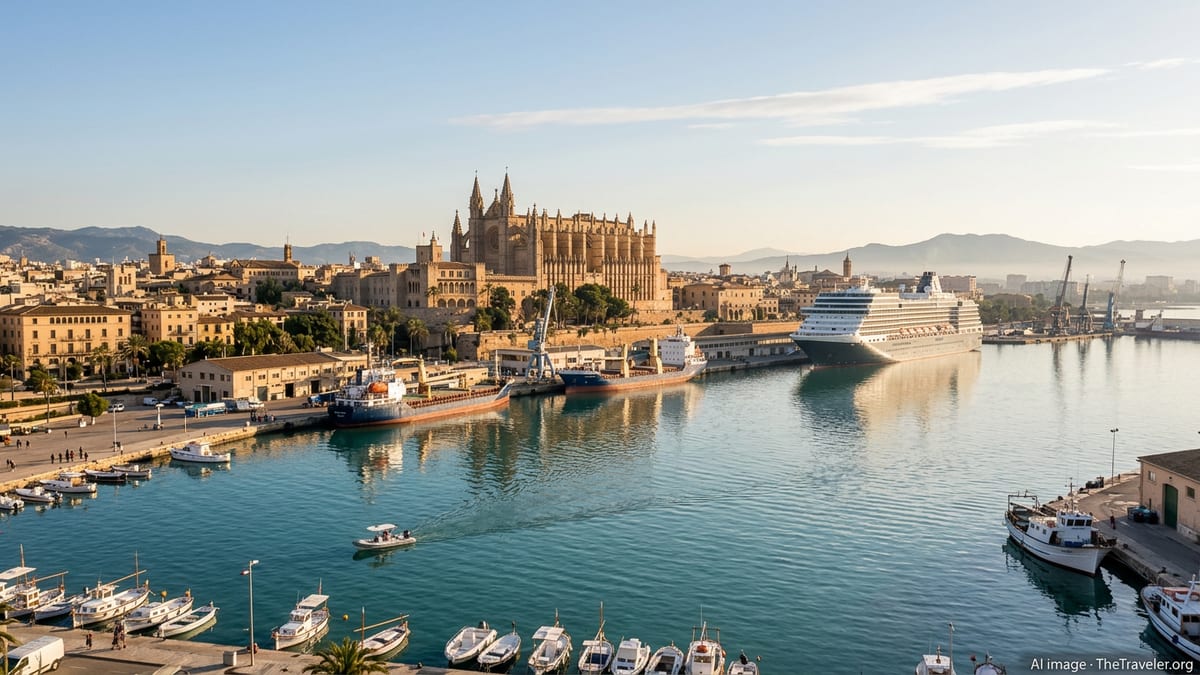
New Daily Caps on Ships and Passengers in Palma
Under the updated framework, agreed by the Balearic government, Palma City Council and major cruise lines, only three cruise ships will be allowed to dock at Palma’s port on any given day during the main season. Crucially, just one of those vessels may carry more than 5,000 passengers, introducing a firm ceiling on the mega‑ships that have come to symbolise mass tourism in the Mediterranean.
The plan also refines existing passenger caps by reducing the maximum number of cruise visitors allowed in a single day during peak summer months. Between June and September, authorities say the total daily cruise capacity in Palma will fall from 8,500 berths to 7,500, with the new rules phased in between 2027 and 2029. Officials describe the measures as a “reset” of the island’s relationship with cruise tourism rather than a rejection of the industry.
The agreement extends and strengthens a previous voluntary pact that had set informal limits but was repeatedly criticised for loopholes and uneven enforcement. By codifying how many ships and passengers can be handled each day, the government is seeking to move from ad hoc management to a more predictable system for both residents and cruise operators.
The new regime is expected to remain in place through the end of the decade, with the core collaboration between the Balearic authorities and around 20 cruise companies slated to run until 2031. Officials stress that the framework will be reviewed regularly so that caps can be tightened or adjusted if visitor numbers and local conditions require it.
Response to Surging Visitor Numbers and Local Backlash
The tougher rules come after years of record tourism growth across the Balearic Islands and mounting tensions in Palma’s historic centre. Regional data show the archipelago welcomed more than 18.7 million visitors in 2024, with totals surpassing 19 million in 2025. Cruise passengers form only a fraction of that overall flow, but their sudden arrival in concentrated waves has had an outsized impact on the capital’s streets, plazas and public transport.
In 2025, Palma alone handled more than 1.9 million cruise passengers and upward of 540 ship calls, according to the Balearic Port Authority. Forecasts for the coming years pointed to further growth in arrivals if no new restrictions were introduced, fuelling concerns that the city could slide into a pattern of permanent saturation during the high season.
Residents, small business owners and local campaign groups have for several years warned that the volume of day‑trippers from ships is distorting the city’s economy and eroding quality of life. Complaints include jammed pavements in the Old Town, pressure on public services and traditional shops being replaced by souvenir outlets or multinational chains. Anti‑tourism protests that began in 2024 across parts of Spain, including Palma, gave added urgency to demands for a comprehensive rethink of mass tourism.
Local political parties have also sharpened their positions. Environmentalist and regionalist groups had called for even stricter caps, in some cases proposing no more than two ships per day and a maximum of 6,000 passengers, arguing that anything higher would be incompatible with residents’ interests. While the new agreement does not go that far, it marks a clear shift towards prioritising liveability over unrestrained growth in visitor numbers.
Balancing Cruise Economy With Heritage and Environment
Authorities insist that the objective is not to shut the door on cruise tourism but to better align it with the island’s carrying capacity and long‑term sustainability goals. Palma’s port is a key economic engine, supporting jobs in port services, transport, hospitality and retail, and regional leaders are acutely aware of the revenue at stake.
Officials argue that a more controlled flow of ships and passengers could actually increase the value of each visit, encouraging longer stays and higher‑quality tourism rather than rapid, low‑spend stopovers. Studies by regional statistics agencies have found that cruise day‑trippers typically spend far less per person than guests staying in hotels, leading to questions about the true local benefit of ever higher passenger volumes.
The new rules are therefore framed as a way to protect what draws visitors to Mallorca in the first place: its seafront promenades, historic architecture and island landscapes. Limiting the number of mega‑ships, in particular, is seen as a tool to reduce congestion around the port area and cut air and noise pollution from the largest vessels, many of which still rely on heavy marine fuels.
In parallel with the caps, the Balearic government continues to explore complementary environmental measures, including stricter emissions standards in port, incentives for cleaner propulsion technologies and closer monitoring of waste management on visiting ships. Officials say these steps, combined with numerical limits, are essential to preserve both the visual appeal of Palma’s bay and the health of surrounding marine ecosystems.
Implications for Cruise Lines and Future Visitors
For cruise operators, the new framework will require careful replanning of itineraries in the western Mediterranean from 2027 onwards. Companies will need to secure berthing slots further in advance and adapt to a system in which Palma, a long‑standing marquee destination, can no longer accommodate unlimited simultaneous calls during peak weeks.
Industry representatives have so far signalled cautious acceptance, emphasising that clear rules are preferable to sudden last‑minute cancellations or public backlash in port cities. Some lines are expected to stagger arrivals by shifting Palma calls to shoulder seasons or by combining shorter port calls with extended time in nearby destinations in the Balearic and Spanish mainland.
For travellers, the immediate effect is unlikely to be a disappearance of Palma from cruise brochures, but demand for limited berths may gradually push more cruise itineraries into spring and autumn. Travel advisers say visitors who wish to experience the city with fewer crowds may benefit from this seasonal rebalancing, as well as from a broader regional push towards slower, more immersive tourism.
On land, the new caps could give Palma scope to redesign how it manages peak days, from improved signage and crowd dispersion strategies to promoting attractions beyond the Gothic cathedral and waterfront. Tourism officials hope that a more even distribution of visitors across neighbourhoods and seasons will help maintain the island’s reputation as an attractive, welcoming destination while easing strain on its most iconic sites.
A Test Case for Mediterranean Cruise Destinations
Mallorca’s move places it alongside other high‑profile European ports that have recently clamped down on cruise traffic in response to overtourism. Venice has banned large ships from its historic centre, while cities such as Dubrovnik and Barcelona have imposed their own caps and environmental rules, turning the Mediterranean into a laboratory for new models of cruise management.
Observers say the Balearic Islands, and Palma in particular, could now serve as a test case for medium‑sized ports that want to remain on the cruise map without sacrificing their character. If the new agreement succeeds in stabilising passenger numbers while reducing friction with residents, similar formulas may be adopted by other island destinations grappling with the same pressures.
The coming years will show whether the tightened limits are sufficient to address public concerns at a time when Spain continues to set new records for overall visitor arrivals. For now, Mallorca’s authorities are betting that fewer, better‑managed ships will help ensure that the view of Palma’s cathedral from the bay, and the narrow alleys of its Old Town, remain a draw for visitors without overwhelming the people who call the island home.