

I had wanted to do a proper walking safari for years, the kind where the vehicle is an afterthought and your own feet carry you through big game country. Mana Pools kept coming up as the place where walking still feels wild, slightly anarchic and definitely not overregulated.
When I finally went, I booked a multi day walking safari along the Zambezi shoreline, with a mix of guided and self guided time. What I found was one of the most intense wildlife experiences I have ever had, wrapped in a set of logistical compromises, costs and small irritations that are worth understanding before you commit.
First Impressions and Getting There
Getting to Mana Pools set the tone long before I saw any wildlife. The park sits in a remote corner of northern Zimbabwe, and there is no quick or cheap way in. I opted to drive from Harare, following the highway toward Chirundu before turning off at Marongora. The last stretch involves leaving the tar road, collecting a free entry permit at the Zimparks office, and then crawling down a steep escarpment on a rough dirt track toward the Zambezi. That last 70 plus kilometers felt longer than the entire first leg.
The dirt road into the park was in worse condition than I had expected. Corrugations, washouts and deep sandy patches made the going slow. I was in a high clearance 4x4 and I was still grateful for low range. If you arrive at the tail end of the rains, the road can be muddy and occasionally impassable. It is not a casual self drive stop and I would not attempt it in a standard sedan. That remoteness is part of the magic of Mana, but it also adds to the cost and effort. I understood quickly why many people fly in on small charter planes or let their walking safari operator handle transfers.
Arriving at Nyamepi, the main camp and office area, felt almost anti climactic. There is a small, slightly chaotic reception, some basic accommodation, a campsite and the river beyond. No slick lodge entrance, no manicured lawns. Just a park that feels lived in and a little tired around the edges. Park fees were straightforward enough, but the payment process was slow and old fashioned, with figures being checked and rechecked by hand. I paid my daily conservation fees as an international visitor, plus vehicle entry, in US dollars. The amounts themselves were reasonable, but the queuing and paperwork were not a highlight after a long drive.
How Walking Safaris at Mana Actually Work
Before going, I had read that Mana Pools is unusually permissive about walking. That is true, but it is not as simple as just wandering off into the bush. There is a layered system of options. The first is guided walking, which you can arrange through your lodge, operator or directly with Zimparks. You book at the tourist office a day in advance and pay after the walk, charged per hour per person. Then there are the Zimparks wilderness trails, multiday hikes usually timed around full moon, where park staff guide you and you carry your own kit.
The most distinctive aspect is the unguided walking permits. Mana is one of the few big game parks where you can pay for a walking permit and then head out on foot without a guide. In theory it is wonderfully liberating. In practice it is a serious responsibility. You are sharing space with elephants, lions, buffalo and hippos, and there is no physical separation. I got my permit at the office, again fighting through paperwork and slightly erratic information about exactly where I could and could not go. What struck me was how casual the issuing process felt for something that carries real risk.
For my main experience, I chose a mobile walking safari along the Mana shoreline operated by a specialist company. Over several days we walked between simple fly camps strung out along the Zambezi, following a route near the Ruckomechi River where it meets the main channel and then along toward the wilderness area. Each morning we left at first light, walking three to five hours with a professional guide and armed scout, reaching the next camp in time for brunch and rest. This format struck a good balance between immersion and safety, but it came at a price that would be out of reach for many people.
On Foot With Big Game: The Good, the Bad and the Adrenaline
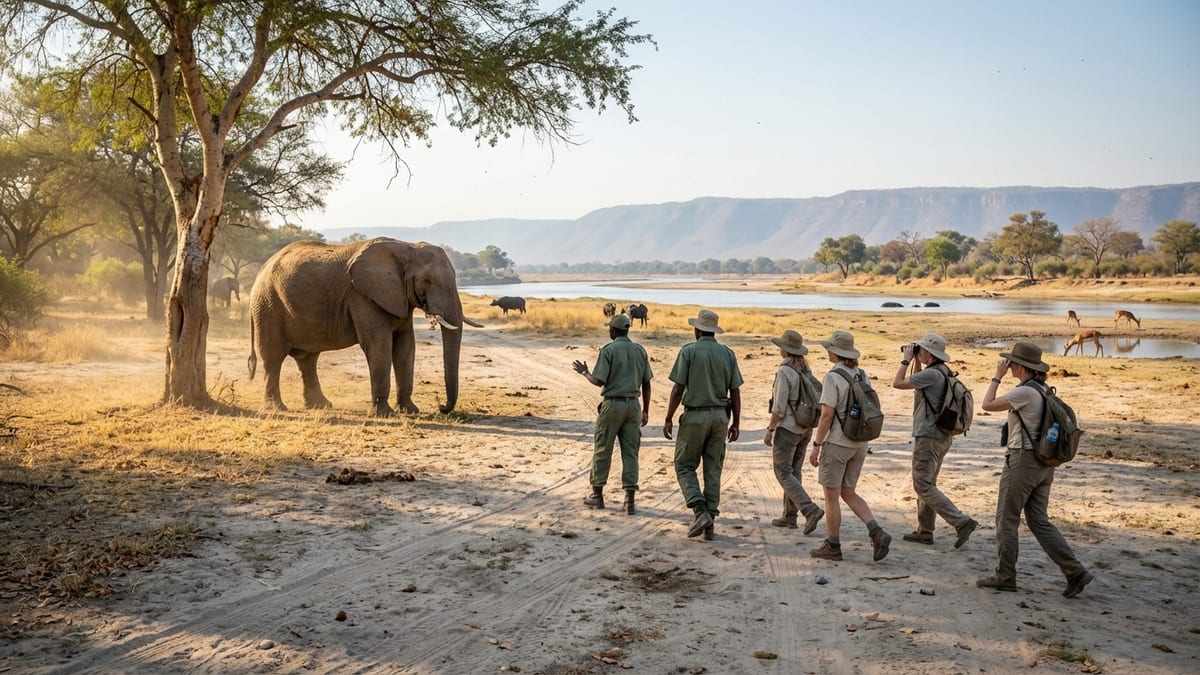
Walking at Mana Pools is visceral in a way I had not experienced elsewhere. On the first morning, I stepped out of camp to find elephant tracks printed in the dust just meters from my tent. As we set off, the early light pooled under winter thorn trees, and within half an hour we were skirting a herd of buffalo, not at some cinematic distance but at a range where one wrong move would have mattered. The guide kept us downwind and moved us patiently through cover, constantly watching their body language. It felt like eavesdropping on something private.
Those close encounters are what make Mana unique. Elephants here have grown used to people on foot and some individuals tolerate you at astonishingly close quarters. One big bull, nicknamed by guides and clearly a local celebrity, walked past us so calmly that I could hear his breathing and the gentle swish of his trunk in the dust. It was the kind of moment that ruins you for game viewing from a vehicle. I also spent time sitting at the edge of one of the park’s famous pools, watching impala, baboons and waterbuck cycle through while hippos grunted in the background.
The flip side of this intimacy is that it sometimes crosses my personal line of comfort. A couple of times, other walkers we met were edging closer to elephants than I felt was respectful or safe, particularly around cows with calves. Because walking and even unguided walking are so normalized here, there is a risk of complacency. I also noticed a few instances where guides from various operators seemed to be positioning guests more for the perfect photograph than for a clean escape route, especially around lions lying out in the open. I never felt actively endangered, but I did feel that the culture leans toward pushing boundaries, and not every visitor will be comfortable with that.
There is another, more mundane downside: walking exposes you fully to the elements. In the dry season the air is dusty and the afternoon heat is draining. On some days, the long slogs through soft sand along the riverbank felt more like endurance exercise than gentle exploration. There are no vehicle shortcuts when your feet are the primary means of transport. If you are unfit or nursing injuries, Mana walking can easily slide from exhilarating to exhausting, and there is little infrastructure to bail you out once you are on a route.
Guides, Safety and the Psychological Load
I cannot overstate the importance of a good guide at Mana. On my mobile walk, my guide had decades of experience and carried not just a rifle but a quiet, constant awareness of the wind, the terrain and the mood of every animal we saw. He explained his decisions in detail, whether it was choosing to approach a hippo pod from a termite mound where we had height, or deciding to back off from a group of elephants that looked unsettled. That transparency made me feel involved rather than just managed.
However, there is a wide range of guiding quality in the valley. On a separate day, I booked a shorter guided walk through the park office rather than a private operator. The ranger who took us out knew the area intimately but was less communicative, and the rifle handling felt more casual. We bumped into a lioness resting in long grass at closer range than was ideal because we were chatting and not scanning the wind. The situation never turned dangerous, but I walked away feeling that I had consumed my slice of luck for the day. For the prices international visitors now pay for park access and activities, I expected more consistency in training and professionalism.
Unguided walking added a different kind of strain. With a paid permit and a reasonable grasp of animal behavior, I set out solo on a short loop near camp one afternoon. Even keeping to open areas and known pathways, the constant mental calculation of where cats might be lying up and where elephants might be feeding took a toll. Every rustle in the thickets felt significant. Seeing fresh lion tracks over my own outbound prints on the return leg sharpened that feeling. It was thrilling, but it was also mentally exhausting in a way that a guided walk was not.
Safety in Mana is as much about your own judgment as it is about formal systems. There are no fences around campsites, no guards patrolling at night and no easy medical evacuation if something goes badly wrong. I was fully aware of this when I chose to go, but I also think some marketing around Mana walking safaris glosses over the real level of personal responsibility involved. This is not a national park where you can switch off and treat the wilderness as a backdrop. You are participating in it, and that participation has consequences.
Camps, Comfort and the Reality of a Mobile Trail
My walking safari used a simple but comfortable mobile camp that leapfrogged along the river while we walked. Tents were set up ahead of our arrival, with stretcher beds, proper bedding and a bucket shower rigged under a tree. Toilets were long drop affairs screened by canvas. Meals were cooked over an open fire and served at a communal table under the stars. It was all charming in that safari traditional sense, but it was not luxurious. If you are expecting lodge level comfort on a walking trail, Mana will probably disappoint you unless you pay for one of the high end permanent camps that offer shorter, optional walks rather than full trails.
Between the dust, the heat and the inevitable presence of insects, I never felt completely clean. The bucket showers were hot and welcome, but water is a precious resource, and the quantities are modest. At night, elephants occasionally moved through camp and once a hippo grazed close to my tent, grumbling to itself in the dark. I loved that rawness, but my sleep was often light and broken. By the third night I was tired and mildly irritable, a state that does not appear in most glossy safari brochures.
Food on the trail was better than I expected given the conditions. There was fresh bread, simple stews and plenty of tea and coffee. Still, it was basic camp fare and it repeated after a few days. If you have dietary restrictions, it is essential to communicate them in advance and with some insistence. The remoteness of Mana means that last minute adjustments are hard. I watched a vegetarian in our group gradually run out of patience with yet another plate of rice and vegetables while others tucked into more varied dishes.
The park’s own campsites and basic accommodation, which I used before and after the trail, are in that familiar African state of semi maintenance. Some toilets worked perfectly, others did not. A shower block had one functioning head and another that dribbled sadly. Staff were friendly but clearly stretched. The lack of reliable shops or fuel stations within close distance of the park added another layer of planning. You really do need to arrive self sufficient, from drinking water and food to spare parts and cash.
Costs, Booking Rules and Seasonal Trade offs
The financial reality of Mana Pools walking safaris is important to face early. At the park level, conservation fees for international visitors are not outrageous by global standards, but they add up quickly on multi day stays. On top of that you have vehicle fees, camping charges if you are self driving, and walking or canoeing activity fees if you book through Zimparks. Wilderness trail hikes and lion tracking incur additional costs. None of these felt unreasonable in isolation, but the cumulative total was significant, especially once I added the price of a guided walking safari with a private operator.
Commercial walking packages along the shoreline now start in the low thousands of US dollars per person for three or four nights, excluding flights or long road transfers. For that you get a small group, a licensed guide, camp staff, park fees and basic comforts. Compared with lodge based safaris in neighboring countries, it is not wildly overpriced, but it is also not the accessible, shoestring adventure that some early accounts of Mana might suggest. Budget travelers can cut costs by self driving, camping at Nyamepi or one of the exclusive riverbank sites, and paying for shorter guided walks or unguided permits, but then you absorb more of the safety and logistical burden yourself.
Seasonality also shapes what you get for your money. The park is most popular in the long dry season, from roughly June to October, when animals concentrate along the river and walking conditions are good. That is also when dust is at its worst and daytime temperatures climb, especially toward the end of the season. I went in late dry season and found game viewing excellent but the landscape parched and smoky from distant fires. Earlier in the year there can be lush greenery and fewer people, but some tracks become muddy, mosquitoes increase, and walking can be restricted in places. I would not come in the heart of the rains, both because of access issues and because walking loses much of its appeal in heavy humidity and tall grass that hides animals.
Booking rules are old fashioned and sometimes obscure. Some of the wilderness trails must be reserved well in advance through Zimparks, with deposits and cancellation conditions that are not always spelled out clearly. Private operators often require full payment before arrival and have strict cancellation policies tied to their own arrangements with the park. I had to send several follow up emails to get confirmations and final itineraries, and at one point a miscommunication about dates nearly cost me a night in camp. It worked out, but it was more effort than it should have been in 2026.
When Walking is Better Than Driving, and When It Is Not
Mana Pools forces you to rethink what a safari is for. On foot you see less in terms of sheer numbers and variety than you might from a vehicle that can cover huge distances. Some days on the trail we had long stretches with very little visible game, just bird calls, tracks and the distant shape of the Zambezi. If your primary goal is to tick off species and collect as many close up photos as possible, this will feel inefficient and maybe disappointing.
What walking gives you instead is context. I remember following the same elephant herd’s tracks for hours one morning, reading the story of where they had paused, where a calf had stumbled in the sand, where they had broken into a trot. We did not actually see them until near midday, but by then they were not just random animals; they were the authors of a story we had been decoding. Similarly, coming across lion tracks suddenly on top of our own footprints from earlier in the walk made me feel the fluidity of time and movement in the bush in a way that vehicle safaris rarely do.
There were moments, however, when I missed the ease of a vehicle. After three hot days on foot, a late afternoon came when the guide suggested a drive to a distant pool where wild dogs had been seen regularly. On foot it would have been a punishing round trip, but in a vehicle it was a comfortable excursion. We reached the pool in time to watch the dogs wake, stretch and play before setting off to hunt. It was one of the most memorable sightings of the trip and would have been completely inaccessible purely on foot. That experience underlined for me that Mana is best when you combine walking with some strategic driving or canoeing, rather than rigidly committing to one mode.
The Takeaway
Looking back, my Mana Pools walking safari was one of the most intense and demanding trips I have done in Africa. It was not smooth or glamorous. Getting there took effort, the bureaucracy was clunky, the infrastructure basic, and the days physically and mentally taxing. There were moments when I questioned the value, especially as costs mounted and small frustrations piled up. Yet the memory that lingers is not the paperwork or the potholes, but the feeling of standing eye level with elephants on foot, of listening to lions roar across an open floodplain at night, and of knowing that there was almost nothing between us and them except judgment and mutual caution.
Mana Pools is not for everyone. If you want guaranteed comfort, predictable routines and a steady stream of easy sightings from the back of a vehicle, there are better parks in southern Africa. If you are uneasy with risk or prefer clearly marked boundaries between humans and wildlife, the permissive walking culture here may feel irresponsible rather than liberating. Families with young children, people with mobility issues or anyone relying on fast medical access should think hard before committing to multiday walks in such a remote space.
But if you are reasonably fit, comfortable with simple bush camps, willing to accept a degree of uncertainty and ready to be an active participant in your own safety, Mana offers something rare. Walking safaris here feel like a throwback to an older style of travel, one where the wild is not fully packaged and tamed for you. You trade convenience for depth, comfort for immediacy. I would not repeat my trip exactly the same way; next time I would build in an extra night of rest at the start, choose my guiding outfit even more carefully, and perhaps skip the solo unguided walk that left me more drained than enlightened. But I would go back.
Under the right conditions and with clear expectations, a walking safari in Mana Pools can be extraordinary. It rewards patience, humility and preparation more than money or bravado. For travelers who value those things, and who understand that “unique” does not mean “perfect,” Mana delivers on its reputation in its own stubborn, unforgettable way.
FAQ
Q1. Is Mana Pools safe for walking safaris?
Safety on a Mana Pools walking safari depends heavily on your guide, your own behavior and your acceptance of risk. There are no fences and you share space with elephants, lions, buffalo and hippos. With an experienced, licensed guide and sensible group size, the risk is managed but not eliminated. If you choose unguided walking with a permit, the responsibility shifts more onto you, and you should be confident reading animal behavior and terrain before attempting it.
Q2. Do I need to be very fit to do a walking safari at Mana Pools?
You do not need to be an athlete, but you should be comfortable walking three to five hours a day on uneven ground in heat and dust. Soft sand, termite mounds and occasional scrambling around gullies can be tiring. If you struggle with long walks, hills or high temperatures, you may find the experience more draining than enjoyable and might be better off with shorter walks combined with game drives.
Q3. How much does a Mana Pools walking safari cost?
Costs vary widely. At the basic level you will pay daily conservation fees, vehicle entry and any camping charges if self driving. A multiday mobile walking safari with a professional operator typically runs into the low thousands of US dollars per person for three or four nights, including guiding, simple camp accommodation and park fees but excluding international flights or charter transfers. Shorter guided walks booked through the park office are cheaper but still add up over several days.
Q4. When is the best time of year to do a walking safari in Mana Pools?
The long dry season from roughly June to October is generally best for walking safaris. Vegetation is more open, animals concentrate along the river and the risk of rain disrupting activities is low. Early in the dry season temperatures are milder but game is slightly more dispersed. Later in the season, sightings can be spectacular but dust and heat increase, especially in October. The wet season brings lush scenery but tall grass, mud and mosquitoes make walking less appealing and sometimes more restricted.
Q5. Can I do an unguided walk on my first visit?
Technically you can, because the park offers walking permits for unguided walking, but I would not recommend starting that way. Without prior experience in big game walking, it is easy to misjudge distances, animal moods and safe routes. I found it far more sensible to spend time on guided walks first, listening to how guides read the bush, before considering any solo outings and then keeping those short and conservative.
Q6. What kind of accommodation is available for walking safaris?
For dedicated walking safaris, most accommodation is in simple mobile camps with walk in tents, stretcher beds, bucket showers and long drop toilets. They are comfortable but not luxurious. Some permanent lodges along the Zambezi also offer walking activities as part of a broader package, giving you more comfort and amenities while still allowing you to go on foot for a few hours a day. At the budget end, you can camp at park campsites and arrange walking separately, accepting more self sufficiency and fewer facilities.
Q7. How far in advance should I book a Mana Pools walking safari?
For popular dry season months, it is wise to book a guided walking safari several months in advance, especially if you have fixed travel dates or want a specific operator. Park run wilderness trails and the more sought after exclusive campsites also fill up early. If you are flexible and traveling in shoulder months, you may find space closer to your trip, but relying on last minute availability is risky given the park’s limited capacity and remoteness.
Q8. What should I pack for a walking safari in Mana Pools?
On foot, every item you carry matters. Lightweight neutral clothing, broken in walking shoes or boots, a wide brimmed hat, high SPF sunscreen, insect repellent and a refillable water bottle are essential. I also found a small daypack, binoculars and a compact camera useful. Because shops and services are far away, you should bring any personal medication, spare batteries and basic first aid items rather than relying on finding them in or near the park.
Q9. Is Mana Pools suitable for children?
Mana Pools is generally not ideal for young children, especially on serious walking safaris. The lack of fences, presence of large predators and the need for constant quiet and discipline on foot make it challenging. Some lodges set minimum age limits for walking activities. Older teenagers who are genuinely interested in nature and capable of following safety instructions may enjoy and benefit from the experience, but families should discuss options carefully with operators before committing.
Q10. Would I go back and do a Mana Pools walking safari again?
Yes, but with adjustments. I would still choose Mana for its unique walking culture and close animal encounters, but I would plan an extra rest day to recover from the journey in, be more selective about which walks I join, and probably skip any solo unguided walks. I would also budget more generously, accepting that the combination of remoteness, guiding and park fees makes this an investment trip rather than a bargain adventure. With those expectations set, I believe a return visit would be even more rewarding than my first.