

More news on this day
Manchester Airport is accelerating its £1.3 billion transformation with a smarter Terminal 2 operating model that combines advanced security technology, redesigned passenger flows and new barrierless parking systems to increase capacity ahead of the busy summer 2026 season.
Get the latest news straight to your inbox!
A New Smart Model for a Bigger, Busier Terminal 2
Publicly available information on Manchester Airport’s transformation programme shows that Terminal 2 is being positioned as the airport’s primary hub, with a single, enlarged check in hall and expanded departure facilities designed to handle significantly more passengers than before. The extension that opened in 2021 effectively doubled the size of Terminal 2, and the current phase focuses on using technology and layout changes to make that additional space work harder.
Planning and financing documents for the final phase describe a “world-class Terminal 2 experience,” centred on higher throughput at security and baggage, along with a more efficient airfield layout that unlocks the potential of the airport’s two runways. The strategy aligns with the airport’s capacity declarations for summer 2026, which indicate rising terminal throughput limits and a shift of more airline operations into the upgraded Terminal 2.
The result is a smart terminal model built around integrated systems rather than isolated upgrades. Check in, security, retail, boarding and ground access are being redesigned to function as a single passenger journey, supported by new digital and sensor technologies that allow the airport to smooth peaks and minimise congestion.
Industry coverage of the programme highlights that Manchester Airport is also preparing supporting infrastructure such as road access and car parking to match increased passenger numbers. This broader approach suggests that the smart Terminal 2 model is as much about orchestrating the entire campus as it is about the building itself.
Next-Generation Security to Cut Queues and Friction
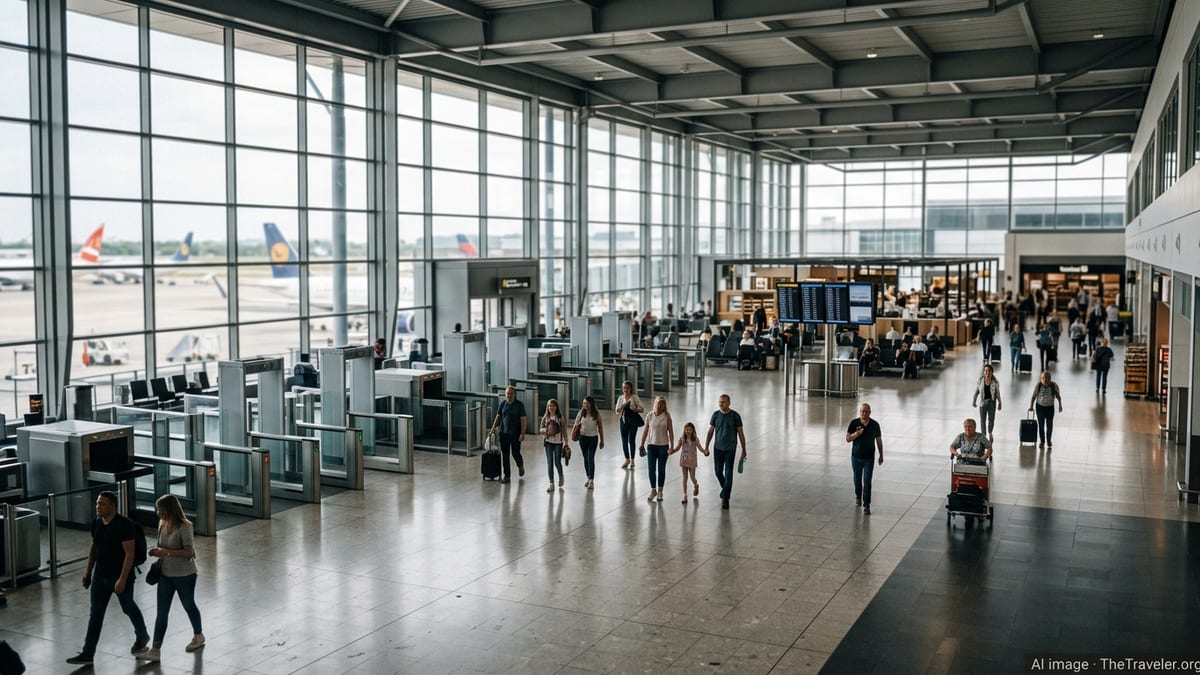
In 2025, Manchester Airport opened a new Terminal 2 security hall equipped with next-generation scanning technology, seen in specialist aviation reports as a key milestone in the transformation. The facility provides ten advanced security lanes, with the ability to screen more passengers per hour while reducing the need for passengers to remove liquids and devices from bags, in line with the latest UK security standards.
Operational updates indicate that this security hall is being used as the backbone of the smart Terminal 2 model. By combining higher-capacity scanners with a redesigned queuing layout and a second security hall in the refurbished parts of Terminal 2, the airport aims to reduce wait times and make flows more predictable, especially at peak morning departure waves.
Analysts following the transformation note that this approach allows Manchester Airport to move away from purely manual queue management toward a more data-led model. With sensors and digital monitoring in place, security teams can adjust staffing and lane allocation in real time, better matching capacity to demand.
For passengers, the most visible changes are shorter, more consistent queues and a simplified process at the checkpoint. For airlines, the improved reliability at security reduces the risk of delayed departures caused by late-arriving passengers held up in screening.
Expanded Departure Lounge, Retail and Pier 2 Operations
The smart Terminal 2 model also relies heavily on a reconfigured airside experience. Manchester Airport’s own updates describe a departure lounge that will more than double in size, with over 20 new retail and food and beverage outlets being introduced through 2025 and beyond. The layout is designed to spread passengers more evenly across the space, reducing pinch points around gates and security exits.
The upgraded pier infrastructure, including a new Pier 2, will give passengers direct, level access to aircraft with more seating at gates and improved airfield views. Construction and engineering partners involved in the programme highlight that this pier network is designed to accommodate a broader mix of aircraft types and airlines, which is central to increasing overall capacity.
From an operational perspective, integrating Pier 2 with the enlarged departure lounge and new baggage systems is expected to streamline the path from security to gate. Passengers will spend more time in the commercial areas and less time waiting in cramped gate zones, while ground handling teams gain more predictable turnaround windows.
Recent references to a new “market hall” style retail area in Terminal 2 suggest that the airport is also using commercial design to support smoother journeys. More seating, clearer sightlines to flight information displays and dispersed dining options are intended to reduce crowding in any one section of the terminal.
Smarter Parking and Ground Access: Barrierless Car Parks and New Layouts
Alongside the terminal interior, Manchester Airport is altering how passengers arrive at and leave Terminal 2. Travel industry briefings show that from March 2026 the airport is introducing a new numbered parking system across the site, with Terminal 2 facilities rebranded under codes such as P1, P2, P3 and P4. This is designed to make wayfinding clearer and reduce confusion between different multi storey and park and walk options.
Reports covering these changes highlight that the Terminal 2 West Multi Storey car park, now signposted as P3, is switching to a barrierless model from late March 2026. Automatic number plate recognition will record vehicle entries and exits, and drivers will pay online, via app or by phone, rather than at physical machines. Manchester Airport has already used similar systems at its drop off and pick up zones, and early commentary suggests that this approach cuts queuing at barriers and shortens the last step of the journey.
Parking specialists note that the wider renumbering and consolidation of car parks around Terminal 2 and Terminal 3, combined with new mid stay and express facilities, is intended to match the terminal’s increased passenger volumes. With more clearly defined zones for meet and greet, park and walk and long stay, passengers are expected to make fewer wrong turns, reducing congestion on access roads.
By tightly integrating these ground access changes with the Terminal 2 expansion, the airport is effectively extending the smart terminal concept beyond the building itself. A smoother parking and drop off experience supports on-time check in and security processing, which in turn helps airlines to maintain punctual schedules.
What Travelers Need to Know Before Flying from Terminal 2
For passengers planning flights from Manchester’s Terminal 2 in 2025 and 2026, the ongoing transformation will be visible at several points in the journey. Publicly available guidance from the airport and travel operators indicates that more airlines are migrating to Terminal 2 as work progresses, so travellers are advised to double check their terminal and parking details before departure dates.
On arrival at the airport, drivers using the Terminal 2 West Multi Storey P3 car park after the switch to barrierless operation will need to remember that payment is moved entirely online or via app and must be completed by the deadline set out in the airport’s terms. There are no on site pay stations under the new model, so leaving without paying will trigger enforcement charges.
Inside the terminal, passengers can expect a more spacious check in hall and a modernised security process using next generation scanners, which, when fully implemented, are expected to allow liquids and large electronics to remain in bags. While this should reduce friction at security, travellers are still being advised to follow the latest official guidance on cabin baggage rules when they fly.
Once through security, the enlarged departure lounge, new market hall concept and gradual opening of additional shops and restaurants are intended to give passengers more choice and more seating. As Manchester Airport shifts more of its operations into this smart Terminal 2 model, the combination of increased capacity and redesigned flows is expected to make journeys smoother than in the past, even as overall passenger numbers continue to rise.