

More news on this day
Rail passengers across the United Kingdom are preparing for a weekend of severe disruption as extensive upgrade works around Manchester Piccadilly station temporarily shut key platforms, cut off routes from the south and east, and place added pressure on alternative rail and tram connections across the city.
Get the latest news straight to your inbox!
Once-in-a-Generation Overhaul Hits the Network’s Busiest Hub
Publicly available planning documents describe the work at Manchester Piccadilly as a once-in-a-generation overhaul of the station’s southern approach, focusing on the complex junctions that feed many long-distance and regional services into the concourse. The project, costed at around £7.9 million, involves replacing multiple sets of points, renewing ageing sleepers with modern concrete, and upgrading lineside signalling and control equipment to modern standards.
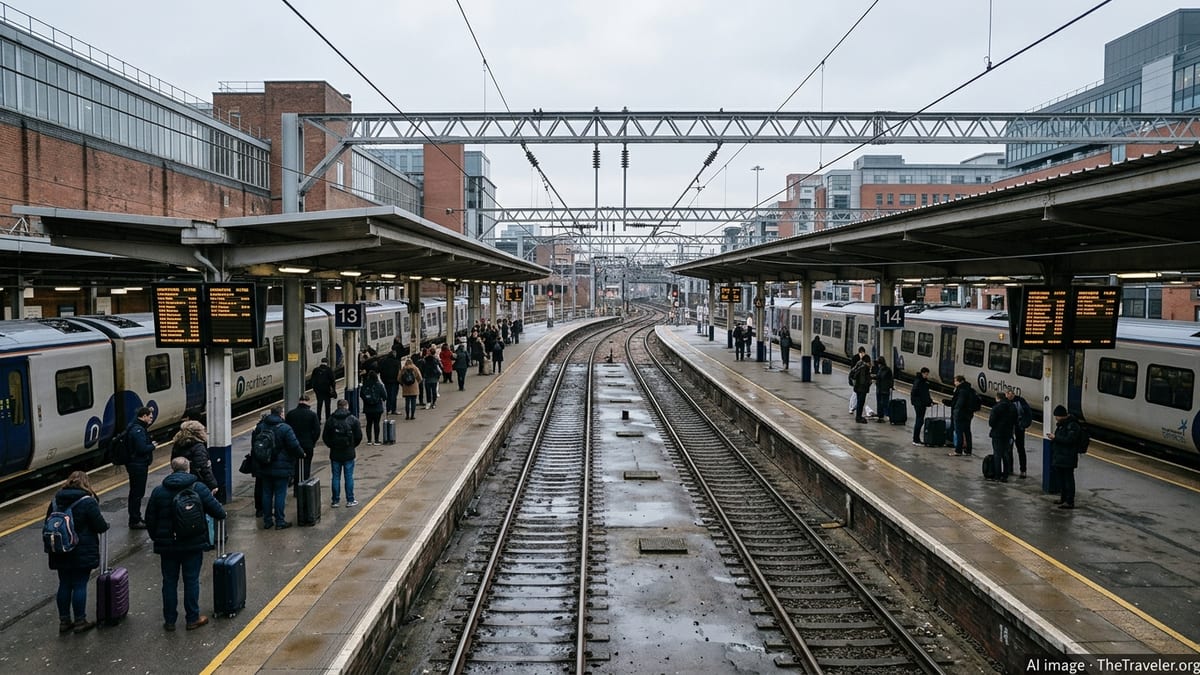
During the main phase of the works, platforms 1 to 12 are scheduled to be taken out of use, with only a limited westbound service operating from platforms 13 and 14. Network maps released for the blockade period show that, while the station building remains open, most routes approaching from Crewe, Stockport, Sheffield and other southern and eastern corridors are either diverted, curtailed at outlying stations or replaced by buses.
Rail industry briefing material notes that the existing infrastructure dates from the 1980s and has become a regular source of congestion and delay, particularly during the morning and evening peaks. The intention is that, once completed, the new layout and equipment will improve reliability for services linking Manchester with London, the Midlands, Yorkshire, the North East and the airport, although the benefits will only be felt after a period of acute short-term pain.
Severe Weekend Timetable Changes for Intercity and Regional Trains
Published timetables and operator notices indicate that passengers travelling from the south and east will face the most significant impact over the affected weekend. Many services that normally run directly into Manchester Piccadilly are instead planned to terminate at stations such as Stockport or Manchester Oxford Road, with onward journeys requiring a change to either local trains or dedicated replacement buses.
Routes from Yorkshire and the North East via the TransPennine corridor are among those seeing major diversions. Journey planners show that several trains from Leeds and Huddersfield are being routed to Manchester Victoria instead of Piccadilly, with passengers then advised to use local connections across the city if they need to reach the main intercity hub or Manchester Airport. This re-routing is intended to keep trans-Pennine capacity available while engineering closes the usual approach lines.
Services between Manchester and the airport are also being significantly restructured. Operator information points to a mix of curtailed rail services and high-frequency replacement buses running between Manchester Piccadilly and the airport, calling at intermediate stations on the route. While these measures are designed to preserve connectivity for holidaymakers and business travellers, journey times are expected to lengthen and vehicles are likely to be busy at peak departure and arrival times.
Across the wider North West, knock-on effects are predicted as rolling stock and crews are redeployed and paths through Manchester are limited. Rail advocates note that even passengers not intending to travel through Piccadilly may experience longer journeys or unusual connections as operators work around the blockade.
Tram Network Feels the Strain as Passengers Seek Alternatives
The engineering focus is on heavy rail, but the impact is set to be felt on Manchester’s Metrolink tram network as well. Public guidance materials highlight Piccadilly’s role as a key interchange, with the undercroft tram stop directly beneath the mainline platforms providing an important link between intercity trains, local services and city-centre destinations.
With many rail passengers being diverted away from their usual direct routes, Metrolink lines serving Piccadilly, Piccadilly Gardens and Manchester Victoria are expected to see increased demand. Travel alerts and operator messaging ahead of the works advise passengers to allow extra time for transfers, be prepared for crowded trams during busy periods, and consider walking between nearby central stops where practical in order to ease pressure on the system.
Some weekend tram journeys may also be adjusted to fit around works close to the station throat and key bridges. While core services are intended to keep running, operational diagrams shared in public documents suggest that turn-back locations and frequencies could shift temporarily, particularly early in the morning and late at night, as engineers access track and signalling equipment in confined areas near the tram corridors.
Transport commentators note that the combination of reduced rail capacity and heavier use of the tram network creates a challenging environment for maintaining punctual, comfortable journeys. Passengers connecting between rail and tram are being urged to check the latest network status on the day of travel and to be flexible about routes through the city centre.
Warnings of Congested Platforms, Busy Buses and Longer Journeys
Stakeholder briefing packs shared with local authorities and community groups portray a weekend of crowded concourses, queues for information, and heavy reliance on replacement buses. With large sections of the platform layout closed, passenger movements will be concentrated into a smaller space, potentially complicating wayfinding for those unfamiliar with the station.
Rail replacement bus maps produced for the works period set out routes linking Manchester Piccadilly with Stockport, the airport and other key nodes. These services are intended to run at relatively high frequency, but journey planners flag that road congestion around central Manchester and along the A6 corridor could add unpredictability, particularly at times when major events or football fixtures coincide with the engineering blockade.
Interchange points such as Manchester Oxford Road and Manchester Victoria are expected to handle additional flows as diverted trains arrive and depart. Passenger groups have raised concerns that some travellers may face multiple changes involving a mix of buses, local trains and trams for journeys that would normally be completed on a single direct service, increasing the risk of missed connections if any part of the chain is delayed.
Despite these challenges, operators are promoting the upgrade as a necessary investment to support future timetable improvements, including potential capacity enhancements linked to the wider TransPennine Route Upgrade and other regional schemes. The weekend disruption is being framed as a short-term cost for long-term reliability gains on some of the busiest interurban routes in northern England.
Advice for Travellers Planning Weekend Trips Through Manchester
Passenger information distributed ahead of the blockade strongly encourages travellers to plan journeys in advance, with an emphasis on checking times as close as possible to the day of travel. Journey planners and operator websites are being updated to reflect revised timetables, alternative routes and bus replacement patterns, enabling passengers to compare options and build in extra time where needed.
Those with flexible plans are being advised, through public messaging, to consider travelling outside the busiest times or, where possible, shifting non-essential trips to alternative days. For unavoidable journeys, particularly to and from the airport, passengers are being urged to allow significantly more time than usual between their rail or bus arrival and scheduled flight departure, in case of unexpected delays or heavy demand.
Rail user groups also highlight practical steps for coping with disruption, such as travelling with lighter luggage to make transfers easier, familiarising oneself with the layout of Piccadilly and alternative stations, and being prepared to use different central Manchester stops on the tram if one location becomes overcrowded. For passengers requiring step-free access, publicly available station information is being signposted as a key resource to confirm lift availability and accessible routes during the works.
With Manchester Piccadilly acting as a critical hub for journeys across the North West and beyond, the weekend overhaul is expected to test the resilience of both rail and tram networks. While the long-term goal is a more reliable and modernised gateway to the city, travellers in the short term are being urged to check before they set out and to brace for journeys that may be slower, busier and more complex than usual.