

More news on this day
Major rail and tram upgrades in Manchester are set to disrupt travel in and beyond the United Kingdom, as a nine day closure of Manchester Piccadilly station and associated Metrolink works alter key domestic and international routes through one of Britain’s busiest transport hubs.
Get the latest news straight to your inbox!
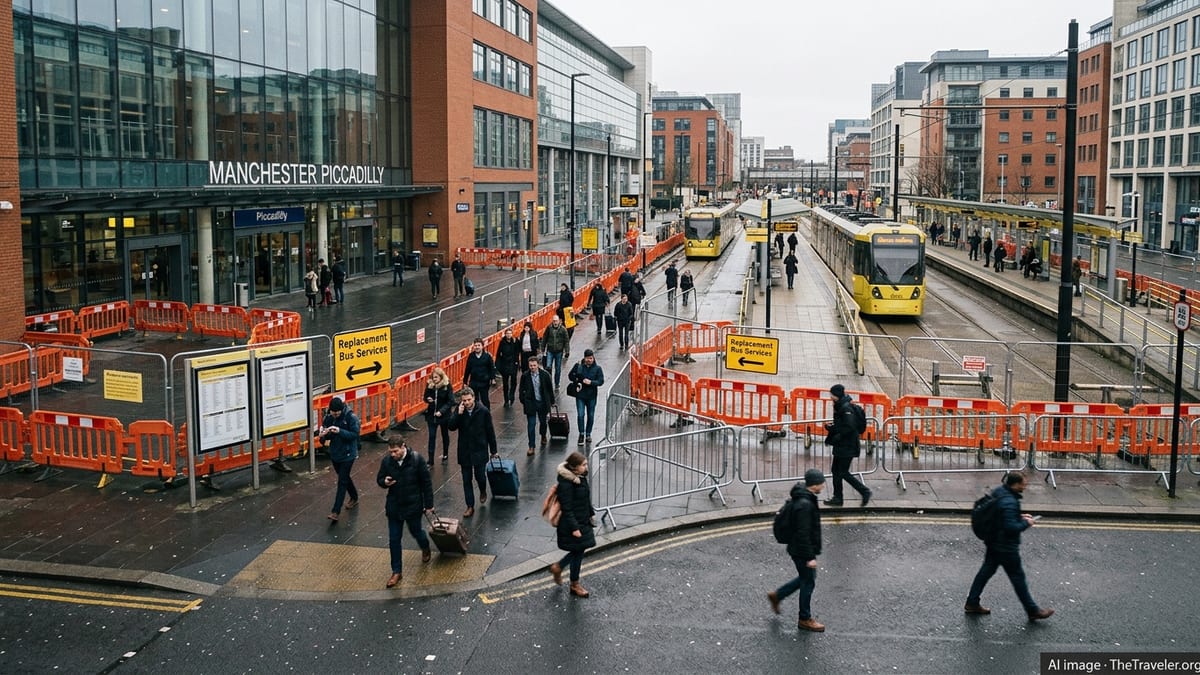
Piccadilly Station Faces Intensive Nine Day Blockade
Publicly available information from Network Rail and train operators shows that Manchester Piccadilly’s main platforms on the southern approach are scheduled to close for nine consecutive days from 14 to 22 February 2026, while track, points and signalling are renewed in a £7.9 million scheme. The blockade affects platforms 1 to 12, where the majority of long distance and regional services arrive from London, the Midlands, Sheffield and routes across northern England.
During the closure, no trains from the south and east will run into the main concourse, with diagrams indicating that services from London Euston, Birmingham, Stoke on Trent, Sheffield and other key cities will either terminate short of Manchester or divert to alternative routes. Replacement buses are planned between Manchester Airport and Manchester Piccadilly and on links between the city and surrounding towns, while some services are expected to use the through platforms 13 and 14 on the Castlefield corridor instead of the principal station throat.
Recent technical coverage of the project notes that the work bundles several years of smaller interventions into a single intensive possession, allowing engineers to renew heavily used junctions that have become a reliability pinch point on the approach to the station. The strategy is intended to reduce the need for repeated weekend closures in future, but it concentrates disruption into a short period that coincides with the UK school half term, when leisure and family travel volumes are typically high.
Industry planning documents also point to follow up Sunday closures and shorter possessions in March 2026 to complete finishing works, testing and signalling integration. These additional interventions are expected to affect Sunday morning timetables from Manchester Piccadilly into late March, requiring passengers to check revised departure times and alternative stopping patterns on several regional routes.
Metrolink City Centre Works Add Pressure to Bee Network
Alongside the rail upgrades, Manchester’s Metrolink network is undergoing its own programme of track and infrastructure renewals on key city centre streets. Recent improvement notices and publicly circulated diversion leaflets show that works around York Street and the busy Market Street and Piccadilly Gardens stops have already prompted temporary closures and diversions on multiple tram lines in 2025, with further works signposted into 2026 as part of the Bee Network upgrade plan.
Previous phases saw no trams running between St Peter’s Square and Market Street or Piccadilly Gardens for periods in March 2025, forcing services to divert via Exchange Square and reducing frequencies on some lines. Similar patterns are anticipated during future phases, with some airport, Altrincham, Bury and Trafford Centre services rerouted or curtailed while track is replaced and junctions renewed in the tight city centre corridor.
Transport planning documents for Greater Manchester highlight that the Bee Network is moving towards an integrated timetable across bus, tram and eventually rail, but they also acknowledge that short term disruption is likely as older infrastructure is upgraded. For passengers, this translates into more frequent changes to stop locations, walking routes between interchanges, and journey times, especially when tram works coincide with major rail possessions at Piccadilly.
The combination of Metrolink city centre constraints and the Piccadilly station blockade is expected to place additional pressure on alternative routes such as Deansgate Castlefield, Manchester Victoria and the city’s bus interchanges. Local travellers connecting between mainline rail, trams and the wider Bee Network will need to factor in longer interchange times and be prepared to use temporary bus links or walking routes across the compact but already busy city centre core.
Domestic Rail Network Feels Knock On Effects
Manchester Piccadilly handles tens of millions of passengers a year and functions as a major junction for services linking northern England, the Midlands, London and Scotland. National rail statements on timetable changes indicate that the February 2026 blockade is integrated into a wider pattern of engineering works across the network, including upgrades on the TransPennine Route and West Coast Main Line, all of which are reshaping timetables during the early months of 2026.
The temporary loss or reduction of capacity at Piccadilly’s main platforms during the nine day period affects intercity and regional operators that usually rely on the station as a terminus or through point. Services from cities such as Leeds, York, Hull, Sheffield, Nottingham and Cardiff are expected to run amended routes or terminate at alternative Manchester stations, while some cross country journeys will require passengers to change onto replacement buses or Metrolink connections to complete their trips into the city centre.
Published advice from train companies and National Rail indicates that the impact is not limited to Greater Manchester residents. Travellers from Scotland and the south of England who would normally change at Piccadilly to reach Manchester Airport or onward connections into northern towns are being advised to plan around diversions, as trains may instead run to Manchester Victoria, Stockport or other hubs during the works. This may add extra time and an additional change of train or mode to otherwise straightforward journeys.
At the same time, the works intersect with a broader reset of performance expectations on some UK routes. Recent Network Rail performance documents flag that major enhancement schemes in the North West and Eastern regions are likely to reduce punctuality in the short term, even as they target long term reliability gains. For passengers, this means a period where amended timetables, longer journeys and bus replacements become a regular feature on some corridors passing through Manchester.
International and Aviation Links Affected via Manchester Airport
Manchester Airport, one of the UK’s principal international gateways, is directly linked to the city centre by rail services that normally run into Piccadilly, as well as by Metrolink and bus connections. Travel advice issued around the February 2026 blockade highlights that these airport rail services will be among those most visibly affected, with replacement buses operating between the airport and central Manchester while the southern approach tracks into Piccadilly are out of use.
For international passengers arriving or departing via Manchester Airport, the changes introduce extra steps into journeys that often involve tight connections with long haul and European flights. Instead of a single direct train to Piccadilly, travellers may find themselves transferring to dedicated rail replacement buses or diverted services that connect via other stations or via Metrolink. Luggage handling, journey time and the need to navigate temporary bus stops all become more significant considerations, particularly for visitors unfamiliar with the city.
The disruption has implications beyond point to point trips between Manchester and the airport. Numerous long distance rail routes that carry overseas visitors heading to destinations across northern England and Scotland rely on smooth interchange at Piccadilly. With those traditional patterns altered during the closure, there is a heightened risk of missed onward connections, especially where timetables are already tight due to wider engineering works on the national network.
Travel industry observers note that airlines, tour operators and travel agents selling packages that include rail transfers to or from Manchester Airport may need to update joining instructions and customer information well ahead of February 2026. Clearer guidance on replacement bus boarding points, expected travel times into the city and alternative rail connections via Manchester Victoria or other hubs is seen as key to reducing confusion for international visitors.
Advice for Travellers Navigating the Upgrades
While the headline closure dates for Piccadilly and notices of Metrolink works are now publicly available, timetables for individual services are being updated in stages as operators finalise diversion plans. Journey planners and published updates indicate that changes for the February 2026 blockade are being phased into booking systems months in advance, but passengers are still being encouraged by industry communications to recheck timings closer to the day of travel.
For domestic travellers, the main practical steps involve allowing more time for interchanges in central Manchester, verifying whether trains are running to Piccadilly, Victoria or alternative stations, and checking if any part of the journey involves a rail replacement bus or diverted tram service. Commuters who usually travel through the Piccadilly corridor, particularly those coming from Stockport and the south, may wish to explore temporary alternatives such as different working patterns, other rail routes or express bus services while the most disruptive works take place.
International visitors planning trips that pass through Manchester in early 2026 may benefit from routing flexibility. Travel planning tools currently show that some longer distance journeys can be rebooked via other UK hubs such as Birmingham, Leeds or London, sometimes at similar journey times once allowance is made for replacement transport into central Manchester. Those with fixed itineraries are advised by published guidance to build in generous buffers between rail arrivals and flight departures or hotel check in times.
Transport strategy documents for Greater Manchester frame the Piccadilly blockade and Metrolink upgrades as part of a broader effort to create a more reliable, higher capacity network later in the decade, including integration into the Bee Network and preparation for future rail schemes. For now, however, the practical reality for many travellers is a period of complex diversions, altered routines and the need for careful advance planning whenever journeys involve Manchester Piccadilly or its city centre tram lines.