

More news on this day
Regional operator Mano Cruises has canceled all scheduled sailings through April 2026, disrupting travel plans for thousands of passengers and intensifying uncertainty across a cruise industry already juggling redeployments, maintenance delays, and shifting regional risks.
Get the latest news straight to your inbox!
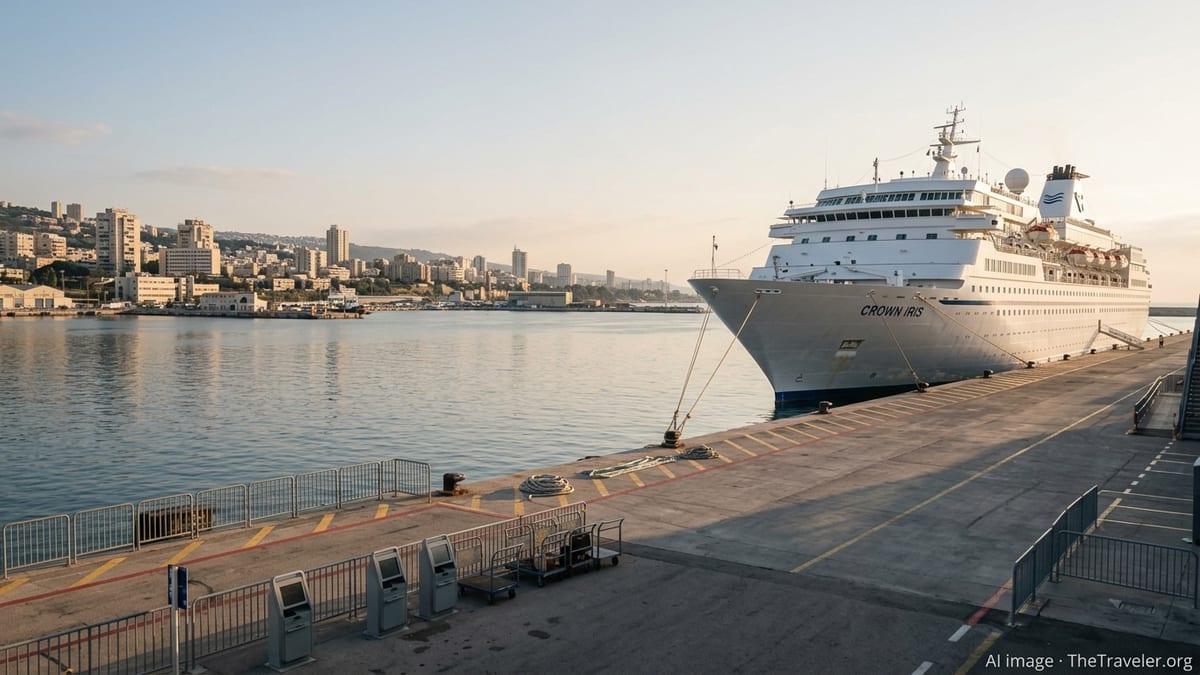
Extended Suspension Leaves Crown Iris Docked
Publicly available schedule data for Mano Cruises and its sole vessel, the Crown Iris, indicate that the company has withdrawn its published departures through at least April 2026, effectively sidelining the ship for multiple upcoming seasons. The Crown Iris, a mid-sized vessel that primarily serves the Eastern Mediterranean from its Haifa homeport, had only recently rebuilt its program after earlier pauses tied to regional tensions and market volatility.
Industry coverage of Mano’s past deployments shows a pattern of concentrated summer and shoulder-season itineraries focused on short-haul cruises from Israel to nearby ports. With the new wave of cancellations, those itineraries no longer appear in forward-looking deployment lists used by travel agencies and cruise-tracking platforms, suggesting a broad suspension rather than isolated sailing adjustments.
The move marks a stark reversal from Mano’s efforts to relaunch and expand operations in 2024 and 2025, when the Crown Iris returned to service following an earlier hiatus. Passengers who had booked far in advance are now reporting that their voyages have been removed from booking engines, prompting a rush to secure alternatives with larger international brands.
Travelers Scramble as Bookings Vanish
The decision has immediate implications for travelers who planned Eastern Mediterranean and regional itineraries built around Mano’s sailings. Many of the line’s customers are based in Israel and neighboring markets, where the Crown Iris has functioned as an accessible, homeport-based alternative to larger international ships calling only periodically at Haifa.
Online discussions among affected guests describe itineraries that simply disappeared from search results, with booking confirmations now referencing canceled voyages and pending refunds or future credits. Some travelers had coordinated multi-generational family trips or group tours around Mano’s short, three to seven night circuits, making last-minute rebooking more complex and often more expensive.
Travel agents specializing in regional cruises are now steering clients toward European and global operators that still list departures from nearby ports, though availability in peak months is already tight. For many, the loss of Mano’s sailings removes a convenient option that offered Hebrew-language service and itineraries tailored specifically to local vacation patterns.
Regional Risks and Fleet Economics Under Pressure
The extended cancellation window through April 2026 aligns with a broader pattern of cruise lines rethinking deployments across sensitive regions. Industry news over the past year has documented multiple brands trimming or abandoning schedules in the Eastern Mediterranean and Middle East, citing a mix of geopolitical risk, operational constraints, and insurance considerations that complicate calls at key ports.
For a single-ship operator such as Mano Cruises, these pressures can be magnified. Without a diversified fleet to redeploy, the company has fewer options to shift capacity toward more stable markets, making long-term suspension more likely when itineraries become difficult to sell or insure. Older tonnage like the Crown Iris also faces rising regulatory and maintenance requirements, which can tilt cost calculations against continued operation if ticket prices cannot keep pace.
Analysts following cruise capacity movements note that, across the industry, smaller regional brands are particularly vulnerable to shocks in demand or sudden cost increases. While global players can redirect ships to North America, Northern Europe, or Asia, regional lines often depend on a narrow geography and repeat clientele, leaving them with fewer levers to pull when conditions deteriorate.
Knock-On Effects for Ports and the Wider Cruise Network
Mano’s withdrawal through April 2026 is not only a setback for passengers, but also for ports that relied on regular calls by the Crown Iris. Haifa, which has been positioning itself as a growing hub for Eastern Mediterranean itineraries, loses a consistent stream of embarkation and turnaround traffic that supported local tourism and port services.
Peripheral ports that appeared regularly on Mano’s routes, such as nearby island and coastal destinations, will also feel the absence of scheduled calls. For many smaller destinations, regional operators like Mano fill scheduling gaps between visits from larger international ships, helping to smooth seasonality and provide more predictable business to local excursion providers, restaurants, and transport companies.
The disruption feeds into a wider reshaping of cruise deployment worldwide, as cruise lines recalibrate routes to factor in everything from regional tensions to shipyard backlogs. Recent seasons have already seen redrawn winter programs in the Gulf, revised itineraries around the Red Sea, and altered plans for ports deemed operationally challenging, underlining how interconnected cruise networks have become.
Broader Cruise Market Faces a Cycle of Cancellations
Mano’s extended pause arrives in what observers describe as a multi-year cycle of cruise cancellations and redeployments. Across the sector, published coverage has chronicled major brands pulling entire seasons from select regions, canceling voyages years in advance to accommodate maintenance, or reshaping deployment strategies around emerging markets and more profitable homeports.
For consumers, the practical outcome is a landscape in which itineraries that once appeared stable two or three years ahead can become fluid with little warning. The widespread use of dynamic deployment tools and long-range booking engines means that travelers often see changes play out in real time, with sailings vanishing from websites or being replaced by repositioning voyages and alternative routes.
As Mano Cruises remains off the market through April 2026, travelers with their sights on the Eastern Mediterranean are being encouraged by travel professionals to secure backup plans, monitor booking systems regularly, and pay close attention to fare rules and cancellation terms. With cruise lines of all sizes continuing to adjust schedules in response to economic, operational, and geopolitical factors, flexibility is becoming a key part of planning any voyage, whether on a regional player like Mano or a global brand.