

More news on this day
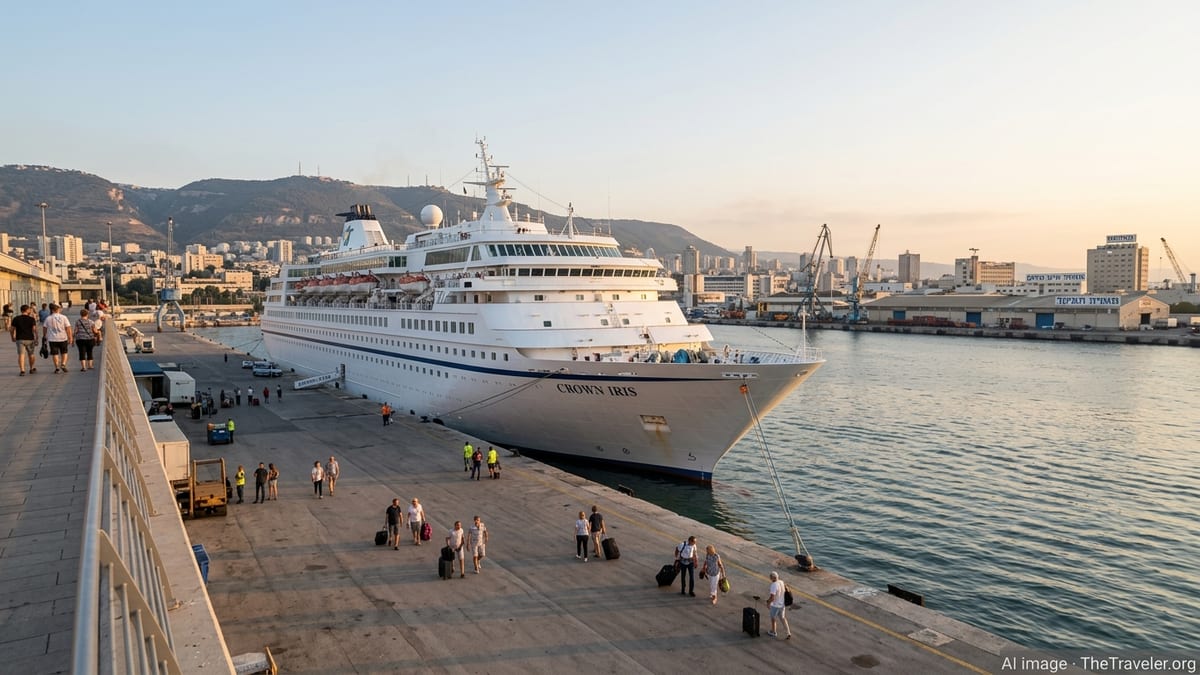
Israeli operator Mano Cruises has suspended upcoming voyages of its flagship Crown Iris in response to heightened instability across the Middle East, while signaling plans to restart Eastern Mediterranean sailings from April 2026 in a move framed as a test of cruise tourism’s resilience in and around Israel.
Get the latest news straight to your inbox!
Cancellations Reflect a Volatile Regional Security Picture
Publicly available information from regional travel advisories and cruise deployment data indicates that Mano Cruises has canceled near-term Crown Iris departures linked to fluctuating security conditions in the wider Middle East. While Israel’s northern ports on the Mediterranean have remained operational, risk assessments tied to broader regional tensions and episodic disruptions to maritime traffic have made medium-range itinerary planning increasingly complex for operators homeporting in Israel.
Industry coverage of recent months has highlighted how changing threat levels, shifting guidance for Israeli travelers, and concerns about potential spillover from conflicts in nearby maritime corridors have added new layers of uncertainty for cruise planning. For Mano Cruises, whose core product relies on regular circuits between Haifa, Cyprus, and Greek islands, the decision to halt scheduled Crown Iris sailings underscores the degree to which even relatively short Eastern Mediterranean routes are exposed to wider Middle East dynamics.
Travel analysts note that cruise line schedule adjustments often lag fast-moving geopolitical developments, but patterns since 2024 show increasingly proactive cancellations and redeployments when risk indicators rise. In that context, the pause in Crown Iris departures is broadly consistent with a wider industry shift toward conservative operational planning in sensitive regions, even where ports themselves remain open.
New Timetable Targets April 2026 for Restart
Against this backdrop, Mano Cruises is positioning April 2026 as a tentative restart window for Crown Iris itineraries originating in Israel. Forward-looking cruise schedules for key ports in Cyprus and Greece list Crown Iris calls from the second quarter of 2026, suggesting that the line is preparing to reintroduce its traditional Eastern Mediterranean routes once regional conditions are assessed as more stable.
Scheduling Crown Iris back into port calendars more than a year ahead reflects a degree of confidence that risk levels will moderate sufficiently to support renewed operations. It also signals that Mano Cruises intends to maintain its identity as an Israel-based regional cruise brand, rather than permanently withdrawing capacity or shifting the vessel away from its home market.
Travel trade reporting indicates that the planned April 2026 return would likely prioritize familiar itineraries such as short-haul circuits from Haifa to Limassol and select Aegean islands, formats that proved popular before the current round of tensions. By focusing first on routes and ports with established operational relationships, the company appears to be aiming for a controlled, incremental relaunch rather than an aggressive expansion.
Crown Iris as a Symbol of Israel’s Cruise Ambitions
The Crown Iris holds particular significance within Israel’s cruise landscape. The 1990s-built vessel, acquired by Mano Maritime in 2018, has served as the backbone of the company’s leisure operation, marketed domestically as a floating resort offering easy access to nearby Mediterranean destinations. Its consistent presence in Haifa has given Israeli travelers a locally based alternative to fly-cruise options from European gateways.
Beyond tourism, the ship has also been repurposed at moments of crisis, including voyages assisting Israelis stranded abroad when air links were curtailed. Coverage of these operations has reinforced Crown Iris as a recognizable national maritime asset, visible both in times of normal holiday travel and during emergencies. That dual role helps explain why its withdrawal from regular itineraries attracts outsized attention within Israel’s travel sector.
The planned reactivation of Crown Iris from April 2026 therefore carries strategic weight beyond a standard seasonal deployment. For Mano Cruises, returning its flagship to regular service from an Israeli port represents a statement of long-term commitment to the country’s outbound cruise market at a time when some global lines have reduced calls to the region.
Regional Protests and Operational Challenges in Greek Ports
Even before the latest cancellations, Crown Iris itineraries had been affected by political protests in several Mediterranean ports. News reports from 2025 describe instances in which pro-Palestinian demonstrators gathered at Greek island terminals, blocking access roads and staging rallies timed to coincide with the ship’s arrival. In some cases, passengers were unable to disembark, and port calls were curtailed or skipped altogether as a precaution.
Accounts from these incidents illustrate how localized activism can ripple through cruise operations. While the protests were concentrated onshore and directed at broader political developments, they created practical obstacles to the smooth handling of thousands of passengers on tight turnaround schedules. For cruise operators, this kind of disruption introduces additional uncertainty even in ports far removed from active conflict zones.
Maritime and tourism observers point out that the experience of Crown Iris in Greek ports has become a case study in how geopolitical issues can intersect with tourism flows. The combination of heightened regional sensitivities, local demonstrations, and evolving official guidance has required Mano Cruises to adapt itineraries in real time, occasionally substituting alternative ports such as Limassol when security assessments called for changes.
Resilience and Future Prospects for Cruise Tourism in Israel
Despite current suspensions, indicators from port booking schedules, travel trade reporting, and government tourism strategies suggest that stakeholders expect cruise activity linked to Israel to recover over the medium term. Mano Cruises’ decision to plan for Crown Iris sailings from April 2026 aligns with a broader assumption that demand for Eastern Mediterranean cruising will rebound once travelers perceive the region as more predictable.
Israel’s role as a turnaround hub for regional cruises is supported by several structural advantages, including established air connectivity, port infrastructure in Haifa and Ashdod, and a domestic market that has shown strong appetite for short regional voyages in recent years. These fundamentals appear to underpin Mano Cruises’ calculus that a restart anchored in Israel will ultimately prove commercially viable.
At the same time, the experience of repeated protests, rerouted sailings, and calendar cancellations has underlined the necessity of flexible planning. Industry observers expect Israeli-linked cruise operations to build in greater contingency capacity, from alternative port options to dynamic itinerary design that can respond swiftly to security and political developments.
For now, travelers eyeing a future voyage on Crown Iris will be watching for further updates as April 2026 approaches. The eventual return of the ship to regular service from Israel would mark not only a milestone for Mano Cruises, but also a broader indicator of how quickly cruise tourism in the Eastern Mediterranean can adapt to and recover from an extended period of regional volatility.