

More news on this day
After more than a decade of silence on its 2,748-metre runway, Manston Airport in Kent is edging closer to a 2029 relaunch as a dedicated air freight hub, with potential to restore limited tourist traffic to one of England’s most overlooked coastal corners.
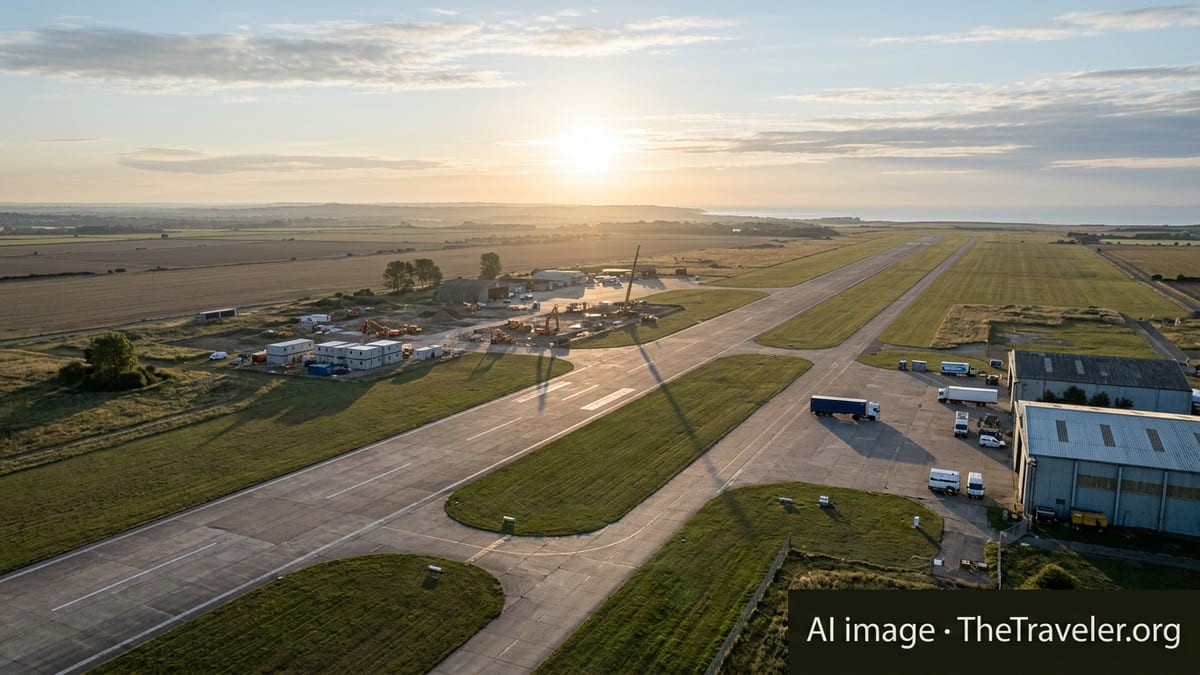
A Former RAF Giant Poised for a New Role
Manston Airport, which closed to commercial traffic in 2014, has long occupied an outsized place in the story of British aviation. Once an RAF base and later branded Kent International and briefly London Manston, the airfield handled a mix of cargo and short-haul passenger services before mounting losses forced its shutdown. Its unusually long runway, coastal location and proximity to Dover and the Channel Tunnel have since kept it at the heart of a heated debate about how best to use one of southeast England’s largest pieces of aviation infrastructure.
The latest plans, backed by RiverOak Strategic Partners, now envisage Manston’s rebirth primarily as an international cargo gateway rather than a traditional passenger airport. The company argues that diverting freight away from congested London hubs will free up runway capacity elsewhere while creating a specialist logistics platform in east Kent. Aviation observers note that the focus on time-sensitive and outsized cargo reflects broader industry trends, with e-commerce and just-in-time supply chains driving demand for specialised airfreight facilities.
Although the blueprint is cargo-led, supporters of the project insist that the site’s scale and history give it long-term potential for a measured return of holidaymakers. Prior to closure, Manston hosted a daily KLM link to Amsterdam alongside charter services to European sun destinations, and local tourism businesses in Thanet and along the Kent coast are watching closely for any commitment to bring back similar routes.
Legal Green Light and a Revised Timetable
For years, Manston’s future was clouded by overlapping legal challenges and political scrutiny. That uncertainty has eased following a series of court decisions upholding the government’s Development Consent Order for the airport’s redevelopment and dismissing attempts to overturn it. With the legal route largely cleared, attention has shifted from whether Manston can reopen to how and when it will do so.
RiverOak now expects the airport to begin operations in 2029, a later date than earlier projections. Company representatives have confirmed that rising construction costs and the complexity of regulatory approvals have pushed back the original timeline. The new schedule allows for a multi-year build-out of cargo handling facilities, airfield upgrades and support infrastructure that will be required to compete with established logistics hubs in the South East.
Before any aircraft return, the developer must complete a detailed airspace change process with the UK Civil Aviation Authority. A statutory consultation on the proposed airspace design is due to run from mid-March to late June 2026, giving residents, airlines and industry stakeholders the opportunity to scrutinise flight paths, noise contours and operational assumptions. That consultation will be a critical test of community sentiment in Thanet, where opinions on Manston’s revival remain sharply divided.
Assuming a smooth regulatory path, construction on the main airport masterplan is anticipated to begin from early 2027, followed by a phased commissioning of facilities and eventual aerodrome certification. Only then will the first freighters be cleared to land, marking the airport’s full return to the UK aviation network roughly 15 years after closure.
A Freight-Focused Vision With Space for Passengers
The relaunch strategy being advanced for Manston places specialist freight operations at its core. RiverOak’s plan emphasises handling express parcels, temperature-sensitive goods, automotive and motorsport cargo, live animals and outsized shipments that are difficult to accommodate at capacity-constrained London airports. The developers say this niche focus leverages Manston’s runway length, uncongested airspace and direct access to key cross-Channel routes.
Behind the freight-first logic lies a broader effort to reposition Kent as a logistics and manufacturing corridor linked to the nearby Port of Dover and Eurotunnel terminal. By clustering high-value cargo operations around Manston and connecting them to road and rail upgrades, regional planners hope to attract new investment and spread economic benefits beyond traditional commuter belts closer to London.
Passenger services, if they return, are expected to follow rather than lead. Informal interest from low-cost carriers has surfaced over the years, particularly around early-morning slots that are hard to secure at London’s main airports, but no commitments have been announced. Industry analysts suggest that any future tourism offer is likely to centre on short-haul, point-to-point services to European cities and holiday islands rather than a full-service hub model.
For Kent’s visitor economy, even a modest schedule of seasonal flights could prove significant. Easier air access would complement existing rail links, offering new ways for travellers to reach the beaches of Thanet, the historic streets of Canterbury and the vineyards and walking routes that have helped redefine the county’s image in recent years.
Local Hopes, Fears and the Promise of Jobs
On the ground in Thanet, Manston’s proposed comeback has stirred a mix of anticipation and anxiety. Supporters point to projections of thousands of direct and indirect jobs across aviation, warehousing, maintenance and support services, in a district that continues to wrestle with pockets of deep deprivation and seasonal employment patterns tied to tourism.
Several local businesses, from logistics firms to hospitality operators, have publicly welcomed the prospect of a working airport bringing new customers and spending power to the area. Some hoteliers and attraction managers see an opportunity to position east Kent as a twin leisure and business destination, capitalising on its coastal setting and fast connections to London and mainland Europe.
Opponents, however, remain unconvinced. Community groups and environmental campaigners have long questioned the robustness of the project’s economic forecasts and raised concerns about aircraft noise, air quality and carbon emissions from a freight-heavy operation. They argue that the same land could be better used for housing, light industry or green energy projects more closely aligned with the UK’s climate commitments.
The upcoming airspace consultation and subsequent planning milestones will provide new forums for these debates to play out. Local authorities and residents will be looking for detailed answers on noise mitigations, night-flight policies, emissions controls and the scale of lorry movements to and from the cargo terminal, all of which will shape Manston’s relationship with its neighbours.
Connectivity, Tourism Potential and the Wider Kent Landscape
As aviation rules tighten and long-haul capacity at London’s airports remains constrained, Manston’s supporters see an opportunity for the Kent site to help rebalance air traffic in the southeast. Proximity to ferry and rail crossings positions the airport as a potential bridge between European supply chains and the UK’s consumer markets, while upgrades to regional road links could ease the movement of goods across the country.
For travellers, Manston’s revival could fold into a broader reshaping of transport across east Kent. The opening of Thanet Parkway station has already shortened rail journeys into London, and any future shuttle links between the station and the airport would create a more seamless experience for both freight workers and, eventually, passengers. Tourism bodies are watching closely for signs that airlines or tour operators might incorporate Manston into packages focused on coastal breaks, heritage tours and food and wine itineraries.
In the meantime, the dormant airfield has remained a physical and symbolic presence on the Isle of Thanet, hosting community events and, at times, emergency logistics and other temporary uses. Its planned transition into a modern cargo hub marks a significant chapter not only for local aviation history but also for how regional England adapts under pressure from shifting trade patterns and environmental expectations.
Whether Manston ultimately becomes known primarily as a workhorse freight platform or can also carve out a sustainable niche for tourist travel, its long-awaited return to active service is set to reshape both the skyline and the economic story of this corner of Kent.