

Many international visitors still assume that getting around Mexico means a choice between buses, flights and rental cars. Yet over the last few years, the country has quietly been rebuilding a national culture of passenger rail, from new intercity lines to ambitious tourist routes. For travelers willing to look beyond the well-worn highway and airport hubs, trains in Mexico now offer an alternative way to move, see the landscape and experience the country at a different pace.
Why So Few Visitors Think of Trains in Mexico
For decades, Mexico’s long-distance passenger rail network was largely dismantled as freight operations took priority and highways expanded. As a result, generations of travelers grew up without seeing trains as a realistic option for getting around the country. Guidebooks focused on excellent long-distance buses and low-cost domestic flights, and many foreign visitors arrived assuming that Mexico simply did not have passenger trains at all.
That impression lingers even as the situation changes. Outside rail enthusiasts and a handful of domestic commuters, most tourists planning a Mexican itinerary today rarely search for train routes the way they might for a trip in Europe or Japan. Travel searches and booking platforms often highlight flights and buses first, while rail options are either absent or buried in local-language sites. The result is a perception gap: visitor expectations have not yet caught up with new rail projects that are already in service.
Language can be another subtle barrier. Key information about Mexican trains is often presented in Spanish first, and automated translation does not always clarify timetables, onboard classes or booking rules. Many travelers conclude, incorrectly, that services are either not running yet or restricted to locals. In reality, most of the new lines are designed expressly to serve a mix of residents, commuters and tourists, and they are generally straightforward to use with a bit of advance research.
Finally, media coverage outside Mexico tends to focus on infrastructure controversies or political debate rather than the practicalities of riding these trains. That can obscure details such as operating sections, safety standards and how the trains integrate with airports, city metros and bus networks. Visitors who could benefit most from rail often never hear how the services actually work on the ground.
Tren Maya: The New Backbone of Rail Tourism in the Southeast
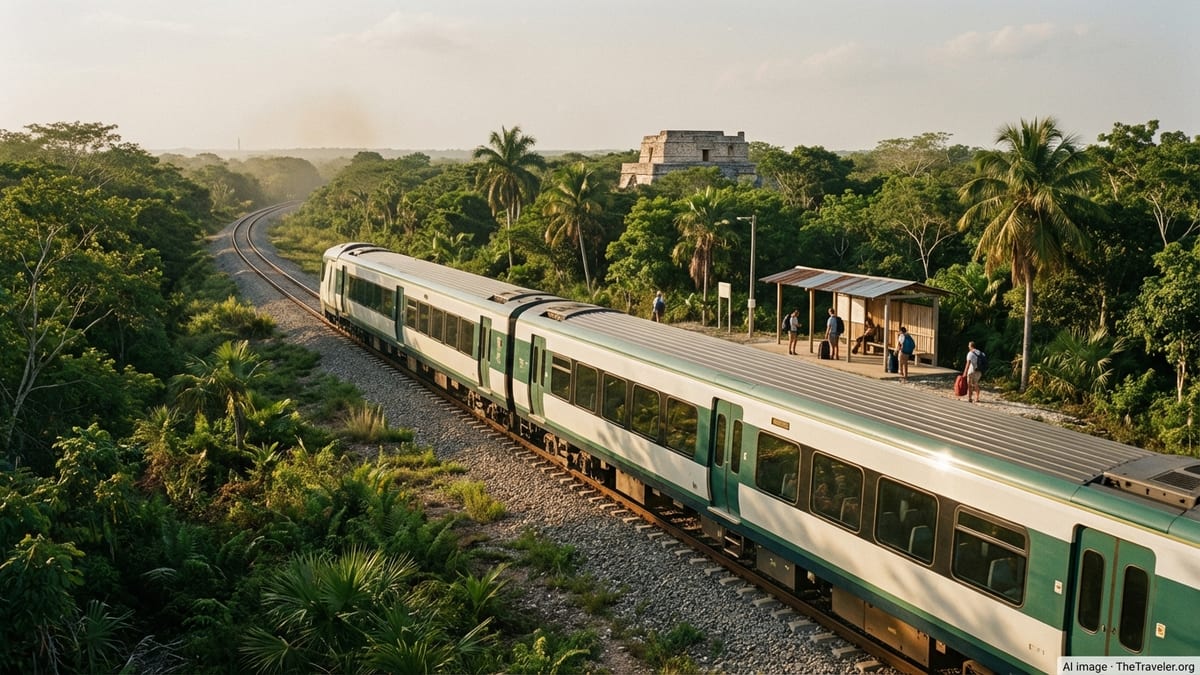
The highest-profile example of Mexico’s rail revival is Tren Maya, a large-scale passenger network designed to connect major destinations across the Yucatán Peninsula and the country’s southeast. Launched in stages beginning in December 2023, the system uses modern multiple-unit trains built by Alstom specifically for this route. Services now link key hubs in Quintana Roo, Yucatán, Campeche, Tabasco and Chiapas along more than 1,500 kilometers of track, with a growing number of stations tied directly to tourist zones and archaeological sites.
Tren Maya operates several train types, each tailored to different trip styles. Some focus on daytime point-to-point travel with wide windows and luggage space, while others are configured for dining or longer overnight segments with cabins and showers. The design incorporates large panoramic windows and interior layouts that emphasize comfort as well as accessibility, reflecting the government’s goal of creating a flagship rail experience for both visitors and residents.
For travelers, the appeal is straightforward. Tren Maya provides a way to move between resort areas such as Cancún, Playa del Carmen and Tulum and cultural centers like Mérida or Campeche without relying entirely on highways crowded with private vehicles and long-distance buses. Along the route, stations connect with protected natural areas, coastal communities and major Maya archaeological zones. The goal is to spread tourism more evenly, encourage longer stays and give visitors exposure to inland towns that were previously harder to reach without a rental car.
It is important, however, to approach the route with realistic expectations. Some sections and stations are still being refined, schedules can evolve as new segments open or are adjusted, and demand on certain holiday periods can be high. Travelers should build some flexibility into their plans, verify current timetables and consider pairing Tren Maya segments with local buses or transfers arranged through reputable hotels and tour operators.
Urban and Suburban Rail: Trains Around Mexico City and Beyond
Mexico’s capital region has been at the forefront of bringing trains back into everyday passenger life. The headline example is El Insurgente, the interurban rail line linking Toluca in the State of Mexico with Mexico City. Opened in stages from 2023 and completed in early 2026, it now offers a fast, electrified connection between the western outskirts and the capital’s Observatorio transport hub, with trains running frequently throughout the day.
For visitors, El Insurgente functions both as a practical commuter line and as an entry point into the region’s rail system. It can be a convenient way to access Toluca and nearby highland towns, or to experience how modern Mexican trains are being woven into the public transport network. The line connects directly with the Mexico City Metro at Observatorio, and services are designed to be regular enough for day trips rather than requiring long-term planning.
Another important, if less publicized, piece of the puzzle is the Tren Suburbano, a commuter rail service that runs north from central Mexico City into the State of Mexico. It has long served workers commuting into the capital, and expansion plans include a branch to Felipe Ángeles International Airport. When that extension opens, it is expected to provide a straightforward train connection between a major airport and the city’s wider transport network, changing how some travelers approach arrival and departure logistics.
Elsewhere, regional projects are emerging that blend bus rapid transit concepts with rail-style operations. The Campeche Light Train, for example, is technically an autonomous guided bus system rather than a steel-wheel railway, but it is designed to function like a tram or light rail line between Campeche’s historic center, its airport and its Tren Maya station. For a visitor, the distinction matters less than the outcome: a fixed, legible, rail-like corridor that simplifies transfers and makes car-free travel more realistic.
Corridor Projects and the Return of Long-Distance Passenger Routes
Beyond the southeast and the capital region, Mexico is in the early stages of rebuilding a lattice of long-distance passenger corridors. One significant step is the rehabilitation of lines in the Isthmus of Tehuantepec, where the government has revived the Tren Interoceánico linking the Gulf of Mexico and the Pacific. Line K of this system, connecting Ixtepec in Oaxaca with Ciudad Hidalgo in Chiapas, has been opened in stages to passenger service, with further extensions planned. While primarily a regional and development initiative, it offers travelers a rare overland rail link across the country’s far south.
Further north, policy announcements point to a broader vision. Authorities have laid out plans for new passenger routes radiating from Mexico City, including a train toward Pachuca, plus longer intercity lines to Nuevo Laredo and Nogales that would eventually create rail connections toward the United States border regions. Construction has begun on some segments, and contracts for new rolling stock, such as diesel multiple units for northern corridors, have been signed with major manufacturers. These projects are long term and subject to change, but they signal a clear shift back toward rail as a national priority.
For international travelers thinking a few years ahead, that matters. If current timelines hold, by the late 2020s Mexico could have several additional intercity passenger routes connecting central, northern and border states. Even before they are complete, construction phases often bring incremental improvements, such as upgraded stations, safer level crossings and better integration between different modes of public transport. Travelers exploring regions like Bajío, the northeast or the northwest should watch for news of pilot services, test runs and partial openings that may not yet be widely publicized in English.
These long-distance initiatives complement, rather than replace, Mexico’s extensive bus system. In many cases, rail corridors mirror major highways and bus routes, offering an additional option along the same axis. The result, over time, is likely to be a mixed ecosystem where travelers can choose trains for some segments, buses for others and flights where distances remain very long. The key is knowing that rail is returning as one of the available choices.
Tourist and Scenic Trains: Beyond Pure Transportation
Not all of Mexico’s trains are designed primarily for point-to-point mobility. The country has a tradition of scenic and tourist-oriented rail experiences that place as much emphasis on the journey as on the destination. These operations can be an excellent introduction to Mexican rail for visitors who might be hesitant to rely on trains for their entire itinerary but are curious to sample the experience in a controlled, curated setting.
The best-known example historically has been the Copper Canyon train in northern Mexico, a route that threads through dramatic canyons and mountain landscapes. While branding, rolling stock and schedules have evolved over the years, the essence of the experience has remained the same: slow, panoramic travel through remote terrain that would otherwise require long, winding drives. Cars are typically configured to maximize views and offer onboard services beyond a basic seat, contributing to the sense of a rail journey as a trip in its own right.
Elsewhere, shorter heritage or tourist trains operate in selected regions, often tied to festivals, historic towns or specific attractions such as agave landscapes or colonial centers. These services may run seasonally or only on certain days of the week, and they can be difficult to spot from abroad if one relies solely on major booking platforms. Local tourism boards and hotel concierges are often valuable sources of information about when these trains run and how to book them.
For visitors, the value of these tourist trains is twofold. Practically, they offer comfortable, camera-friendly ways to reach outlying areas without driving. Experientially, they put travelers in direct contact with landscapes, villages and small-town stations that might otherwise glide past unseen from a highway. Even a half-day excursion by train can shift one’s sense of Mexico’s geography and scale, underscoring how varied the country is beyond its major resort corridors.
How to Plan a Trip Using Trains in Mexico
Successfully incorporating trains into a Mexican itinerary requires a bit more planning than in countries where rail has been dominant for decades, but the core steps are straightforward. The first task is to identify which segments of your route are realistically served by passenger rail today, and which are better left to buses or flights. As of early 2026, the most fully developed options for visitors include Tren Maya in the southeast, El Insurgente and Tren Suburbano around Mexico City, the guided light train in Campeche, and selected scenic or tourist services like the Copper Canyon route.
Once you have a sense of where trains fit, look up official operators or government-backed information portals for schedules and fares. Because the system is still evolving, timetables are more likely to change than on long-established networks, especially when new sections open or seasonal demand shifts. It is wise to recheck times shortly before travel, and to allow generous connection buffers, particularly when linking trains with flights or long-distance buses.
Booking practices vary. Some services offer online sales portals and digital tickets, while others still rely on station counters, authorized agencies or hotel partners. International credit cards are usually accepted on major flagship lines, but not universally so on smaller or regional operations. Travelers should also be prepared for boarding procedures that may include luggage screening, ID checks or seat assignments, especially on state-run routes that combine tourism with strategic infrastructure roles.
As with any form of travel, flexibility helps. Delays, weather disruptions and occasional service adjustments are possible, and backup plans using buses or shared transfers are worth having. Treat the rail portion of your trip as a highlight rather than a fragile linchpin, and you will be better positioned to enjoy the experience without anxiety if conditions change.
What Train Travel in Mexico Feels Like on the Ground
For visitors accustomed to rail in Europe or East Asia, Mexican trains can feel both familiar and distinct. On newer lines such as Tren Maya and El Insurgente, the onboard environment is recognizably modern: air-conditioned cars, clear signage, accessible seating areas and a mix of local and international passengers. Large windows frame views of jungle, highlands or suburban landscapes, and the ride quality is generally smooth, reflecting recent investment in track and rolling stock.
The atmosphere onboard often has a social dimension. Families, students, commuters and tourists share cars, and conversations flow in Spanish with occasional bursts of other languages in more touristed sections. Informal etiquette tends to be relaxed but respectful, with travelers keeping luggage close and often carrying snacks or small meals for longer journeys. On tourist-oriented trains, staff may offer commentary, local tips or curated food and beverage options that highlight regional specialties.
Station environments vary widely. At major hubs in Mexico City or along the Caribbean coast, passengers can expect modern terminals with security screening, ticket counters, restrooms and sometimes food courts or small shops. At smaller or newly opened stations, facilities may be simpler, and last-mile connections might involve taxis, rideshares or local buses rather than integrated transit. This is where advance research is especially valuable: understanding what awaits at each end of a train journey can prevent unpleasant surprises, particularly at night or in poor weather.
Safety perceptions are a common concern for visitors, especially given headlines about migration on freight trains in past years. It is important to distinguish between unauthorized travel on cargo trains and the regulated passenger services aimed at tourists and residents. Official passenger lines have controlled access, ticketed boarding and routine security measures. As with any travel in Mexico, situational awareness and standard precautions apply, but for most visitors who stick to official services, train travel can feel organized and predictable.
The Takeaway
Mexico is not yet a rail-centric country in the way that some European or Asian nations are, and it may never abandon its deep reliance on highways and buses. Yet the last few years have changed the landscape enough that visitors who ignore trains entirely risk missing both practical options and memorable experiences. With projects like Tren Maya reshaping the southeast, El Insurgente knitting Toluca more tightly to Mexico City, and new corridors taking shape across the isthmus and toward the north, rail is once again part of the story of moving through Mexico.
For travelers, the key is awareness. Before defaulting to a domestic flight or overnight bus, it is worth asking whether a train now runs along part of your route, or whether a scenic or regional service might enhance a segment of your journey. Doing so may add a layer of planning, but it can also reveal landscapes, communities and conversations that would be harder to find from a highway shoulder or airplane window.
As Mexico’s rail renaissance continues, the most rewarding itineraries will likely be those that treat trains not as novelties but as integral threads in a broader tapestry of mobility. Combined thoughtfully with buses, metros, taxis and walking, they can help visitors experience the country’s vast scale and diversity with a little more calm and a lot more connection. For now, simply knowing that these train options exist is the first step toward traveling the country in a richer, more nuanced way.
FAQ
Q1. Do passenger trains in Mexico actually operate, or are they just future plans?
Yes, several passenger trains already operate, including Tren Maya in the southeast, El Insurgente between Toluca and Mexico City, the Tren Suburbano in the capital region, and selected tourist and regional services. Additional intercity routes are under construction or in planning stages.
Q2. Is Tren Maya fully open and easy for foreign visitors to use?
Tren Maya has opened substantial sections and continues to refine operations. Foreign visitors can generally buy tickets, choose from different service classes and board with passports as identification, but they should always verify current routes, schedules and booking procedures before travel.
Q3. How safe is it to travel by train in Mexico as a tourist?
On official passenger services, safety standards are comparable to other forms of regulated public transport in Mexico, with ticketed entry, basic security checks and staff on board. Travelers should follow normal precautions, avoid unauthorized freight trains and stay informed about local conditions, especially in remote areas.
Q4. Can I rely on trains to cover an entire trip around Mexico?
Not yet. Trains are best seen as one component of a wider transport mix that still includes buses, domestic flights and local transit. In some regions, such as the Yucatán Peninsula or the Mexico City area, they can cover key segments, but many corridors remain bus or car dependent.
Q5. How do train ticket prices compare with buses and flights?
Fares on Mexican trains vary by route and class, but they are generally positioned to be competitive with midrange bus services on similar distances. Budget airlines may be cheaper on some longer routes, while trains can offer better value when you factor in comfort, scenery and city-center to city-center convenience.
Q6. Do Mexican trains offer different classes and onboard services?
Yes. Newer trains often have multiple seating classes, luggage areas and in some cases dining or café cars. Tourist-oriented services may offer panoramic windows, commentary and regional food, while commuter and suburban lines focus more on frequent, no-frills transport.
Q7. How far in advance should I book train tickets in Mexico?
Advance booking is advisable for popular tourist routes and holiday periods, when demand can spike. For commuter and suburban services around Mexico City, tickets are often purchased on the day of travel. Because timetables and booking systems can change, it is wise to check close to your travel dates.
Q8. Are Mexican train stations well connected to local transport?
Major stations in cities like Mexico City, Cancún and Mérida tend to have good links with metros, buses, taxis or rideshares. Smaller stations may offer only basic onward options, so researching last-mile connections in advance, and arriving in daylight when possible, is recommended.
Q9. Can I bring large luggage or sports equipment on trains in Mexico?
Most long-distance and tourist trains accept typical suitcases and backpacks, with overhead racks or dedicated luggage spaces. Oversized items, such as bicycles or surfboards, may be restricted to certain services or require special handling, so travelers should confirm policies with the operator beforehand.
Q10. Will train options in Mexico expand significantly in the next few years?
Government plans and recent contracts suggest that passenger rail will continue to expand, particularly around Mexico City, in the southeast and along selected northern corridors. Timelines can shift, but travelers can reasonably expect more rail choices to appear over the second half of the 2020s.