

More news on this day
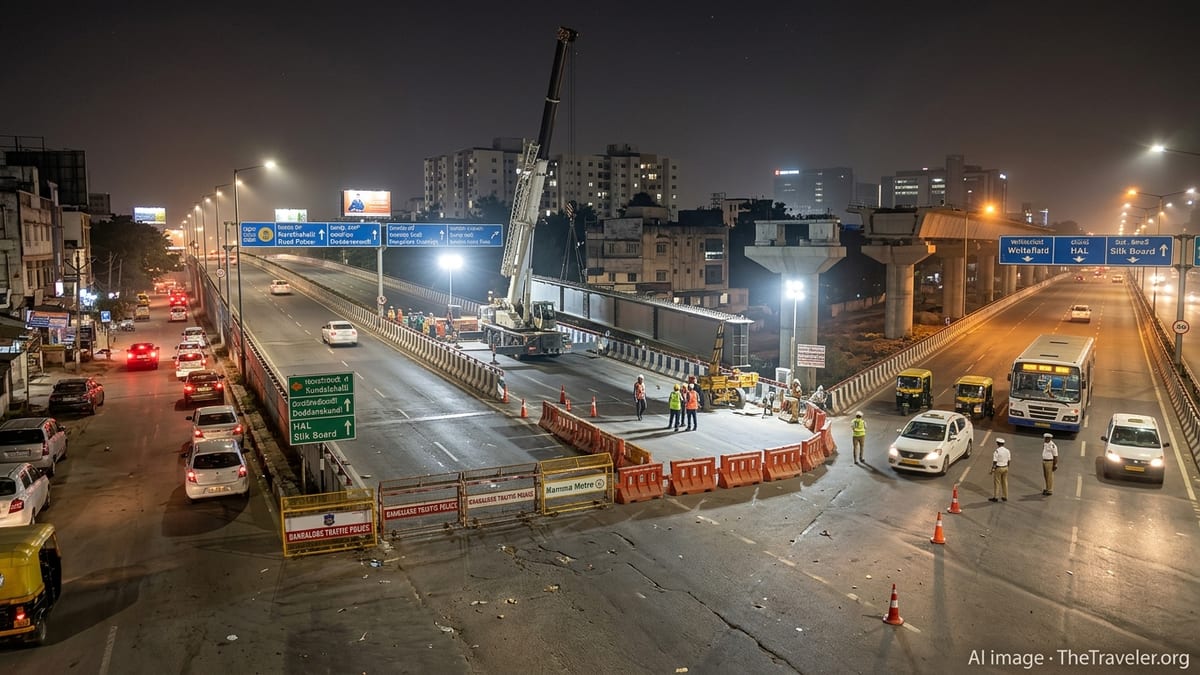
Traffic patterns around one of Bengaluru’s busiest choke points are being reshaped for three nights as vehicle movement over the Marathahalli bridge is halted to facilitate metro construction, prompting diversions along key approach roads and the Outer Ring Road corridor.
Get the latest news straight to your inbox!
Three-Night Closure at Crucial ORR Junction
Publicly available traffic advisories indicate that the Marathahalli bridge in east Bengaluru is being closed to vehicular movement during the night for three consecutive days, from Friday, March 27, to Sunday, March 29. The halt in traffic is understood to apply primarily to late-night hours, allowing contractors to carry out a critical phase of work linked to the upcoming Blue Line of Namma Metro.
The affected junction lies on the Outer Ring Road, a core connector for technology parks and residential neighbourhoods stretching between Hebbal in the north and Silk Board in the south. The bridge serves as a key crossing between the Kundalahalli and HAL corridors and has long been regarded by commuters as one of the most heavily congested bottlenecks in the city.
Reports circulating in local media and commuter forums suggest that the temporary shutdown is aimed at enabling safe installation of major structural components, including a large composite girder segment associated with the future Marathahalli metro station. Night-time working windows have been chosen to reduce disruption to peak-hour traffic while still advancing construction on a line that is expected to become operational in the second half of 2026.
While the closure is short in duration, it comes at a time when many arterial and service roads along the ORR and adjoining stretches are already under pressure from ongoing infrastructure work, raising concern among road users about cumulative delays and corridor-wide congestion.
Diversions for Traffic from HAL, Varthur and Whitefield
According to diversion details shared through local traffic updates, vehicles approaching Marathahalli from multiple directions are being rerouted onto parallel corridors during the closure period. Motorists travelling from the HAL side towards Kundalahalli are being guided to turn left at the Doddanekundi junction and continue through Karthik Nagar and the Alpine Eco Road to rejoin the main route near Kundalahalli Signal.
Traffic approaching from Varthur towards the bridge is being advised to divert at the Kundalahalli Signal and follow the Alpine Eco Road through Doddanekundi before regaining access to the HAL side. Alternative guidance circulating among commuters also highlights the option of using the Vibgyor School road and proceeding via Kadubeesanahalli junction for those continuing towards Silk Board and southern segments of the ORR.
The stretch between Kundalahalli Signal Junction and Doddanekundi Junction, a crucial link serving residential clusters and the IT corridor, is listed as directly impacted by the works. During the closure window, vehicles that would ordinarily pass over the Marathahalli bridge are instead pushed onto local streets that already carry heavy daily volumes, heightening the risk of slow-moving queues in Karthik Nagar, AECS Layout and adjacent micro-markets.
Commuter commentary on public platforms underscores the importance of checking timings carefully. Several posts emphasise that the bridge restrictions are concentrated roughly between midnight and the early hours of the morning, and that daytime cross-traffic over the structure remains largely open. Despite this, some travellers working late shifts or returning from the airport and tech parks are still expected to encounter delays and sudden route changes.
Metro Blue Line Push Brings Short-Term Pain
The closure is part of a broader acceleration of work on the Blue Line of Namma Metro, which will run along the Outer Ring Road before connecting to the airport corridor. Official project documents and background briefings describe the stretch around Marathahalli as especially complex due to dense development, multiple existing flyovers and the need to insert new elevated infrastructure above live traffic.
Marathahalli and nearby Doddanekundi, Kadubeesanahalli and Bellandur stations are all listed as elevated facilities along this section of the line. Environmental and traffic assessments prepared for the project have long warned of temporary congestion at junctions such as Marathahalli and ISRO Layout as barricading, girder launches and foundation works narrow available carriageway space.
To limit daytime disruption, much of the heaviest activity, including launching of large span girders, is scheduled during late-night windows when normal traffic flows drop. The present three-night bridge closure fits that pattern, allowing engineers to handle oversized components and lifting operations under controlled conditions without continuous cross-traffic.
The Blue Line is projected, in published timelines, to open around late 2026, promising a high-capacity link through one of India’s busiest office corridors. Until then, commuters on the ORR are expected to navigate a rolling sequence of partial closures, diversions and lane restrictions as work proceeds segment by segment.
Commuter Response and Travel Strategies
The announcement of the Marathahalli bridge closure has drawn strong reactions from regular users who rely on the junction to commute between Whitefield, Mahadevapura, Marathahalli, Bellandur and HSR Layout. Social media threads and neighbourhood groups show a mix of anxiety over potential gridlock and cautious optimism that compressed night-time shutdowns will, in the long run, speed up project completion.
In the short term, many office-goers and shift workers appear to be rescheduling late-night movements or switching to alternate corridors such as the Varthur main road, the Kadubeesanahalli junction link, or interior neighbourhood roads that loop around AECS Layout and Karthik Nagar. A recurring piece of advice among local commuters is to avoid experimental shortcuts and instead follow signposted diversions, as some side roads near construction zones are narrowed or intermittently blocked.
App-based navigation services may not yet fully reflect the overnight closures, prompting some residents to recommend checking local traffic police bulletins and real-time congestion maps before starting late-night trips. There is also growing interest in park-and-ride strategies around currently operational metro lines, particularly for those who can combine early-evening train travel with short last-mile rides instead of driving the full ORR stretch.
For businesses operating late shifts in technology parks around the ORR, the three-night closure is prompting closer coordination of staff transport and cab pick-up timings. Some published commentary suggests that where possible, work-from-home options and flexible shift starts are being used to decrease the number of vehicles on the road in the affected window.
What Travelers Should Know Over the Next Few Days
For both local residents and visitors passing through Bengaluru’s eastern suburbs between March 27 and March 29, the key message from publicly available information is to plan ahead and assume that normal travel times near Marathahalli may not apply at night. Late-night airport trips, intercity bus connections and outstation departures that require crossing the ORR at Marathahalli could be vulnerable to unexpected detours.
Travel planners recommend that those with fixed departure times build in significant buffers, particularly if they must traverse the Kundalahalli, Doddanekundi or HAL corridors during the scheduled closure window. Using alternate junctions on the ORR, such as Kadubeesanahalli or KR Puram where feasible, may help spread volumes away from the primary work site.
The situation around Marathahalli also highlights a broader pattern across Bengaluru, where rapid expansion of high-capacity transit requires short but intense phases of road reconfiguration. The latest bridge closure is one more reminder that metro progress, while promising long-term relief, continues to reshape daily mobility decisions for residents, workers and travelers across the city.
As the three-night operation unfolds, further advisories on lane openings, diversions and subsequent construction phases are expected to emerge through traffic bulletins and local coverage, giving commuters more clarity on how often similar closures may recur in the months leading up to the Blue Line’s launch.