

Set in the middle of the Danube between Buda and Pest, Margaret Island is Budapest’s green heart, a car free parkland where leafy paths, thermal pools, historic ruins and playful fountains sit within sight of the city’s grand riverfront.
For visitors, it offers a calm counterpoint to the capital’s boulevards and ruin bars, with enough attractions to fill anything from a quick stroll to a full day out. This guide explains what Margaret Island is, what to see and do once you are there, and the most practical ways to reach it on today’s public transport network.
Understanding Margaret Island and Why It Matters
Margaret Island, or Margitsziget in Hungarian, is a long, narrow island roughly 2.5 kilometers in length, lying in the Danube between the Margaret Bridge to the south and the Árpád Bridge to the north. Administratively it belongs to Budapest’s 13th District, but in character it feels like a distinct pocket of the city: relaxed, heavily wooded and almost entirely pedestrian. Vehicles are tightly restricted, which keeps the atmosphere quiet even when visitor numbers rise in summer.
The island’s name comes from Saint Margaret of Hungary, a 13th century princess and Dominican nun who lived and died in the convent that once stood here. Earlier in its history the island was used as a royal hunting ground and monastic retreat; for centuries it was dotted with religious houses and gardens rather than public promenades. The convent ruins still visible today are a reminder that Margaret Island was a place of withdrawal long before mass tourism.
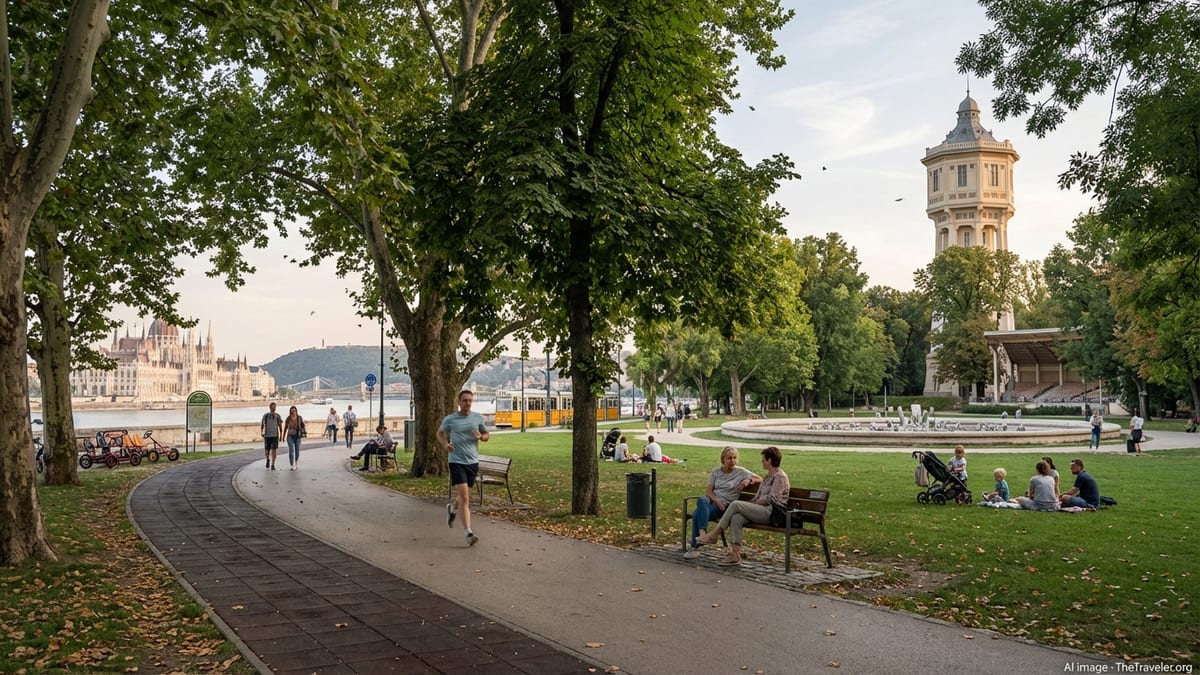
Modern urban planning has preserved that spirit by limiting traffic and heavy development. Instead, the island has been shaped as a leisure park serving both city residents and visitors. Paths loop through woodland and along the riverfront, rose beds and lawns open onto views of Parliament and the Buda Hills, and cultural venues like the open air theater and the historic water tower anchor the northern half. The result is a rare combination of city convenience and almost resort like ease.
For travelers, Margaret Island works in several ways at once. It is an accessible place to recover from sightseeing without actually leaving the city. It offers a cross section of Budapest life, from office workers jogging the riverside track after work to families pushing prams under the trees. And it is a practical base for inexpensive fun thanks to free attractions like the musical fountain, the small zoo and the gardens.
Parks, Gardens and Open Spaces
The essence of Margaret Island is its greenery. A central spine of paved paths and smaller trails runs the length of the island, lined by mature plane, chestnut and poplar trees. In summer these create a tunnel of shade that can feel several degrees cooler than the city streets. Benches, lawns and informal picnic areas appear at regular intervals, so it is easy to stop wherever a view takes your eye.
Two of the most distinctive horticultural spaces are the Rose Garden (Rózsakert) and the Japanese Garden at the northern tip. The Rose Garden is a formal arrangement of beds filled with hundreds of rose bushes in assorted colors and shapes. Peak bloom usually comes in late spring and early summer, but the area remains a pleasant promenade throughout the warm months, especially in the late afternoon when the light softens and the city skyline glows beyond the trees.
The Japanese Garden, refurbished in recent years, offers a more intimate mood. It incorporates dwarf trees, shaped shrubs, a koi filled pond, rock arrangements and a small artificial waterfall. In full operating season the water features run steadily and turtles and fish are visible in the clear shallows. In winter, some fountains and cascades are turned off to protect the plumbing from freezing, and parts of the pond may ice over, but the scene remains atmospheric with frost on bamboo and stone lanterns.
Beyond these two named gardens, much of Margaret Island is simply well kept parkland. Wide meadows fill with locals playing football or laying out blankets in summer; in shoulder seasons they become quiet, wind brushed spaces ideal for a slow walk. Because the island sits slightly elevated above the river in places, you can find angles where the Danube and the city beyond form a panorama while traffic noise remains muted behind the trees.
Signature Attractions: From Musical Fountain to Water Tower
While the greenery is a constant, several headline attractions give Margaret Island its distinct flavor and are worth planning around. Closest to the city center, at the southern end near Margaret Bridge, is the Musical Fountain. In warm months, this large circular basin hosts choreographed shows in which jets of water rise, fall and pivot in time with recorded music, backed by a colored lighting system after dark. Schedules vary by season, but from late spring through autumn visitors can usually expect regular daytime and evening performances.
The fountain shows are free and easy to combine with a wider visit. On typical days families gather early to claim the front benches, while casual passersby pause on the surrounding paths for a song or two. Because the repertoire ranges from classical to contemporary, one performance may feature symphonic pieces while the next leans on pop standards. If your stay in Budapest includes a clear evening, catching a show after sunset is particularly memorable when the water columns stand out against the darkening sky.
Farther north stands the Margaret Island Water Tower, an octagonal Art Nouveau structure dating from the early 20th century. At around 57 meters high, it is visible from much of the island and from the riverbanks on both sides. The tower still plays a functional role in the island’s water system but has also been adapted as an observation and exhibition space. In the main summer season visitors can usually climb an internal staircase to a viewing platform for sweeping views over the Danube, Parliament, and the Buda Hills.
At the base of the tower lies the island’s open air theater, one of Budapest’s principal summer performance venues. From roughly May to September it stages a rotating program of concerts, opera, dance and film screenings. Seating faces a stage framed by trees, and evening performances often begin just as the sky turns pastel over the river. Tickets are required for events, but even when no show is scheduled the structure gives this part of the island a low key festival feel.
Thermal Baths, Pools and Wellness
Budapest’s bathing culture extends onto Margaret Island through Palatinus Baths, one of the city’s largest thermal and leisure complexes. Located near the middle of the island on the eastern side, Palatinus combines traditional thermal pools fed by mineral rich springs with family oriented wave pools, slides and outdoor sunbathing terraces. This makes it one of the most versatile options for mixed groups where some want classic soaking and others prefer more energetic water play.
In peak summer, Palatinus functions as an open air aqua park, with multiple outdoor pools running, slides in operation and a broad lawn filled with loungers and towels. As temperatures drop, the emphasis shifts indoors. Covered thermal pools and wellness areas remain open year round, and at least one outdoor hot pool typically operates even in cold weather, so visitors can sit in steaming water while breathing winter air.
Opening hours and ticket prices adjust slightly by season and day of week, but as of the current winter 2025 to 2026 period, Palatinus has maintained a daily schedule that comfortably allows for morning or afternoon visits. Tickets are significantly cheaper when purchased directly from the official Budapest spa operator or at the gate than through third party agencies, so it is worth budgeting a little time for on site arrangements rather than paying a premium for convenience.
For travelers, Palatinus is perhaps most appealing as a way to pair a park stroll with an extended break from city sightseeing. You can arrive on Margaret Island by tram or bus, walk through the trees to the baths, spend a few hours rotating between pools and loungers, then dry off and continue exploring the island’s gardens or return to central Budapest before dinner.
Sports, Play and Family Fun
Margaret Island is one of Budapest’s main playgrounds for locals, and many facilities are tuned to repeat use by residents as much as casual visitors. The most famous is the dedicated running track that circles the perimeter of the island. Made from a rubberized material that is softer on joints than concrete, the route is roughly 5.3 kilometers long and mostly flat, with continuous views across the Danube to Parliament, the Castle District and the modern skyline of Pest.
At almost any daylight hour you will see runners using the track for training, social jogging and post work exercise. There are several access points where the path intersects with interior routes, so you can start or finish at different places depending on where you enter the island. Water fountains and occasional rest spots appear at intervals, which is helpful in midsummer when temperatures can climb and shade is essential.
For those who prefer wheels to running shoes, several rental vendors on the island offer an assortment of equipment, from standard bicycles and e bikes to four wheel pedal cars known locally as bringóhintó. These multi seat vehicles are a fixture of family life here, especially on weekends, and they can be an enjoyable way for groups to explore the full length of the island without much effort. E scooters are also a common sight, though users must follow local rules on where they can be parked or dropped at the end of a ride.
Children are particularly well served. In addition to conventional playgrounds and open lawns, Margaret Island hosts a compact mini zoo or petting area where fallow deer, peacocks, ducks, rabbits and birds of prey are kept in small enclosures. Entry is typically free, and while the facility is modest compared with a city zoo, it offers younger visitors a clear point of interest along a longer walk. Pony rides are sometimes available in peak season, and seasonal light installations near Palatinus create an evening attraction in winter months.
History, Ruins and Culture
Beneath the park amenities lies a dense layer of history, much of it still visible in ruins scattered across the island. The most important remains are those of the Dominican convent where Saint Margaret lived. Low stone walls, partial arches and foundation outlines mark where cloisters, chapels and domestic spaces once stood, set amid grass and trees. Informational boards help visitors interpret the layout and understand how the island functioned as a religious center in the Middle Ages.
Nearby are traces of other monastic and ecclesiastical structures dating from the same period, along with remnants of a Franciscan church and assorted outbuildings. Walking through these sites ties Margaret Island’s present role as a retreat to its earlier life as a cloistered world apart from the bustle of Buda and Pest. While there are no extensive museum interiors here, the openness of the ruins invites casual exploration and photography.
Culture on the island today centers on performance and seasonal events rather than permanent galleries. The open air theater at the water tower anchors a summer festival program that draws leading Hungarian and international artists for opera productions, orchestral concerts, musicals, contemporary dance and crossover shows. Schedules for each year’s program are typically published months in advance, and tickets can sell quickly for major nights, so travelers with a strong interest in performing arts should check dates early when planning a trip.
The island also occasionally hosts temporary installations and family oriented festivals in cooperation with city institutions, particularly during holiday periods. These might range from light art trails that wind through the park in winter to sports events and charity runs that make use of the running track and central lawns. Because the core park area is open 24 hours a day year round, there is space to accommodate everything from quiet morning walks to large scale evening gatherings without the island ever losing its essential calm.
Practicalities: When to Visit and Seasonal Details
Margaret Island is open at all hours throughout the year, and entry to the park itself is free. However, the feel of a visit varies sharply by season, and some attractions operate on distinct calendars. From late spring through early autumn the island is at its busiest and most complete, with fountains running, the musical fountain operating on a full schedule, Palatinus functioning as an outdoor spa complex, rental kiosks fully staffed and the open air theater in session.
Summer months bring the highest temperatures and the largest crowds, especially on weekends and during school holidays. On these days main paths, playgrounds and bathing areas can feel lively but rarely oppressive, thanks to the absence of through traffic and the breadth of open space. Early mornings and late evenings are especially pleasant, with lower temperatures and softer light on the river.
In shoulder seasons such as April, May, late September and October, the park is quieter and foliage shifts from blossom to autumn color. Some commercial kiosks, seasonal cafes and boat services scale back operations, and specific attractions like the musical fountain may reduce show frequency or pause altogether during colder months. Water features in the Japanese Garden and other ornamental ponds are often turned off from late autumn to early spring to avoid damage, though the ponds themselves stay filled.
Winter has its own appeal, particularly in the current 2025 to 2026 season, when a dedicated light park has been operating around Palatinus, drawing families and couples after dark. Joggers and dog walkers remain a constant presence, and snow, when it falls, softens the island’s architecture and tree line. Visitors during this period should pack warm clothing, as the open river setting can make the wind feel strong, and check in advance if a particular show, bath section or seasonal event is operating on their intended dates.
How to Get to Margaret Island Today
Reaching Margaret Island is straightforward using Budapest’s well developed public transport system, and in most cases it is the simplest option. The island is connected to both riverbanks by two bridges: Margaret Bridge (Margit híd) to the south and Árpád Bridge (Árpád híd) to the north. Pedestrian walkways on both bridges give direct access onto the island, and one public bus route crosses the island itself from end to end.
From the city center on the Pest side, tram lines 4 and 6 are the most commonly used routes. Both run along the Grand Boulevard and cross Margaret Bridge, stopping at a halt signed for the island near the center of the span. From this stop, a short walk along a dedicated side path brings you directly onto Margaret Island near the musical fountain at the southern end. Trams 4 and 6 operate at high frequency throughout the day and late into the night, making this entrance particularly convenient.
Bus 26 is the only regular public transport line that runs the full length of the island. It typically starts at Nyugati Railway Station on the Pest side, crosses Margaret Bridge onto the island, stops at several points along its axis, then exits again near Árpád Bridge at the northern end. For visitors who want to minimize walking or who are heading straight to the Japanese Garden or mini zoo, staying on Bus 26 to its island terminus at the north can be a smart strategy, then strolling back south on foot.
From the Buda side, riverfront tram lines such as 19 and 41 offer a quick way to reach the Margaret Bridge area, from where you can walk across onto the island using the same pedestrian route as those arriving from Pest. Cyclists can ride onto the island via the bridge cycle paths, and Budapest’s official bike share scheme maintains docking stations on or near the island. Private cars are not permitted to cruise the interior of the park, although there is limited paid parking at the extreme northern tip accessed from Árpád Bridge, and licensed taxis may drop passengers at designated points before exiting.
Getting Around Once You Arrive
Because Margaret Island is essentially car free, moving around is a matter of walking, cycling or taking the cross island bus. For most visitors, walking remains the main way to experience the island. The central promenade and the running track both offer clear, continuous routes, while smaller side paths weave between gardens, ruins and river viewpoints. Distances are manageable: a direct stroll from the southern entrance near Margaret Bridge to the northern tip near the Japanese Garden takes roughly 30 to 40 minutes at a moderate pace.
For those with limited mobility or traveling with small children, it can be helpful to combine walking with a short ride on Bus 26. You might, for example, enter the island at the south, explore the fountain and nearby lawns, then catch the bus midway up the island to the north, saving energy for a slower wander downhill through the Japanese Garden and back along the river. Because the bus line is relatively short, it is easier to navigate than more complex urban routes.
Rental options add flexibility. Pedal cars and family cycles are concentrated near popular entry points and around central landmarks, and pricing is usually by the half hour or hour. These vehicles are not designed for speed, but they are steady and sociable, allowing riders to chat and look around while covering more ground than on foot. Standard bicycles and e scooters, whether rented from local outfits or through app based services, can cover the full loop of the island in under an hour with stops.
Facilities such as toilets, snack kiosks and seasonal cafes are scattered fairly evenly along the main routes, though some are closed outside peak months or charge small fees for use. As a rule of thumb, you will find the greatest concentration of services near the southern entrance, the central Palatinus area and the vicinity of the water tower. It is sensible to carry a little cash for small purchases, as not every kiosk consistently accepts cards, especially when crowds are light.
The Takeaway
Margaret Island is more than a city park. It is a microcosm of Budapest’s identity, blending history, water, greenery and a certain unhurried charm in the middle of a European capital. Within a single visit you can listen to music accompanied by dancing jets of water, soak in thermal pools fed by ancient springs, wander through medieval ruins, and finish the day with a slow walk along the Danube as trams glide over the bridges.
Its accessibility is part of the appeal. With frequent trams and a dedicated bus route serving both ends, there is little friction in reaching the island from most central neighborhoods. Once on the island, car free paths and clear sightlines make navigation simple even for first time visitors or families with children. The experience is largely what you choose to make it, whether that means a focused itinerary of attractions or an improvised afternoon of strolling and stopping wherever looks inviting.
Seasonality matters, but every time of year offers a distinct mood. Summer showcases the full range of shows, fountains and outdoor pools; spring and autumn emphasize blossoms, color and quieter paths; winter strips the trees to their bones and highlights the structure of the island, with light installations and steaming baths providing warmth. For travelers planning a trip to Budapest, setting aside even a few hours for Margaret Island adds context to the city’s grand architecture and ties the urban experience to the river that sustains it.
FAQ
Q1: Is there an entrance fee to visit Margaret Island?
There is no entrance fee for Margaret Island itself; the park is open to the public free of charge all year. However, specific attractions on the island, such as Palatinus Baths, certain events at the open air theater or temporary light installations, have their own admission charges.
Q2: How long should I plan to spend on Margaret Island?
If you only want a quick look and a short walk, one to two hours is enough to see the musical fountain area and stroll a portion of the central paths. To visit key attractions like the Japanese Garden, Palatinus Baths, the water tower and the convent ruins at a relaxed pace, plan at least half a day, and a full day if you intend to use the pools.
Q3: What is the best way to reach Margaret Island from central Budapest?
For most visitors, the easiest route is to take tram lines 4 or 6 to the stop on Margaret Bridge marked for the island, then walk onto the island via the pedestrian path. Those starting near Nyugati Railway Station can also use Bus 26, which runs directly across the island and stops near many major sights along the way.
Q4: Are cars and taxis allowed on Margaret Island?
Private cars are generally not allowed to drive through the island. There is limited parking near the northern end, accessible from Árpád Bridge, but the interior is reserved for pedestrians, cyclists and the cross island bus. Licensed taxis may drop passengers at designated points but do not circulate freely as in the rest of the city.
Q5: When does the Musical Fountain operate?
The Musical Fountain runs seasonally, typically from late spring through autumn, with several shows scheduled throughout the day and into the evening. In colder months, especially during winter, performances are usually suspended and the fountain may be drained or operated without music. Exact dates and times can change slightly each year.
Q6: Is Margaret Island suitable for visiting in winter?
Yes, Margaret Island can be rewarding in winter, particularly if you enjoy quiet walks and crisp river views. Some features, such as ornamental waterfalls and the musical fountain, are inactive, but the park remains open, joggers use the running track year round, and indoor sections of Palatinus Baths offer warm thermal pools even in cold weather.
Q7: Are there food and drink options available on the island?
There are multiple kiosks, snack stands and seasonal cafes scattered along the main routes of the island, especially near the southern entrance, Palatinus Baths and the water tower area. In peak season you will find plenty of options for drinks, ice cream and light meals. In low season, fewer outlets operate, so it can be wise to bring water and a small snack.
Q8: Can I rent bikes or pedal cars on Margaret Island?
Yes, rental points on the island offer standard bicycles, family sized pedal cars and sometimes e bikes or e scooters. These can be hired by the half hour or hour and are a popular way to explore the full length of the island, especially for families and groups who want to cover more ground than they would on foot.
Q9: Is Margaret Island a good place for children?
Margaret Island is very child friendly. It is largely car free, has wide paths for running and cycling, playgrounds and open lawns for games, and a small petting style zoo with animals such as deer, rabbits and peacocks. In warmer months the pools and slides at Palatinus add another layer of family entertainment.
Q10: Do I need to book anything in advance for a visit to Margaret Island?
For general access to the island and casual use of the park, no booking is required; you can simply arrive by tram, bus or on foot. Advance planning is useful only if you want tickets for a specific event at the open air theater, timed entry to a special light installation, or to secure spa tickets on particularly busy days at Palatinus.