

More news on this day
Marlow in Buckinghamshire is attracting renewed attention from visitors as recent accolades for its thriving High Street highlight the town’s blend of historic architecture, independent shops and scenic Thames-side walks within easy reach of London.
Get the latest news straight to your inbox!
High Street Recognition Puts Marlow in the Spotlight
Recent coverage by national lifestyle media has identified Marlow as home to one of Britain’s strongest high streets outside London, citing research by a major property firm that tracks the health of town centres. Reports indicate that Marlow ranked highly for a mix of independent retailers, well-known brands, hospitality venues and overall visitor appeal, reinforcing its reputation as a prosperous small town with a resilient retail core.
The High Street, framed by Georgian and Victorian frontages, forms the spine of the compact town centre. Publicly available information from local and tourism bodies describes a streetscape of boutiques, delis, cafes and restaurants that link the station side of town with the riverside. The relatively short length of the High Street concentrates activity, creating what promotional material describes as a “village feel” despite Marlow’s growing commuter-town role.
Reports on the town’s economy suggest that strong demographics, frequent rail connections toward London and good road links via the A404 have underpinned investment in the High Street. New openings in food, drink and lifestyle retail continue to appear alongside long-established local businesses, helping the centre weather wider pressures facing UK bricks-and-mortar shopping.
Local council and tourism publications also point to active town-centre management, regular events and seasonal décor as further reasons Marlow’s High Street scores well in national comparisons. Recent community newsletters reference awards for village presentation and cleanliness, aligning with the town’s image as a well-kept and carefully curated destination.
Riverside Setting on One of the Thames’s Most Scenic Reaches
Marlow’s position on a broad, gently curving section of the River Thames is central to its visitor appeal. Official visitor guides describe the town as sitting midway between Reading and Windsor, on a reach noted for boating, rowing and riverside walking. The combination of water, historic buildings and tree-lined banks has long drawn leisure visitors, and recent travel features continue to promote the area as one of the more picturesque stretches of the Middle Thames.
The riverfront opens out at Higginson Park, a large public green space directly beside the water. According to Buckinghamshire Council, the park has been recognised with a Green Flag Award, a national benchmark for well-managed parks in the UK. The park’s lawns, flowerbeds and riverside paths give direct access to the Thames Path National Trail, offering visitors level walks towards Bourne End in one direction and Hurley and Henley-on-Thames in the other.
Guided walking materials published by heritage and geography organisations highlight how the river shaped Marlow’s history, from its origins as a modest port to its transformation into a late Victorian and Edwardian resort town. Interpretive trails encourage visitors to follow the water’s edge, cross the bridge, and explore quieter back streets and islands, presenting the riverside not only as a scenic amenity but also as a route into the town’s industrial and literary past.
Rowing and paddle sports remain a visible feature of the river scene, especially at weekends and in summer. Promotional information about local regattas and club activity describes crews training on this reach of the Thames, while pleasure craft, trip boats and private cruisers add to the sense of a busy but relaxed waterside environment.
Iconic Suspension Bridge and Historic Townscape
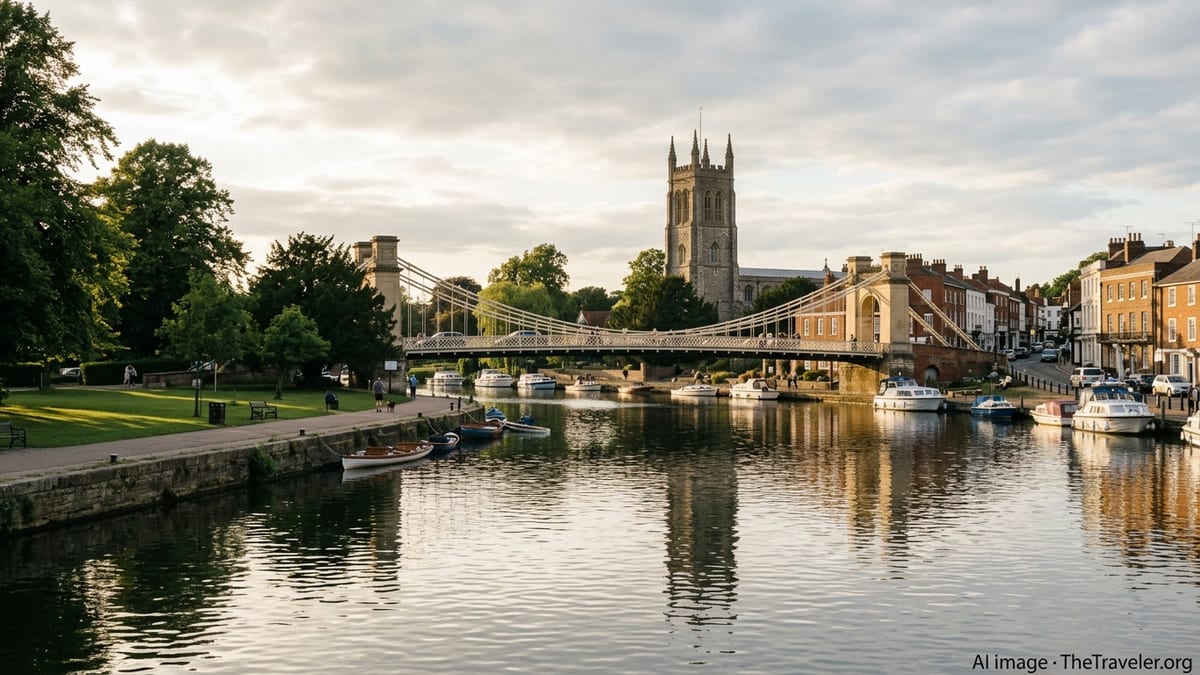
One of Marlow’s most recognisable features is its Grade I-listed suspension bridge, which links Buckinghamshire on the north bank with Berkshire on the south. According to historical summaries, the present bridge dates from the 1830s and was designed by engineer William Tierney Clark, whose work in Marlow later inspired a larger structure of similar appearance across the Danube in Budapest.
Tourism material describes the bridge as a focal point for visitors, both as a vantage point for river views and as an architectural landmark in its own right. Photographs widely used in travel coverage typically show the cream-painted suspension chains and towers framed against the gothic tower of All Saints Church and the moored boats below, a composition that has become closely associated with Marlow’s identity.
Away from the waterfront, the town centre retains a network of streets with brick and stucco-fronted buildings, traditional pubs and small courtyards. Local heritage groups emphasise the survival of Georgian and Victorian details in many façades, contributing to the sense of a cohesive historic environment. This backdrop, combined with limited high-rise development, enhances the perception of Marlow as a human-scale town where the river and the High Street remain visually and physically connected.
Published visitor guides also underscore literary and cultural links, noting that figures such as Percy Bysshe Shelley and Mary Shelley once lived in the town and that modern television productions have used Marlow and surrounding villages as filming locations. These associations add an additional layer of interest for culture-focused travellers exploring the Thames Valley.
Gastronomy, Independent Retail and Year-Round Events
Marlow’s dining scene has developed into a major part of its tourism offer. Travel features in national magazines and newspapers commonly characterise the town as a riverside gastronomic hub, citing a concentration of acclaimed restaurants, casual dining spots and contemporary pubs within a walkable area. The presence of high-profile chefs and venues has helped draw food-focused visitors who often combine meals with shopping and river walks.
Alongside headline restaurants, information from local tourism platforms highlights a wide range of independent cafes, bakeries and specialist food shops on and around the High Street. This mix of everyday and destination dining is frequently cited in rankings that place Marlow above comparable towns for hospitality choice relative to its size.
Events further amplify the town’s profile. Public listings reference the Marlow Town Regatta and Festival on the river, a programme of outdoor concerts and community events in Higginson Park, and a growing calendar of food and drink festivals. Seasonal lights, street markets and charity runs bring additional footfall to the High Street and waterfront, providing reasons to visit beyond traditional summer months.
Retail studies and local commentary suggest that this interplay of gastronomy, independent retail and events has helped Marlow avoid the “empty shopfront” issues facing many UK high streets. For visitors, it translates into a town centre where riverside walks, shopping and dining can be combined in a single day trip.
Access, Day Trips and Regional Positioning
Marlow’s accessibility is another factor strengthening its appeal as a short-break and day-trip destination. Public transport information shows that the town sits on a branch railway line connecting with Maidenhead, linking onward to services toward London and the West. By road, it is a short drive from the M4 and M40 via the A404, placing it within comfortable reach of Heathrow Airport and other Thames Valley employment centres.
Regional tourism platforms position Marlow as a useful base for exploring neighbouring river towns such as Henley-on-Thames, Cookham and Windsor, as well as the beechwoods and chalk hills of the Chilterns Area of Outstanding Natural Beauty. Suggested itineraries often combine a morning exploring Marlow’s High Street and riverside with afternoon walks in surrounding countryside or visits to nearby historic houses and villages.
Accommodation options in and around the town include riverside hotels, guesthouses and rental properties, according to booking and tourism listings. While demand and pricing reflect Marlow’s popularity and affluent catchment area, the range of places to stay allows visitors to choose between central, car-free stays by the water and quieter locations in nearby villages.
For tourism planners and local businesses, the recent spotlight on Marlow’s High Street is seen in published commentary as both recognition of work already done and an incentive to maintain the balance between growth and character. For visitors, it signals that the combination of a lauded town centre and classic Thames riverside scenery is likely to remain a defining feature of Marlow’s appeal in the seasons ahead.