

More news on this day
Thousands of airline passengers across Canada are facing a day of severe disruption as more than 200 flight cancellations and nearly 600 delays sweep through major airports from Vancouver and Calgary to Toronto, Ottawa, Montreal, Halifax and St. John’s, hitting services operated by Air Canada, WestJet, Jazz, United, Porter and several regional carriers.
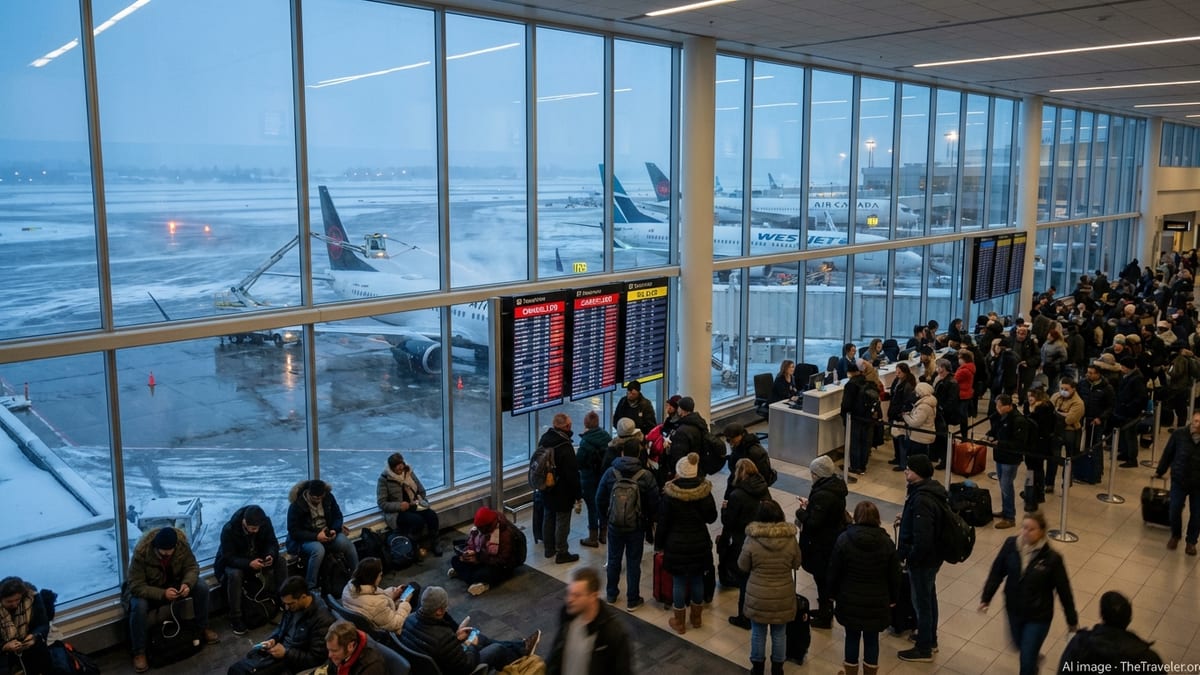
Storm System and Winter Conditions Collide With Busy Travel Weekend
The latest wave of disruption comes as a broad winter weather pattern settles over much of the country and Atlantic Canada braces for heavy snow and strong winds tied to an intensifying storm in the North Atlantic. Aviation data and airport operation reports for Sunday, February 22 indicate that a mix of snow, freezing drizzle and low cloud has reduced visibility and slowed ground handling at multiple hubs, particularly in central and eastern Canada.
While conditions vary from airport to airport, the overall impact is similar: slower deicing queues, extended runway clearing times and tighter spacing between takeoffs and landings. These factors combine to reduce hourly airport capacity, forcing airlines to proactively cancel flights and accept rolling delays in order to keep their networks from spiraling further out of sync.
Operational planners say the timing could hardly be worse. The disruptions follow weeks of weather-related irregularities across Canada in January and early February, leaving little recovery time for carriers already struggling to restore normal aircraft and crew rotations. With another significant winter storm forecast to affect parts of Atlantic Canada and the Northeastern United States into Monday, airlines are bracing for further knock-on effects.
Major Hubs From Vancouver to St. John’s Under Strain
Canada’s largest gateways are once again bearing the brunt of the turmoil. Toronto Pearson, the country’s busiest airport, is reporting one of the highest concentrations of cancellations and late departures as domestic connections and international routes both feel the squeeze. Airlines have cut dozens of frequencies on short-haul services in and out of Toronto in an effort to protect long-haul flights and minimize crew and aircraft misalignment later in the week.
In Montreal, winter conditions and the broader system-wide disruption are contributing to mounting delays on transcontinental and transatlantic services. Passengers connecting through Montreal–Trudeau are encountering congested terminal areas, long lines at customer service counters and departure boards dominated by revised departure times.
On the West Coast, Vancouver International is dealing with a combination of residual schedule knock-ons from earlier storms in central Canada and localized low cloud and precipitation that periodically slow operations. Flights to and from Calgary and Edmonton, key links in both the Air Canada and WestJet networks, have seen elevated delay rates, compounding challenges at those Alberta hubs.
Farther east, Ottawa, Halifax and St. John’s are experiencing a patchwork of cancellations and extended delays as regional services are trimmed and aircraft arrive out of position. In Atlantic Canada, where airports often operate closer to the margins during winter, even modest visibility reductions and gusty winds can rapidly trigger cascading schedule changes.
Air Canada and WestJet at the Center of the Disruption
As Canada’s two largest carriers, Air Canada and WestJet are at the center of the latest disruption. Air Canada, with its heavy concentration of flights at Toronto Pearson, Montreal and Vancouver, is fielding a significant share of today’s more than 200 cancellations and hundreds of delays. The airline has been trying to balance its responsibility to maintain critical domestic connectivity with the need to preserve international links that are difficult to re-accommodate if disrupted.
WestJet, whose operations are anchored in Western Canada but now extend across the country and into the United States, the Caribbean and Europe, is also dealing with widespread schedule pressures. Flights through its Calgary hub and key spokes such as Edmonton, Vancouver and Toronto are showing elevated delay statistics, particularly on routes that feed into longer-haul services later in the day.
Regional affiliates and partners are similarly exposed. Jazz, which operates a large share of Air Canada’s regional network, has trimmed or delayed services on thinner routes where low passenger volumes and marginal weather make operating conditions most challenging. Porter Airlines, expanding its jet network from Toronto, Ottawa and Montreal, is grappling with the same combination of weather-related operational limits and network congestion as larger competitors.
United Airlines and other foreign carriers with significant Canadian footprints are feeling secondhand effects as well. Delayed inbound aircraft and reduced departure slots at Canadian hubs send ripples through their broader North American networks, complicating crew assignments and disrupting onward connections for passengers bound for the United States, Mexico and Europe.
Passengers Face Long Lines, Uncertain Itineraries and Limited Options
For travelers, the statistics translate into a familiar and frustrating reality: crowded departure halls, long waits in rebooking queues and difficulty securing timely alternatives. At Toronto, Montreal and Vancouver in particular, lines at airline customer service desks began forming early in the morning and lengthened steadily as more flights were canceled or assigned extended delays.
Many passengers whose short-haul flights were scrubbed are being offered same-day rebookings on later departures, although seats are limited on some of the busiest domestic corridors. Travelers on longer-haul or international itineraries, especially those with connections through the United States or Europe, face tougher choices as missed connections and crew duty-time limits narrow the number of workable options.
At smaller airports such as Halifax and St. John’s, options can be even more constrained. When a morning or afternoon departure to a major hub is canceled and the station has limited remaining service for the day, some passengers are being offered hotel vouchers and rebookings for Monday or Tuesday. Others are choosing to abandon air travel altogether, turning to long-distance bus or rail options where available, or postponing their trips.
Travelers already in the air are not immune from disruption. Extended holding patterns, diversions to alternate airports when weather briefly falls below landing minima and last-minute gate changes are all contributing to confusion and longer journey times, even for those whose flights ultimately operate.
Weather and Operational Knock-Ons Behind the Numbers
Aviation analysts say that while today’s chaos is highly visible, it is also the predictable result of an exceptionally punishing winter season layered on top of an aviation system still rebuilding resilience after years of pandemic-related volatility and last year’s labor unrest. A severe cold wave in late January brought record-low temperatures to parts of Ontario and Quebec, while a major winter storm just weeks ago produced historic snowfall at Toronto Pearson and led to hundreds of cancellations in a single day.
Those earlier episodes left airlines with aircraft and crews out of their usual rotations, forcing a series of rolling schedule changes that, in some cases, are still being unwound. Every new weather event, even one producing fewer direct cancellations, has the potential to reopen those operational scars. The multi-day pattern affecting central and eastern Canada this week has done precisely that, repeatedly disrupting the careful choreography of aircraft maintenance windows, crew duty limits and hub connectivity.
Compounding the challenge are continuing labor and infrastructure constraints. Staffing levels in some ground-handling and maintenance roles have not fully recovered to pre-pandemic norms, leaving thinner margins when activity spikes or weather slows operations. At the same time, aging airport infrastructure at several Canadian hubs limits the number of aircraft that can be deiced or handled simultaneously in severe conditions.
Industry observers note that while the total of more than 200 cancellations and nearly 600 delays is lower than the most extreme days seen earlier in the winter, the geographic spread from Vancouver through central Canada to Atlantic airports such as Halifax and St. John’s has made this latest episode especially disruptive for passengers attempting multi-leg journeys.
Airlines Activate Flexible Policies and Recovery Plans
In response, major carriers are rolling out a familiar toolkit of mitigation measures designed to reduce chaos in the terminals and give passengers more options. Air Canada, WestJet and Porter have each issued weather-related travel advisories for parts of their Canadian networks, encouraging customers to monitor their flight status closely and, where eligible, adjust their plans without change fees.
In many cases, airlines are allowing affected passengers to rebook onto alternate dates within a limited window, often up to a week from the original travel date, provided seats are available in the same cabin. Fare differences may still apply on some itineraries, particularly on popular domestic routes and transborder flights tied to school holidays or business travel peaks.
Operationally, airline control centers are prioritizing aircraft and crews for high-demand trunk routes linking major hubs, as well as for long-haul international services that are more difficult and costly to reaccommodate when disrupted. Shorter regional flights and lightly booked services are more likely to be pre-emptively canceled to free up resources and runway slots.
Where local conditions permit, carriers are also using larger aircraft on select routes to consolidate passenger loads from multiple canceled flights. This strategy is particularly evident on key domestic corridors such as Vancouver–Toronto, Toronto–Calgary and Montreal–Halifax, where available widebody or higher-capacity narrowbody aircraft can help clear backlogs more quickly.
What Travelers Can Do if Their Flight Is Affected
Travel experts advise that in a fast-moving situation like Sunday’s network-wide disruption, proactive planning and digital tools are essential. Passengers are urged to check their flight status repeatedly on airline apps or airport information systems, even after receiving an initial confirmation, since schedule changes are being loaded throughout the day as weather conditions and operational constraints evolve.
When a flight is canceled, most airlines now enable customers to rebook directly through their mobile apps or websites, often with access to more options and faster confirmation than waiting in physical lines at the airport. Using these digital channels can also make it easier to compare routings, especially for itineraries involving multiple connections or travel across several carriers.
For those already at the airport, staff recommend approaching self-service kiosks and automated customer service phones where available, which can sometimes handle rebookings more quickly than overburdened counters. Passengers requiring special assistance, such as unaccompanied minors or travelers with mobility needs, are encouraged to identify themselves early to airline staff so that alternative arrangements can be prioritized.
Travel insurance, whether purchased independently or included with some credit cards, may provide coverage for hotel stays, meals or alternative transportation in cases of extended delays or cancellations. However, policies vary widely, and passengers are advised to keep all receipts and review terms carefully before incurring major additional costs.
Broader Questions About Reliability in a Tough Winter
The latest disruptions are likely to renew debate about the reliability of Canada’s air transport system during the harshest weeks of winter. Advocacy groups have argued that the combination of climate-driven extreme weather events, tight airline scheduling and aging airport infrastructure leaves passengers too vulnerable to cascading disruptions, particularly during holidays and peak business travel periods.
Regulators and policy makers are also watching closely. Past episodes of mass cancellations and delays have prompted calls for stronger passenger protection rules, clearer compensation standards and more robust contingency planning from both airlines and airports. While safety remains the overriding priority in severe weather, critics say that better communication and more conservative scheduling could reduce the human and economic cost of repeated system-wide breakdowns.
For now, attention is focused on the next 24 to 48 hours, as forecasters track the evolution of the winter storm expected to intensify near Atlantic Canada and along the Northeastern United States. If conditions deteriorate as predicted, today’s 200-plus cancellations and 593 delays could mark only the beginning of another difficult stretch for travelers trying to move within, to and from Canada’s major cities.
Airlines say they will continue to adjust schedules in real time as conditions change, but they caution that restoring full normal operations after a disruption of this scope can take several days. For thousands of passengers scattered across airports from Vancouver to St. John’s, that means patience, flexibility and, in many cases, a revised understanding of when they will finally reach their destinations.