

More news on this day
Hundreds of passengers were left stranded at Hamad International Airport in Doha on Wednesday after a fresh wave of regional airspace restrictions triggered the cancellation of at least 245 flights and delays to a dozen more, disrupting services by Qatar Airways, Gulf Air and other carriers on key routes including London, Bahrain, Cairo and Dubai.
Get the latest news straight to your inbox!
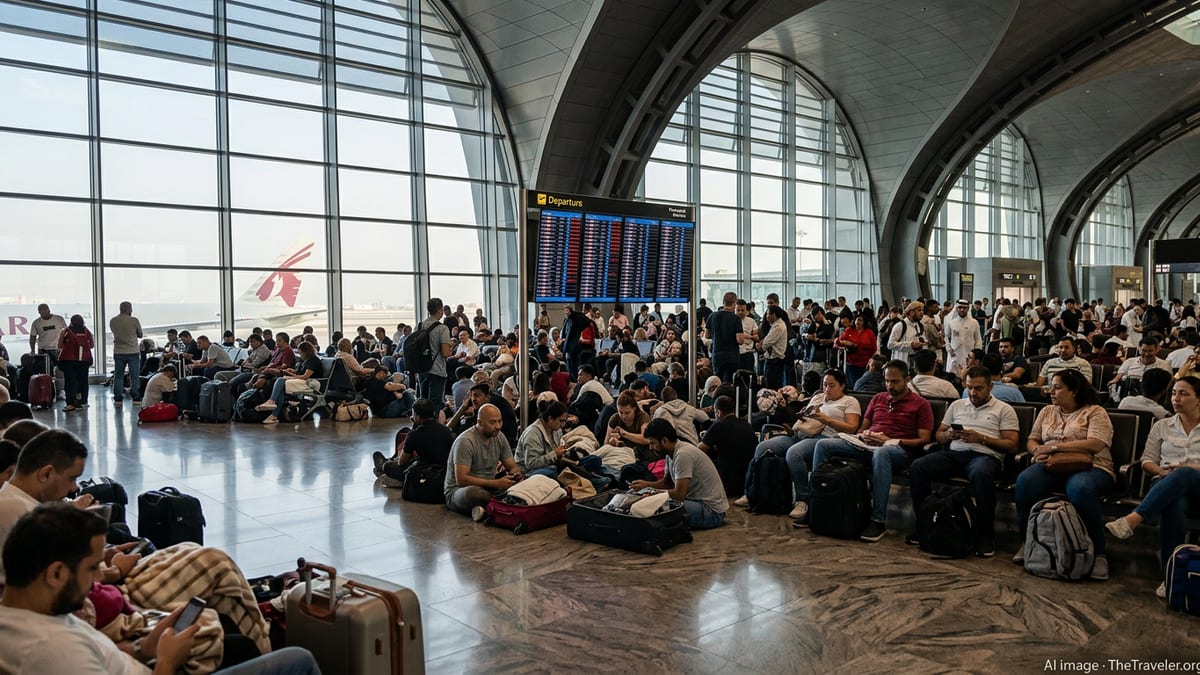
Regional Airspace Crisis Hits Doha Hub
The disruption at Hamad International Airport comes amid continuing closures and tight restrictions in Qatari and neighboring airspace, part of a wider security crisis that has rippled across the Gulf. Airport officials have confirmed that regular commercial operations in and out of Doha remain largely suspended, with only a limited number of authorized corridors available for selected movements.
Data from live flight-tracking boards on Wednesday showed a dense pattern of cancellations across the departure and arrival banks that normally define Doha’s role as a global transfer hub. Services operated by Qatar Airways, Gulf Air and several regional low-cost carriers were among those most heavily affected, as aircraft scheduled to operate to London, Bahrain, Cairo, Dubai and other major cities remained grounded.
The cancellations since early morning quickly cascaded through the schedule, as aircraft and crew were displaced and connection waves collapsed. Airport concourses that typically see fast-moving transit flows instead filled with exhausted travelers camped out on rows of seats and along terminal walls, clutching rebooked itineraries or waiting for updates that in many cases remained scarce.
While Hamad International has weathered previous waves of disruption, aviation analysts noted that the current shutdown of Qatari airspace has been longer and more complex than many earlier episodes, leaving airlines with fewer options to reroute traffic around the Gulf’s tightly interlinked hubs.
Qatar Airways and Gulf Air Forced to Curtail Operations
Qatar Airways, the dominant carrier at Hamad International, has been forced to operate on a sharply reduced schedule while its core hub remains constrained. Many of its short- and medium-haul services to regional destinations such as Bahrain, Cairo and Dubai have been canceled outright, while some long-haul links, including certain London services, have been pushed back or removed from the timetable at short notice.
Gulf Air, which relies on flows between Bahrain and Doha as part of its regional network, has also suffered a series of cancellations. A number of Gulf Air flights that would typically shuttle passengers between Bahrain and Qatar or onward to cities such as Cairo and Dubai were removed from departure boards, further compounding disruption for travelers attempting to connect across the northern Gulf.
Other airlines that use Doha as a secondary transit point have not been spared. Carriers from the United Arab Emirates and beyond the region have cut or delayed services into Hamad International while airspace restrictions remain in place, eroding the redundancy that often helps absorb shocks in the Gulf’s aviation system.
Industry observers say both Qatar Airways and Gulf Air are now relying heavily on aircraft and crew positioned outside their home hubs to mount limited point-to-point or rescue-style flights, an operational workaround that can only partially offset the loss of normal hub connectivity through Doha and Bahrain.
Passengers Face Long Waits, Sparse Information
For travelers caught at Hamad International, the human impact of the cancellations has been immediate and stark. Passengers bound for London reported being repeatedly rebooked as outbound services failed to receive final clearance to depart, while those heading to nearby Bahrain, Cairo and Dubai spoke of hours-long queues at transfer desks and difficulty obtaining reliable information.
Families with young children and elderly passengers were particularly visible in the crowded gate and seating areas, many of them having already spent one or more nights in the terminal as rolling cancellations eroded confidence in departure times. Some travelers described rationed meal vouchers and limited hotel availability as airlines struggled to find enough rooms in Doha to accommodate the disrupted crowds.
Airport staff and airline ground agents deployed portable loudspeakers in busy zones of the terminal, repeatedly urging passengers to monitor their flight status on display boards and through airline apps rather than heading directly to the gates. However, with schedules changing by the hour, many stranded customers said they were wary of leaving the terminal for fear of missing narrow departure windows on rare outbound flights.
Despite the frustration, the overall atmosphere at Hamad International remained largely orderly. Volunteer staff and contracted support teams circulated among the waiting crowds, directing passengers to rest areas and charging points, and assisting those in need of medical or mobility support.
Limited Rescue Flights and a Gradual Recovery Plan
Qatar Airways has begun rolling out a program of limited flights from Doha aimed at gradually clearing the backlog of stranded passengers. These services, described by the airline as non-scheduled and subject to regulatory approval, have included selected departures to major gateways such as London and Cairo, as well as a small number of regional cities.
Seats on these flights are being prioritized for travelers who have already been stranded in transit, with particular focus on families, elderly passengers and those with urgent medical or compassionate travel needs. Many flights are departing at full capacity, reflecting the scale of the backlog that has built up since the initial wave of cancellations.
Gulf Air and other regional carriers have similarly announced limited operations using aircraft that remained outside closed airspace when the current disruption began. In some cases, these airlines have been able to operate from alternative airports in Saudi Arabia and Oman to help move passengers closer to their final destinations, though such workarounds add complexity and travel time.
Aviation experts caution that while these rescue-style services can significantly reduce the number of passengers stranded at any one airport, they do not yet signal a full return to normal operations. Airlines must balance the pressure to move people quickly against the need to keep crews and aircraft positioned safely amid a volatile regional environment.
Advice for Affected Travelers
With conditions in the region still fluid, both airport authorities and airlines are urging passengers to avoid traveling to Hamad International unless they hold a confirmed ticket on a flight that is explicitly listed as operating. Travelers who have not yet started their journeys are being encouraged to work with airlines or travel agents to rebook onto later dates or alternative routings that bypass Doha until schedules stabilize.
Passengers already stranded at the airport are advised to stay closely in touch with their airline via mobile apps, email and SMS notifications, as carriers increasingly use direct digital channels to allocate scarce seats on outbound flights. Many travelers have been reassigned at very short notice, sometimes during nighttime hours, as new departure slots open within the limited air corridors.
Consumer-rights specialists note that air passengers affected by cancellations and significant delays may be entitled to care, re-routing and, in some cases, compensation, depending on the airline operating the flight and the jurisdiction under which the ticket was issued. However, they also point out that extraordinary circumstances related to security and airspace closures can complicate some compensation claims.
For now, the global travel industry is watching closely as Qatar’s main gateway navigates one of the most severe disruptions in its recent history. While the gradual expansion of limited flight operations offers some hope to those stuck in Doha, a full restoration of the airport’s role as a seamless international hub will likely depend on a broader easing of airspace restrictions across the region.