

More news on this day
Thousands of travelers were left stranded at New York’s John F. Kennedy International Airport on Sunday as a wave of 91 flight delays and 702 cancellations rippled through airline schedules, disrupting links to major U.S. cities and key international gateways including Los Angeles, Chicago, London and Paris.
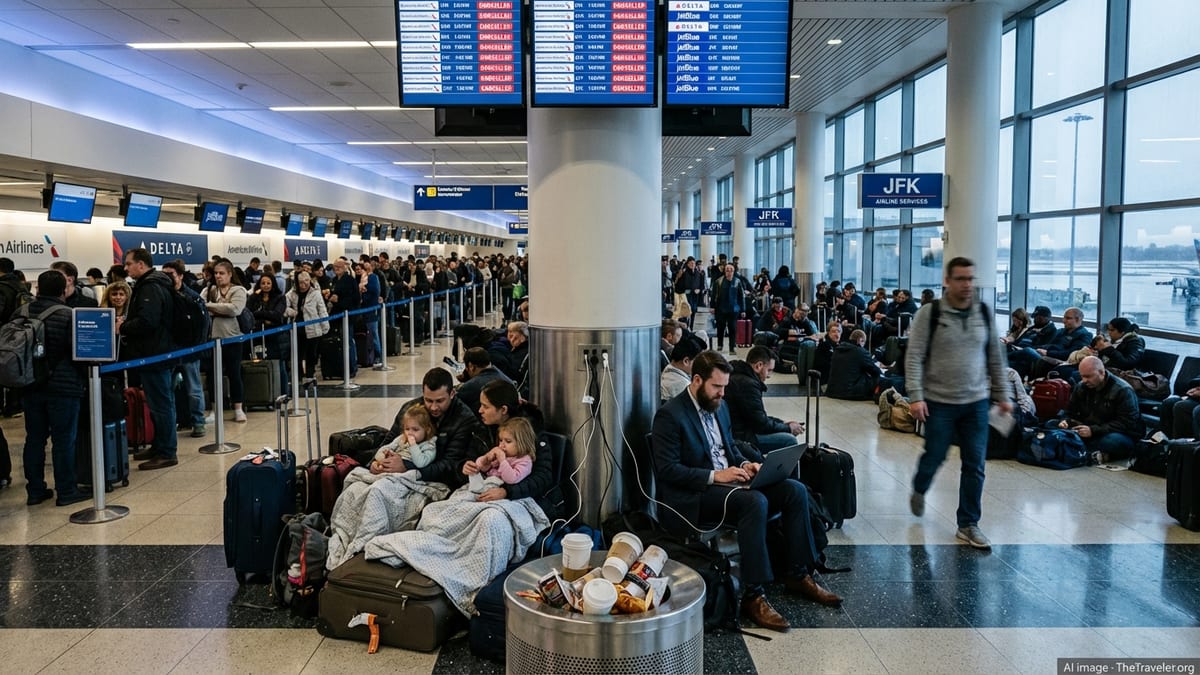
Severe Disruptions Hit One of America’s Busiest Gateways
The latest disruption at John F. Kennedy International Airport unfolded against a backdrop of already stressed U.S. air travel, with airlines still grappling with weather-related backlogs, tight staffing and congested airspace. JFK, a critical hub for both domestic and transatlantic traffic, bore the brunt of Sunday’s turmoil as cancellations accelerated through the day and stranded passengers filled terminals.
Data from flight-tracking services and aviation industry briefings indicated that more than 700 flights linked to JFK were canceled over the course of the operating day, alongside dozens more that departed or arrived significantly behind schedule. While conditions varied by airline and route, the net effect was a near logjam of disrupted journeys, missed connections and improvised rebooking efforts that extended far beyond New York.
American Airlines, Delta Air Lines and JetBlue Airways, all of which operate major services from JFK to leading U.S. and international destinations, were among the most affected. Their schedules into and out of New York connect to key routes such as Los Angeles, Chicago, San Francisco and Miami, as well as high-demand transatlantic corridors to London Heathrow, Paris Charles de Gaulle and other European hubs. As cancellations mounted, disruption spread rapidly across these networks, affecting travelers who had never intended to pass through New York at all.
Airport officials and carriers pointed to a combination of factors behind the wave of cancellations, including residual impacts from winter weather along the U.S. East Coast, scheduling constraints on crews and aircraft, as well as knock-on effects from earlier storms and system disruptions in late 2025 and early 2026. While no single cause fully explained Sunday’s volume of cancellations, the episode underscored how fragile the system remains when several pressures converge at once.
American, Delta and JetBlue Struggle to Stabilize Operations
For the major airlines most exposed at JFK, Sunday’s disruption represented a complicated operational puzzle. American Airlines, Delta and JetBlue all rely on New York as a cornerstone of their domestic and international networks, and each airline was forced to make rapid decisions about which flights to cancel outright and which could still operate with delays.
JetBlue, with a sizable footprint at JFK and a significant share of transcontinental and Caribbean services, saw a high proportion of its departures scrubbed from departure boards. Its connections between New York and cities such as Los Angeles, Orlando and San Juan were hit particularly hard, compounding stress on routes that regularly report heavy leisure and visiting-friends-and-relatives traffic. Passengers on these flights often faced limited alternatives on the same day as nearby departures filled quickly.
Delta, which has invested heavily in its JFK presence in recent years and experienced a high-profile system disruption in 2024 that led to thousands of cancellations nationwide, moved to trim schedules early in the day to avoid having aircraft and crews trapped out of position. Flights to major domestic hubs like Atlanta, Detroit and Minneapolis, and international services to European cities including London and Paris, were all affected as the carrier sought to reset its operation.
American Airlines, whose network ties JFK to its major hub at Dallas–Fort Worth as well as to Chicago, Miami and several West Coast cities, also recorded dozens of cancellations and late departures. The airline has already faced pressure in recent weeks following separate disruptions at Dallas–Fort Worth, where hundreds of delays and cancellations left passengers stranded across Texas and beyond. Sunday’s New York cancellations added a new layer of complexity to American’s efforts to stabilize nationwide schedules.
Ripple Effects Across Los Angeles, Chicago and Other Major U.S. Hubs
While the most immediate scenes of frustration were visible inside JFK’s terminals, the disruption quickly radiated outward along the spokes of major airline networks. Los Angeles International and Chicago O’Hare, both among the busiest hubs in the United States and top destinations from New York, saw mounting delays as aircraft and crews failed to arrive on time for turnarounds.
On transcontinental routes between New York and Los Angeles, which are heavily trafficked by both business and leisure travelers, airlines were forced to consolidate flights or cancel off-peak services in order to keep at least some capacity intact during core travel times. That meant that early-morning and late-evening departures were often first to go, leaving passengers with fewer options and long rebooking queues stretching across terminal concourses.
Chicago, a critical domestic and international connector, experienced its own spike in disruptions as aircraft scheduled to arrive from New York never departed, or did so many hours late. Travelers connecting through O’Hare to secondary markets in the Midwest and Great Lakes region reported missed onward flights and overnight stays in airport hotels, echoing the chaotic scenes previously seen during severe winter storms in late December and January.
Other major hubs, from Dallas–Fort Worth and Atlanta to Miami and Orlando, also felt the knock-on impact as carriers retimed departures to await inbound aircraft or reassigned jets from other routes to cover critical JFK services. The result was a patchwork of delays and last-minute schedule changes that left airline apps and departure boards in constant flux throughout the day.
Transatlantic Links to London and Paris Disrupted
The turbulence at JFK was felt particularly acutely on transatlantic routes, where long-haul aircraft and tightly scheduled rotations leave airlines with limited room to maneuver. Flights between New York and London, among the busiest international city pairs in the world, were thinned out as carriers chose to cancel some services entirely while prioritizing others that could still operate within crew duty limits.
Passengers bound for London Heathrow and Gatwick faced lengthy waits in check-in halls as staff worked to reassign them to later departures or to flights on partner airlines from nearby airports. For many, this also meant missing train connections or hotel bookings in the United Kingdom, adding financial and logistical headaches to an already stressful day of travel.
Services to Paris, a key European gateway for both leisure and business travelers, were similarly affected. Cancellations of JFK departures cascaded into disruptions at Paris Charles de Gaulle, where inbound aircraft from New York were either delayed or absent altogether. Ground staff in both cities reported packed customer service desks and mounting pressure on available seats for the following day’s flights.
Other long-haul international services, including those linking New York with cities in Latin America and the Caribbean, also faced schedule changes as airlines attempted to reposition widebody aircraft and maintain at least partial connectivity across their global networks. The combination of disrupted long-haul schedules and already busy winter holiday and business travel demand meant that many passengers were offered rebookings several days out rather than same-day alternatives.
Scenes of Frustration Inside JFK’s Crowded Terminals
Inside JFK’s terminals, the human cost of the cancellations was clear. Long lines formed at airline counters as passengers sought answers, vouchers and alternative itineraries. In some terminals, families sat on the floor beside their luggage, refreshing airline apps and messaging relatives about revised arrival times that often shifted hour by hour.
Airport staff worked to distribute basic essentials to those facing overnight waits, including blankets and water, while airlines handed out meal vouchers and, in some cases, hotel accommodations. However, with thousands of travelers affected and nearby hotel capacity already tight, not everyone was able to secure a room for the night. Many resigned themselves to sleeping in departure halls under fluorescent lights.
Food outlets and shops inside the terminals reported brisk business as delayed passengers stretched brief layovers into full-day stays, looking for ways to pass the time. Power outlets became scarce as travelers clustered around charging points to keep phones and laptops alive, essential tools for monitoring flight status and managing rebookings.
For international passengers arriving into chaos, language barriers and unfamiliarity with U.S. consumer-protection rules compounded the challenge. Volunteers and airline staff with language skills were deployed to help interpret announcements and explain rebooking options, but communication remained inconsistent as conditions evolved rapidly.
Why the System Remains Vulnerable to Cascading Disruptions
The magnitude of Sunday’s disruptions at JFK highlights broader structural vulnerabilities in the global air travel system. U.S. airlines have largely restored capacity to or beyond pre-pandemic levels on many routes, but staffing and fleet flexibility have not always kept pace. That leaves carriers with fewer backup crews and aircraft when storms, air-traffic constraints or technical problems arise.
Industry analysts note that major hubs such as New York, Chicago and Los Angeles operate close to capacity during peak travel periods, with little margin for recovery when things go wrong. Once a critical mass of flights is canceled or severely delayed, it can take days for airlines to fully reset their schedules, particularly when long-haul aircraft operating to London, Paris and other distant markets are involved.
Recent episodes, including severe winter storms over the 2025 holiday season and high-profile technology outages that disrupted operations for major carriers, have underscored the importance of resilient scheduling and modernized systems. Even so, airlines continue to walk a tightrope between maximizing utilization of planes and crews and maintaining enough slack to absorb shocks without widespread cancellations.
For passengers, that reality translates into greater unpredictability and a heightened need to prepare for potential disruptions, particularly during the winter months when weather can close runways or slow traffic across large swaths of the country.
What Stranded Travelers Can Do Now
For those still stranded by the latest round of JFK cancellations, travel experts recommend a combination of persistence and flexibility. Passengers are advised to use airline apps and websites as the primary tool for rebooking, as digital channels often display available seats and new itineraries more quickly than what can be arranged at crowded airport counters.
Where possible, travelers may have better luck asking agents to reroute them through alternative hubs such as Boston, Washington, Philadelphia or even smaller regional airports that still have spare capacity. While such routings can add hours and additional connections to a journey, they may offer the fastest path to a final destination when direct flights remain heavily oversubscribed.
Experts also stress the importance of knowing airline policies on compensation, meal and hotel vouchers, and ticket changes during major operational disruptions. While rules differ depending on the cause of the delays and cancellations, many carriers offer fee waivers that allow passengers to change travel dates without penalty when large portions of a schedule are affected.
Looking ahead, Sunday’s turmoil at JFK serves as another reminder for travelers to build extra time into itineraries involving key hubs and long-haul connections, especially during winter and peak holiday periods. For now, thousands of passengers are still waiting in terminals from New York to Los Angeles, Chicago, London and Paris, hoping the next update on the departure board finally brings a confirmed seat and a path home.