

More news on this day
Thousands of passengers were left stranded on March 18 after a major European hub airport cancelled 445 flights, disrupting travel plans for an estimated 57,000 people and triggering knock-on delays across Europe and long-haul routes worldwide.
Get the latest news straight to your inbox!
Severe Operational Disruption Hits Key European Hub
Published coverage from flight-tracking platforms and regional media on March 18 highlights an extraordinary day of disruption at one of Europe’s busiest hub airports, where 445 flights were cancelled within a single operational window. The cancellations affected a mix of short-haul intra-European services and long-haul connections to North America, the Middle East, Africa and Asia, creating widespread bottlenecks across multiple airline networks.
Based on typical load factors at large European hubs, analysts estimate that more than 57,000 passengers either saw their flights cancelled outright or experienced missed onward connections as a result of the disruption. Airport departure boards reportedly showed entire blocks of services marked as cancelled, while remaining flights quickly filled, limiting options for same-day rebooking.
Operational data indicates that the disruption was not confined to a single airline. Several major network carriers and low-cost operators saw large portions of their schedules from the affected hub either cancelled or heavily delayed, amplifying the impact for travelers using the airport as a connecting point between regional European cities and intercontinental destinations.
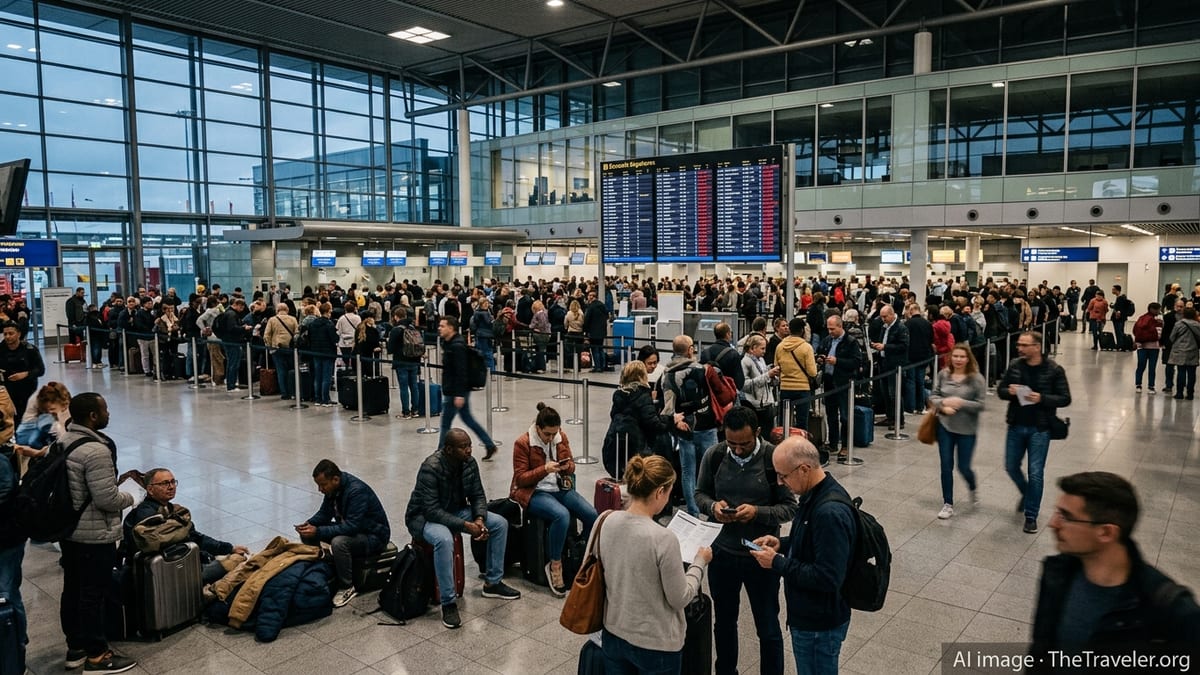
The scale of the cancellations placed immediate strain on the airport’s terminals, with images shared by travelers on social platforms showing dense crowds at check-in, transfer desks and security points. Publicly available information suggests that airport contingency plans were activated, but the sheer number of affected passengers made rapid recovery difficult.
Ripple Effects Across Europe and Global Networks
The loss of 445 flights at a key hub on March 18 had an outsized effect across the wider European aviation system. Many of the cancelled services were part of complex connecting itineraries, and when those flights disappeared from the schedule, downstream flights departing from other European airports were left with empty seats or delayed departures as airlines attempted to consolidate passengers.
According to data shared by major flight-tracking services, airports in neighboring countries recorded elevated levels of delays and a noticeable uptick in last-minute schedule changes throughout the afternoon and evening. Some carriers redirected aircraft to alternative hubs to reposition crews and equipment, while others opted to trim frequencies on lower-demand routes in the following days to create capacity for stranded travelers.
Long-haul networks were particularly affected. Reports indicate that transatlantic flights to major North American cities departed with substantial numbers of no-show passengers whose feeder flights into the hub never operated. Similarly, services linking Europe with key destinations in the Middle East and Asia experienced schedule disruption, with some aircraft departing late to await rebooked passengers while others left on time but with unfilled seats that would normally be occupied by transfer traffic.
For regional airports around Europe, the disruption translated into unexpected congestion at arrival halls as passengers on rerouted itineraries arrived at different times and on different carriers than originally planned. Ground transport providers, including intercity rail and long-distance coach operators, reported higher-than-normal demand from travelers seeking alternative routes.
Stranded Passengers Face Long Queues and Limited Options
For the estimated 57,000 travelers directly affected, March 18 quickly turned into an exercise in patience. Publicly available accounts from passengers describe hours-long queues at airline service desks, with many travelers standing in line only to learn that the next available replacement flight would depart days later due to constrained capacity during a busy travel period.
Hotel capacity near the airport and in the surrounding metropolitan area was rapidly consumed as airlines and travelers sought overnight accommodation. Travel industry observers noted that rooms within a short radius of the airport were reported fully booked by evening, pushing some passengers to seek lodging in outlying towns reachable only by late-night trains, buses or taxis.
Families traveling with children, elderly passengers and those with tight onward commitments, such as cruises, tours or business meetings, appeared to face some of the most acute challenges. Social media posts showed travelers improvising sleeping arrangements in terminal seating areas while they waited for rebooking confirmations, meal vouchers or updated information on the evolving situation.
Consumer organizations pointed to the episode as a reminder of the vulnerability of modern hub-and-spoke air travel, where the concentration of flights at a small number of mega-airports can magnify the impact of a single day’s disruption and leave passengers with few immediate alternatives.
Passenger Rights and the EU261 Framework
The events of March 18 again brought the European Union’s passenger rights regulation, commonly referred to as EU261, into sharp focus. Under this framework, travelers departing from EU airports or flying on EU-based airlines are entitled to specific forms of assistance in cases of cancellations and long delays, including meals, refreshments, accommodation where necessary and, under certain conditions, financial compensation.
Legal specialists and consumer advocates highlighted that eligibility for monetary compensation depends on the cause of the disruption. If the cancellations stem from factors described as extraordinary circumstances, such as certain categories of severe weather or airspace closures, carriers may not be required to pay compensation, although they must still provide care and basic support. If the cause relates to the airline’s own operations, technical issues or crew availability, compensation may be due.
In practice, passengers affected on March 18 were encouraged by advocacy groups to retain boarding passes, written notices and receipts for essential expenses incurred during the disruption. Public guidance from national enforcement bodies typically advises travelers to submit claims directly to the operating carrier first, and then escalate to regulatory channels or alternative dispute resolution schemes if the outcome is disputed.
Given the volume of affected passengers, travel law observers expect a significant number of claims to be lodged in the weeks following the incident, with potential backlogs for airline customer-service teams and national complaint-handling bodies tasked with reviewing EU261-related cases.
Calls for Stronger Resilience and Contingency Planning
The mass cancellations have prompted renewed debate about the resilience of Europe’s major hub airports in the face of operational shocks. Industry analysts note that the region’s biggest hubs typically operate close to capacity, leaving limited room to absorb sudden disruptions without large-scale schedule cuts. When an event of this magnitude occurs, options for quickly reallocating aircraft and crews are constrained.
Recent policy discussions at European level have emphasized the need for detailed contingency planning for large disruptions, building on regulatory expectations that airports and airlines coordinate closely on crisis response. Travel industry commentators argue that events such as those on March 18 demonstrate the importance of stress-testing these plans, particularly around passenger care, communication and the rapid deployment of additional staff during peak disruption windows.
Digital tools are expected to play a growing role in future responses. Technology providers and airline IT specialists have highlighted the potential of real-time rebooking platforms, automated voucher delivery and clearer mobile messaging to reduce the need for long physical queues at desks. However, the events at the hub show that even advanced systems can be quickly overwhelmed when tens of thousands of passengers require itinerary changes within a few hours.
For travelers, the March 18 disruption serves as another reminder to build flexibility and contingency time into itineraries that rely on tight connections through major hubs. Travel advisers commonly recommend allowing generous layover times, considering overnight staging points for critical journeys and maintaining travel insurance that explicitly covers missed connections and extended delays during periods of large-scale disruption.