

More news on this day
More than 120 flights in and out of Doha have been cancelled in recent days, creating severe disruption for passengers on Qatar Airways, Gulf Air, Malaysia Airlines and other carriers relying on Qatar’s Hamad International Airport as a key transit hub.
Get the latest news straight to your inbox!
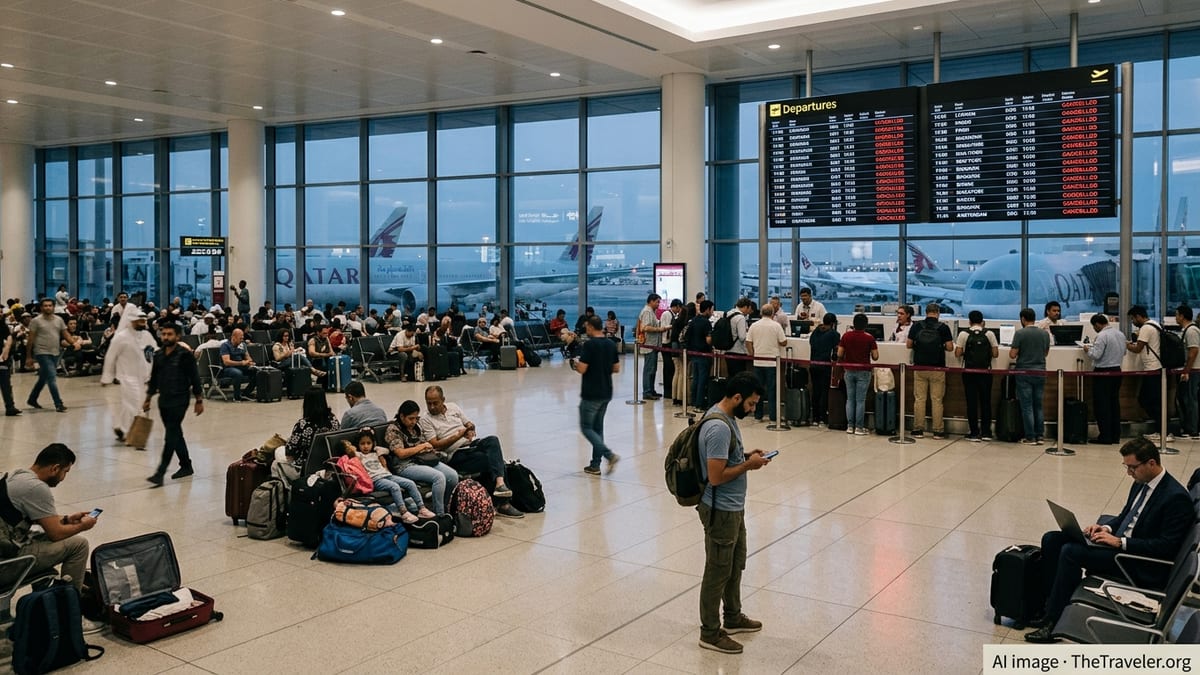
Wide-Scale Disruptions Hit Doha Hub
Hamad International Airport has become a focal point of aviation disruption as airlines sharply reduce operations through Qatar. Publicly available flight information and traveler reports indicate that over 120 services touching Doha have been cancelled within a short period, affecting both origin and connecting traffic. The cancellations span a mix of long-haul and regional routes, leaving passengers facing extended delays, rerouting and last-minute itinerary changes.
Qatar Airways, the dominant carrier at Doha, has implemented a heavily reduced interim schedule while other airlines that rely on the hub for connectivity have trimmed or suspended services. According to published coverage and updated schedules, the carrier has consolidated frequencies on key trunk routes and suspended others outright, contributing to a rolling wave of cancellations that is still evolving.
The disruption coincides with broader instability in Gulf airspace, where restrictions and operational constraints have forced airlines to repeatedly adjust flight plans. Travel advisories describe commercial operations at Hamad International as limited and highly subject to change, warning of backlogs and prolonged queues as carriers work through schedule revisions.
Key Long-Haul Routes to Europe, Asia and the US Affected
Among the most severely affected services are long-haul routes linking Doha with major global cities including London, Paris, Singapore, New York, Bangkok and Amsterdam. Updated timetables show sharply reduced frequencies on several of these corridors, with some flights removed from sale and others retimed or downgraded to smaller aircraft. Passengers holding tickets on these routes report flights disappearing from airline apps, legs of journeys being cancelled while others remain active, and new itineraries appearing with significantly longer layovers in Doha.
On Europe-bound services, reports of cancellations and downsized schedules have focused on connections from Doha to London Heathrow, Paris Charles de Gaulle and Amsterdam. Interim timetables indicate that certain daily rotations have been cut, while others operate only several times per week. Travelers transiting through Qatar to reach secondary European cities have described struggling to find replacement options when their Doha flights were removed from the schedule.
In Asia, connections to Singapore and Bangkok have also been affected as airlines rebalance their networks. Revised schedules show reduced weekly frequencies between Doha and Singapore and adjustments on the popular Doha to Bangkok corridor. Some passengers travelling between Europe or the Middle East and Southeast Asia via Doha have reported being rerouted on alternative carriers through different hubs when their original Qatar itineraries were cancelled.
Transatlantic links are not immune. Services between Doha and New York have been operating on a trimmed basis, with fewer weekly departures than originally planned. These cuts ripple across connecting markets, impacting passengers travelling between North America and destinations in South Asia, Africa and Oceania that typically depend on Doha as a one-stop gateway.
Knock-On Effects for Gulf Air, Malaysia Airlines and Partner Carriers
The turmoil is not limited to Qatar Airways. Gulf Air, Malaysia Airlines and other partner carriers that depend on Doha and neighbouring Gulf hubs for connectivity have also been forced to recalibrate their operations. Public notices and commercial policy updates show Gulf Air extending flexible cancellation and change options for flights across March, in recognition of the heightened uncertainty in the region.
Malaysia Airlines and various codeshare partners have, according to publicly available information, reduced exposure to the Gulf by suspending or consolidating services that route through Qatar and nearby states. This has had a direct impact on passengers booked on multi-carrier itineraries that include a Doha sector, where a cancellation by one airline can invalidate connections on another. Some travelers have reported being advised to seek alternative routings through hubs outside the immediate Gulf region, such as via Istanbul or key European and Asian gateways.
Airlines that interline with Qatar Airways for onward connections have also faced difficult choices. Capacity cuts at the Doha hub force partner carriers either to reroute customers over different hubs or to issue refunds where viable alternatives cannot be arranged. The result has been a wave of itinerary rewrites involving multiple airlines, often within a very tight timeframe before scheduled departure.
Passengers Face Cancellations, Long Layovers and Limited Alternatives
For individual travelers, the operational picture on the ground has translated into chaotic and often stressful experiences. Passengers connecting through Doha have described seeing one leg of their journey cancelled in booking systems while the other remains active, leading to confusion over whether their full itinerary will operate. In some cases, entire round-trip bookings have partially disappeared from airline apps, with only return segments still visible.
Travelers bound for London, Amsterdam, Bangkok and other major cities report being rebooked onto earlier departures, diverted to alternate hubs, or left with uncomfortably long layovers in Doha as airlines piece together workable routings. Some have accepted itineraries involving overnight or 15-hour layovers at Hamad International, while others have opted to cancel and seek refunds or book with different carriers altogether.
Reports also suggest that call centres and digital customer service channels are operating under significant strain, with long hold times and intermittent availability. Airlines have encouraged passengers to monitor mobile apps and manage bookings online where possible, but frequent schedule changes mean that travelers may need to check repeatedly in the days leading up to departure.
The disruption has particularly affected those travelling for time-sensitive events such as weddings, work obligations or connecting cruises. With limited spare capacity on alternative routings, many passengers have had to make rapid decisions about whether to wait for potential rebooking options via Doha or shift their travel plans entirely to other hubs in Europe or Asia.
Uncertain Outlook as Interim Schedules Continue to Shift
The outlook for operations through Doha remains uncertain, with interim schedules revised multiple times during March. Published timetable updates suggest that Qatar Airways is gradually reinstating some routes and increasing frequencies on others, including a phased return of larger aircraft on services to London and Bangkok, but at levels still below its previous network reach. Industry observers note that further adjustments remain likely as conditions in regional airspace and demand patterns evolve.
Travel advisories continue to urge caution for those planning to transit the Gulf, highlighting the potential for short-notice cancellations, equipment changes and extended layovers. Publicly available guidance recommends that passengers holding tickets on flights touching Doha monitor their bookings closely, ensure contact details are up to date, and remain prepared for last-minute changes.
For now, the combination of reduced capacity, operational constraints and volatile schedules means that travel through Qatar’s once reliably smooth hub is far less predictable than usual. Until airlines can restore more stable patterns of service, passengers on routes linking Doha with London, Paris, Singapore, New York, Bangkok, Amsterdam and other key cities should expect a higher risk of disruption and plan their journeys with additional flexibility in mind.