

More news on this day
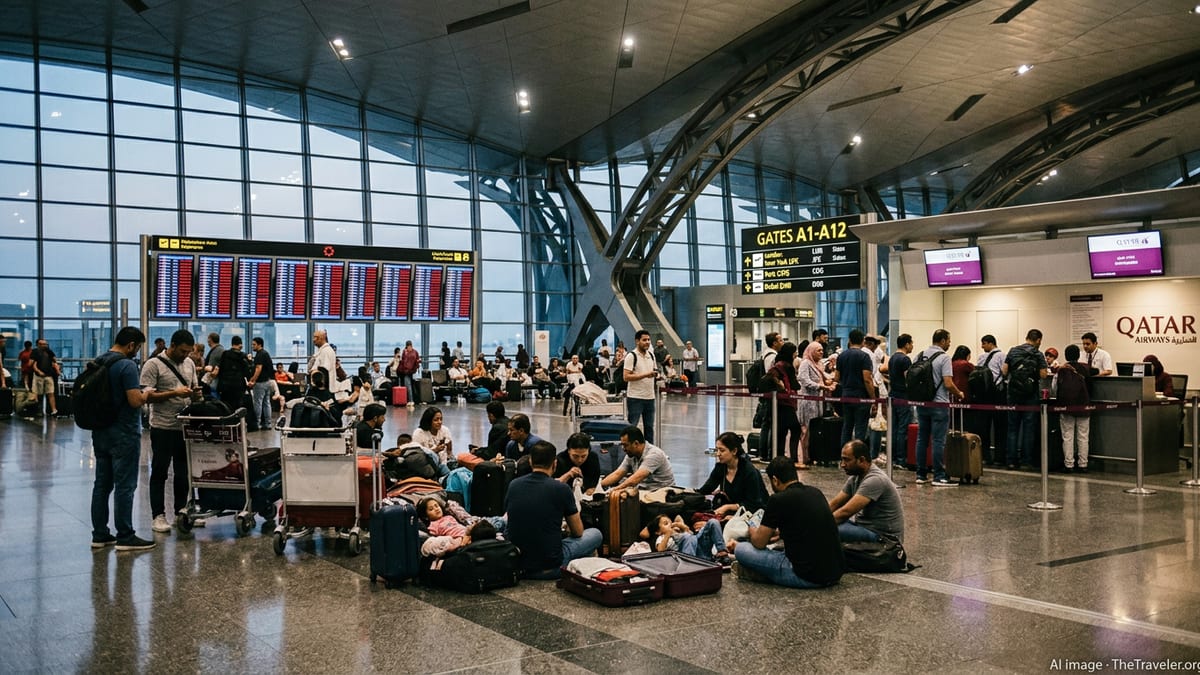
Travelers connecting through Doha’s Hamad International Airport are facing severe disruption as hundreds of flights are canceled or rerouted amid regional security tensions, leaving passengers stranded across cities including Doha, London, New York, Paris and Dubai.
Get the latest news straight to your inbox!
Regional Tensions Trigger Widespread Airspace Disruption
Publicly available information indicates that air operations over parts of the Gulf have been heavily disrupted in March 2026 as the Iran–Israel–United States conflict spills into surrounding airspace. Summaries of recent events describe Iranian missile launches toward Qatar and other states, prompting temporary airspace closures and restrictions affecting commercial aviation in and out of Doha.
Reports on the developing situation note that Hamad International Airport, Qatar’s main international gateway, has seen commercial operations significantly curtailed at various points in early March. Advisories compiled by risk and security consultancies describe the airport as partially open with limited movements and emphasize the possibility of short-notice changes to flight schedules, diversions and cancellations as conditions evolve.
Against this backdrop, airline schedules across the region have been redrawn. Qatar Airways, which usually operates one of the world’s largest global connecting networks through Doha, has been joined by regional carriers such as Gulf Air and Saudia in adjusting or suspending services on specific routes. Long-haul operators that rely on Doha as a key hub are also reported to be affected as they navigate restricted corridors and heightened security considerations.
The result is a cascading effect across continents: once a major transfer hub experiences a sustained reduction in capacity, delay and cancellation waves quickly appear at origin and destination airports in Europe, North America, Africa and Asia. This has contributed to a sharp spike in disrupted journeys involving Doha and in knock-on cancellations on routes to and from cities such as London, Paris, New York and Dubai.
Flight Cancellations Mount Across Global Networks
Operational data and traveler accounts circulating online point to a rolling pattern of cancellations on Qatar Airways services since early March, coinciding with the most acute phase of regional tensions. While exact daily totals fluctuate, reports describe days with several hundred flights removed from schedules, including long-haul sectors and feeder flights that normally sustain the airline’s hub-and-spoke model through Doha.
Regional airlines Gulf Air and Saudia have also publicly acknowledged route suspensions and schedule changes in response to evolving airspace advisories. In North Africa, Royal Air Maroc services that typically intersect with Gulf traffic patterns have been affected on selected days, particularly where flights traverse or connect through the Gulf region. Industry trackers indicate that combined cancellations across these and other affected carriers have run into the hundreds as airlines seek to comply with safety directives while maintaining limited corridors where possible.
In addition to outright cancellations, there has been extensive use of rerouting and aircraft swaps. Some long-haul flights that would usually operate via Doha have been reconfigured as nonstop services where aircraft range allows, while others have been shifted to alternate hubs in the Middle East and Europe. These workarounds reduce the absolute number of stranded passengers but can still leave travelers facing extended layovers, missed connections and last-minute rebookings.
Capacity constraints are further intensified by the concentration of cancellations around high-demand dates in mid and late March. With advance bookings already strong for school holidays and spring travel, airlines attempting to condense passengers from multiple cancelled flights onto a reduced schedule have faced limited seat availability, particularly in and out of major markets like London Heathrow, Paris Charles de Gaulle, New York, Dubai and key South Asian gateways.
Passengers Stranded from Doha to London and New York
Travelers attempting to pass through Doha report a rapidly changing operational picture. Some describe reaching Hamad International Airport to find departure boards dominated by the word “cancelled,” while others recount receiving notification of cancellations through airline apps only hours before scheduled departure. In many cases, multi-leg itineraries involving transits in Doha, such as journeys between Africa and North America or Asia and Europe, have broken down at the hub stage.
The impact is highly visible at global connection points. In London and Paris, passengers with Qatar Airways, Gulf Air, Saudia and Royal Air Maroc tickets have shared accounts of extended airport stays as they seek alternative routes. New York area airports have also reported growing clusters of disrupted travelers attempting to rebook onto other transatlantic or Europe–Gulf services, frequently competing for space on already busy flights.
In the Gulf itself, Dubai has emerged as a critical pressure point. As one of the region’s largest hubs with multiple carriers and route options, it has absorbed a portion of passengers unable to transit through Doha. However, this surge in demand has placed additional stress on schedules, with some services from Dubai to Europe and Asia reportedly departing full for several consecutive days, limiting the ability of airlines to accommodate late-notice rebookings from Doha-linked itineraries.
Onward travel beyond these hubs presents further challenges. With seat inventory tight and some neighboring countries also enforcing route suspensions or airspace adjustments, passengers originating in secondary cities across Africa, South Asia and Southeast Asia have sometimes struggled to secure new connections home. This has led to reports of travelers facing multi-day delays, overnight stays at transit points and the need to temporarily fund additional accommodation and living costs while waiting for confirmed alternative flights.
Limited Operations and Repatriation-Style Flights
Even as large portions of the regular schedule remain cut back, publicly shared operational updates from Qatar Airways indicate that the airline has been running a skeleton network of departures from Doha where safe corridors have been identified. In some periods, these flights have functioned in a manner similar to repatriation services, focusing on returning travelers to key home markets such as London, Paris, Frankfurt, Madrid and Rome.
These limited operations are subject to rapid adjustment. Advisories compiled by travel security analysts emphasize that route permissions and overflight clearances can shift within hours, prompting sudden changes to departure times or last-minute cancellations. Passengers booked on these flights are being urged, through airline statements and widely circulated guidance, to monitor their booking status and flight trackers closely rather than assuming previously issued schedules will hold.
Other carriers with a presence at Hamad International Airport have pursued similar strategies, maintaining a narrow set of point-to-point flights into and out of Doha where security assessments permit. This has included coordination with partner airlines in Europe, North America and Asia to provide onward connectivity, although the reduced number of through-services and the requirement to avoid certain airspace sectors have constrained the overall effectiveness of such arrangements.
The ultra-competitive Gulf aviation landscape, normally defined by dense long-haul connectivity, is therefore exhibiting patterns more usually associated with crisis response. Aircraft rotations, crew positioning and maintenance windows are being replanned at short notice, and many standard seasonal schedule increases for late March are being postponed or revised.
What Travelers Can Expect in the Coming Days
Forward-looking advisories from travel risk consultancies and aviation analysts suggest that disruption centered on Doha is likely to persist in the short term, even if the intensity of regional tensions fluctuates. Flight schedules published for the second half of March show a continued reduction in frequencies on some of Qatar Airways’ flagship routes, alongside indications of gradual restoration on others as airlines test newly approved corridors.
Passengers currently booked to travel through Hamad International Airport are being advised, through publicly available guidance, to treat flight status as highly dynamic. Industry experts recommend confirming bookings directly via airline websites or mobile applications on a repeated basis in the 48 hours before departure and again on the day of travel, as cancellations and retimings may appear with limited notice.
Travel planning is also becoming more complex for those yet to depart. Some tour operators and corporate travel managers are encouraging travelers to consider routings via alternate hubs where more stable schedules are available, even if this involves additional connections or slightly longer journey times. At the same time, airlines have expanded disruption policies in recent weeks, allowing many passengers to rebook, reroute or request refunds without standard change penalties, subject to ticket conditions.
For now, Hamad International Airport remains at the center of a volatile operating environment. Its status as a leading global hub means that even partial suspensions reverberate through airline networks on several continents. Until a more durable easing of airspace restrictions is reflected in published schedules, travelers connecting through Doha and neighboring hubs should expect elevated risks of cancellation, missed connections and extended travel times.