

More news on this day
Thousands of airline passengers across the United States were left stranded or sleeping in terminals after a fresh wave of disruptions saw at least 446 flights canceled and nearly 5,000 delayed at major hubs including Seattle, Chicago, Charlotte, New York and Cleveland.
Get the latest news straight to your inbox!
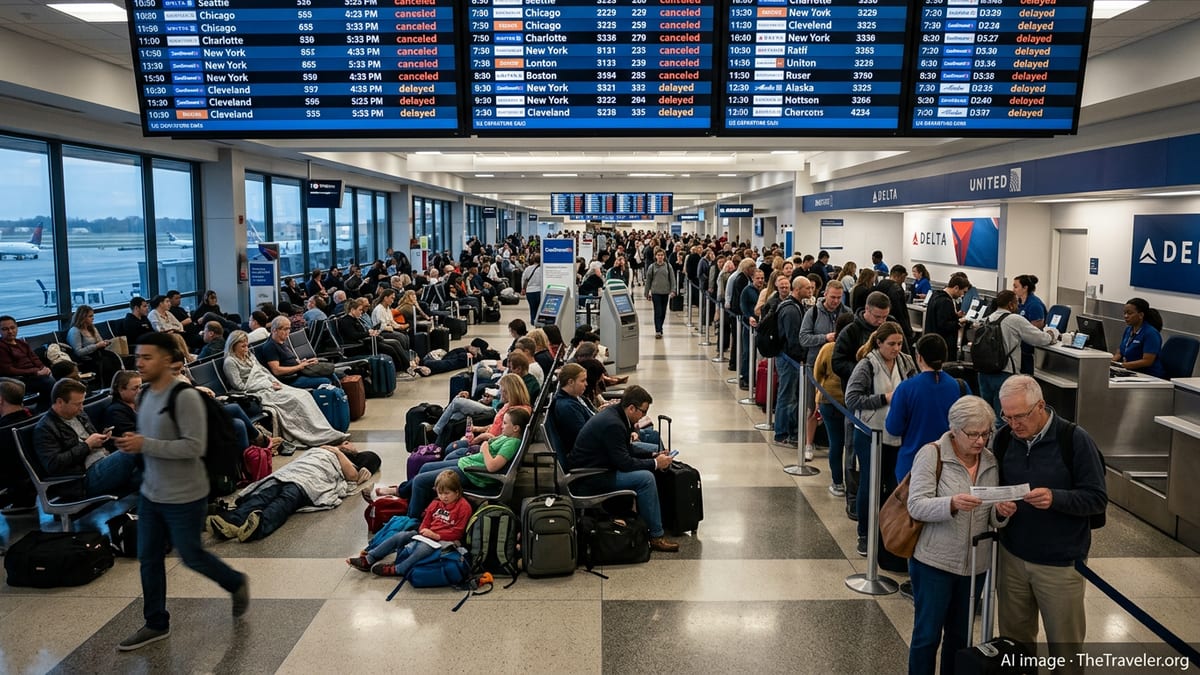
Airline Operations Snarled Across Major US Hubs
The latest operational breakdown rippled across the national air network, hitting both legacy carriers and regional operators. PSA Airlines, a regional carrier for American Airlines, along with Delta, United, Southwest and Alaska, were among those reporting clusters of canceled and heavily delayed flights. The disruption was felt most acutely at hub and focus cities, where one bottleneck quickly cascaded into missed connections and rolling delays throughout the day.
At Seattle-Tacoma International Airport, long lines snaked from check-in counters to security checkpoints as passengers tried to rebook after early-morning cancellations triggered a backlog that spilled into the afternoon. In Chicago, both O’Hare and Midway saw departure boards dominated by orange and red status alerts, with airlines repeatedly pushing back departure times as they waited for inbound aircraft and flight crews to arrive.
Airports in Charlotte, New York and Cleveland experienced similar scenes, with domestic and regional flights bearing the brunt. While a limited number of long-haul services departed close to schedule, domestic connections feeding those flights were plagued by delays of one to three hours, effectively stranding travelers mid-journey even if their long-haul segments remained nominally on time.
Industry analysts noted that even a few hundred outright cancellations can affect far more flights and passengers once knock-on effects are taken into account. With schedules still operating close to capacity on many routes, airlines had little slack to absorb the sudden spike in irregular operations.
Passengers Face Overnight Stays and Missing Luggage
For passengers, the statistics translated into missed vacations, lost workdays and nights spent trying to sleep upright in crowded gate areas. Families described racing between terminals in search of rebooking options, only to find the last available seats on alternative flights already taken by other stranded travelers. Many reported being told that the next confirmed seats to their destinations were not available until one or two days later.
Hotel vouchers and meal coupons were offered inconsistently, leaving some travelers with support while others were left to pay out of pocket for last-minute rooms or to camp in the terminal. At several airports, cots were set up in quiet corridors as airport staff attempted to manage growing numbers of people facing unplanned overnight stays.
Baggage systems also struggled under the strain. Suitcases continued to arrive on flights that did make it out, even as their owners found themselves stuck at origin airports or rerouted through different hubs. Piles of unclaimed luggage developed near carousels and in secure storage rooms, with airport announcements repeating instructions to file delayed baggage claims and check status updates through airline apps.
By late evening, social media feeds were crowded with images of crowded concourses and long customer service lines, along with screenshots of repeated delay notifications and last-minute cancellation alerts. For many frequent flyers, the scenes revived memories of previous mass disruption events that have hit US aviation in recent years.
Weather, Congestion and Crew Availability Under Scrutiny
While specific causes varied from airport to airport, a combination of adverse weather, congested airspace and tight crew availability appeared to be at the center of the latest round of disruptions. Short bursts of severe weather around major hubs can quickly trigger ground stops and reroutings, forcing airlines to reshuffle aircraft and crews in a network that often has little margin for error.
Airline executives and aviation experts have repeatedly warned that the system remains vulnerable to such shocks, especially during peak travel periods. When storms, low visibility or high winds force temporary halts to departures and arrivals at a major hub, the capacity crunch can ripple through the system for hours. Flights that do depart may do so with crews nearing duty-time limits, raising the risk of later cancellations if legal limits are exceeded before a full schedule can be recovered.
Regional carriers, including PSA, are especially exposed because they operate dense schedules with smaller fleets and highly synchronized connections into their mainline partners. A disruption early in the day can quickly lead to aircraft and crews being out of position, with fewer spare planes available to plug the gaps. That in turn makes it harder for the major carriers they feed, such as American, Delta or United, to maintain smooth connections for passengers on multi-leg itineraries.
In recent years, federal transportation officials have urged airlines to strengthen their contingency planning, improve staffing buffers and communicate more proactively with customers during irregular operations. The latest incident is likely to renew scrutiny of how effectively those measures are being implemented across different carriers.
Travelers Weigh Changing Plans and Modes of Transport
As cancellations mounted, many travelers made the difficult choice to abandon their itineraries altogether and seek refunds or credits, particularly for short-haul routes that could be replaced with long drives or rail journeys. Others sought creative workarounds, booking last-minute one-way tickets on competing airlines, even at elevated fares, to salvage crucial meetings, family events or international connections.
At airports serving overlapping markets, such as New York’s trio of major airports and Chicago’s dual gateways, some stranded passengers tried to switch departure points entirely, racing across town in hopes of finding seats from a different terminal before those too disappeared. Anecdotally, rideshare drivers near affected airports reported a spike in trips between hubs as people tried to outmaneuver the disruption.
For travelers with more flexibility, the disruption served as a stark reminder of the benefits of building slack into itineraries, particularly when connecting through busy hubs or during periods of unstable weather. Some passengers arriving at their destinations a day or two late noted that they had begun scheduling critical events at least a day after their planned arrival, anticipating that major disruptions like this one are becoming more frequent rather than less.
However, for leisure travelers working around limited vacation days or families coordinating complex plans, that kind of buffer is not always practical. For them, the wave of cancellations and delays reinforced growing frustration about the unpredictability of domestic air travel, even outside of traditional holiday peak periods.
Pressure Mounts on Airlines and Regulators
The episode is likely to add pressure on both airlines and federal regulators to address the recurring pattern of large-scale operational breakdowns. Passenger advocacy groups argue that carriers have not invested enough in resilience, including spare crews and aircraft, and that travelers are too often left bearing the cost when schedules fall apart.
Lawmakers have already been examining proposals to strengthen passenger protections, particularly around compensation when passengers are stranded for reasons within an airline’s control. Although weather-related disruptions are typically exempt from mandatory compensation rules, consumer advocates say the line between unavoidable events and preventable operational failures has grown increasingly blurred.
For their part, airline leaders have maintained that they are balancing the need for operational resilience with ongoing financial pressures, including higher labor, fuel and maintenance costs. They also point to broader constraints in the national airspace system, including air traffic control staffing and outdated infrastructure, as factors that limit their ability to recover quickly when severe weather or technical issues arise.
As operations gradually stabilize following the latest wave of disruptions, attention will now turn to how carriers adjust schedules and staffing for the months ahead. With spring and summer travel demand expected to remain strong, the question for many passengers is not whether there will be another day like this, but when it will arrive and how prepared the system will be to handle it.