

More news on this day
Hundreds of travelers have been left stranded across Mexico after widespread disruption at major hubs in Mexico City, Tijuana, Guadalajara, and Monterrey led to the cancellation of 34 flights and delays to at least 46 more, affecting operations at VivaAerobus, Volaris, American Airlines, Aeroméxico, and other carriers.
Get the latest news straight to your inbox!
Major Mexican Hubs Hit by Widespread Disruptions
Publicly available flight-tracking data and local media reports indicate that services at Benito Juárez International Airport in Mexico City, as well as key northern and western gateways in Tijuana, Guadalajara, and Monterrey, experienced an abrupt wave of cancellations and delays. The disruption unfolded across both domestic and international routes, intensifying throughout the day as knock-on effects spread through already busy schedules.
The 34 cancelled and 46 delayed flights represent a significant portion of daily movements for some routes linking these cities, where multiple daily frequencies are typically operated by VivaAerobus, Volaris, and Aeroméxico, alongside U.S. airlines such as American Airlines. The concentration of irregular operations at four of Mexico’s busiest airports quickly translated into long queues, missed connections, and crowded terminal areas as passengers sought rebooking options.
Operational data show that these hubs are tightly interconnected, with carriers using Mexico City and Monterrey as key connecting points and Tijuana and Guadalajara as high-density trunk and regional gateways. Any disruption at multiple hubs simultaneously can therefore ripple across the national network, compounding delays and forcing airlines to reshuffle aircraft and crews.
While the precise balance between weather, operational constraints, and other factors varied by airport and carrier, the net effect was a widespread reduction in on-time performance over the course of the day, with some routes experiencing multiple consecutive delayed departures.
VivaAerobus, Volaris and Aeroméxico Among Most Affected
Low cost carriers VivaAerobus and Volaris, together with full service operator Aeroméxico, account for a large share of domestic capacity linking Mexico City, Tijuana, Guadalajara, and Monterrey. Publicly available route and frequency data show that these airlines typically operate numerous daily services on these corridors, leaving them especially exposed when schedules begin to unravel.
VivaAerobus, which has built a dense network from Monterrey and other secondary hubs, saw a number of its high-frequency domestic links disrupted, including routes where aircraft are turned around several times per day. Volaris, which likewise maintains substantial capacity from Tijuana and Guadalajara, also experienced cancellations and extended delays that affected onward connectivity for passengers traveling to and from northern border and U.S.-bound services.
Aeroméxico, the country’s largest full service airline, faced its own operational challenges as cancellations and delays at Mexico City reverberated through its network. With many passengers using Mexico City as a connecting hub for both domestic and international flights, even a relatively small number of cancellations can trigger missed onward connections and the need for hotel accommodation or next-day rebooking.
American Airlines and other U.S. carriers, which operate a mixture of point-to-point and hub-feeding services into these Mexican airports, were also affected when aircraft and crews were caught up in the disruption pattern. For travelers attempting same-day connections onward to the United States, irregular operations in Mexico often translate into cascading delays across the border.
Travelers Face Long Queues, Rebookings and Overnight Stays
According to published coverage in Mexican and international media, the sudden wave of cancellations and delays left many passengers waiting for hours at check-in counters and service desks as airlines worked through rebooking requests. Some travelers reportedly spent the night in airport terminals after available hotel capacity near the airports was exhausted or after being offered first-available flights departing the following day.
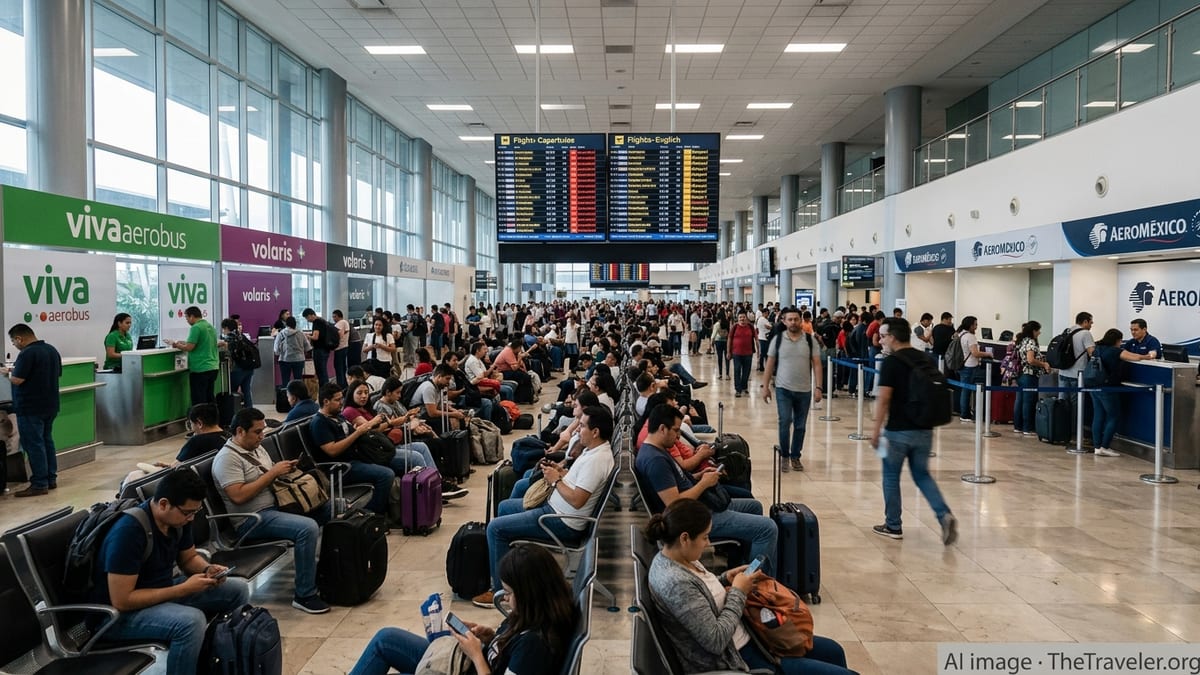
At Mexico City’s primary international airport, photos and descriptions shared on social platforms showed crowded departure halls, with passengers seated on the floor surrounded by luggage as they awaited new itineraries. Similar scenes were reported in Tijuana and Guadalajara, where lines formed at customer service counters for VivaAerobus, Volaris, Aeroméxico, and American Airlines.
Families traveling with children and elderly passengers appeared particularly affected by the length of delays and the shortage of clear information during peak periods. Publicly available passenger accounts describe instances of gate changes announced at short notice and boarding processes paused and restarted as crews and aircraft were reassigned.
For many travelers, the disruption also led to missed events and lost vacation time, as same-day arrivals turned into unplanned stopovers. Tourists heading to resort destinations via connections in Mexico City, Guadalajara, or Monterrey were among those forced to rework itineraries on short notice.
Knock-on Effects Across Mexico’s Domestic Network
Industry data on Mexico’s air connectivity underline how quickly problems at a handful of major hubs can spread through the wider domestic network. Schedules for 2025 and 2026 show dense webs of flights operated by VivaAerobus, Volaris, Aeroméxico, and their competitors linking Mexico City, Tijuana, Guadalajara, and Monterrey to dozens of secondary cities across the country.
When aircraft and crews are held on the ground due to delays at these primary airports, subsequent rotations to destinations such as León, Culiacán, Hermosillo, Querétaro, and others can be pushed back or cancelled. Publicly available schedules list high weekly frequencies on many of these routes, which means a single delayed aircraft can affect multiple flights within the same day.
These knock-on effects are particularly pronounced for low cost carriers that rely on tight turnarounds to maintain high aircraft utilization. If one early flight in the day is significantly delayed or cancelled, each subsequent sector for that aircraft may depart late or be swapped with another plane, creating a complex puzzle for airline operations teams.
For passengers traveling to or from smaller regional airports, this can translate into sudden changes to departure times, unexpected overnight stays at hub airports, or the need to route via an alternative city entirely. Travel planners note that such network-wide disruptions can persist into the following day as airlines work to reposition aircraft and normalize schedules.
What Passengers Can Do During Major Disruptions
Consumer advocates point out that during large-scale disruptions affecting multiple airlines and airports at once, travelers have limited but important options to reduce inconvenience. Public guidance commonly emphasizes checking flight status frequently via airline apps or airport information screens, rather than relying on printed boarding passes, which can become outdated quickly when schedules are shifting.
Passengers are also advised in widely circulated travel guidance to keep documentation of delays and cancellations, including screenshots and written confirmation of any revised itineraries, which can be useful when seeking refunds, vouchers, or compensation where applicable under airline policies. In cases where overnight stays become necessary, travelers are encouraged to ask carriers about available support such as meal vouchers or hotel arrangements.
For future trips, travel experts frequently recommend allowing extra connection time when routing through busy hubs such as Mexico City, Tijuana, Guadalajara, and Monterrey, especially during peak travel seasons or when weather or operational strains are more likely. Flexible tickets or travel insurance with coverage for missed connections and delays can also provide added protection when unforeseen disruptions occur.
While operations at major Mexican airports typically normalize within a day or two after an event of this scale, the experience of hundreds of stranded travelers during this latest wave of cancellations and delays underscores the vulnerability of tightly scheduled domestic and international networks to sudden shocks, and the importance for passengers of staying informed and prepared.