

More news on this day
Travel across three continents was severely disrupted on April 11, 2026, as Cairo International Airport experienced a wave of more than 100 delayed flights, tangling vital air routes between Europe, the Middle East, and North Africa and leaving passengers facing long queues, missed connections, and uncertain travel plans.
Get the latest news straight to your inbox!
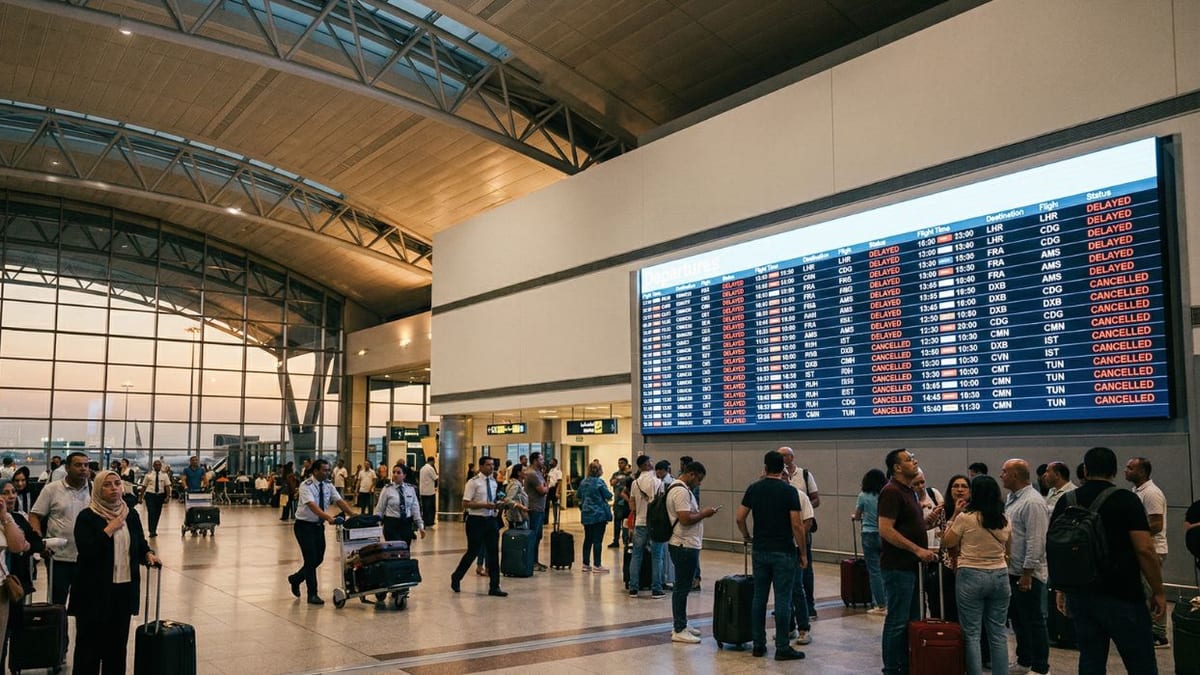
Delays at One of Africa’s Busiest Hubs Ripple Across Three Regions
Publicly available operational data and industry tracking platforms show that Cairo International Airport, already under pressure from weeks of regional airspace disruption, saw delays surge into triple digits on April 11. Reports indicate that well over 100 flights were affected across arrival and departure banks, with some services pushed back by several hours.
The disruption at Cairo, a major transfer point linking African, European, and Gulf networks, quickly cascaded across the broader system. Delayed departures to London, Paris, Frankfurt, Rome, Istanbul, Athens, and other European cities contributed to late arrivals at downstream airports, where tight turnarounds gave airlines limited flexibility to recover schedules. Similar patterns emerged on services to regional hubs in the Gulf and Levant, as carriers attempted to absorb knock-on congestion.
Recent coverage highlighting a broader spike in delays at Cairo, including nearly 200 disrupted flights in the preceding days, underscores how April 11 marked a new flashpoint in an already fragile operating environment. With the airport routinely ranking among the busiest in Africa and the Middle East, even modest schedule slippage can quickly multiply into extensive disruption across multiple continents.
Passengers connecting through Cairo reported extended time on the tarmac, re-screening at security checkpoints, and long waits at transfer desks as airlines worked through rebooking backlogs. For travelers bound to or from secondary cities in Europe, North Africa, and the Gulf, missed connections often meant unplanned overnight stays or rerouting through alternative hubs.
Middle East Airspace Restrictions and Reroutes Add Minutes and Complexity
The Cairo delays unfolded against a backdrop of prolonged turbulence in Middle Eastern airspace. Updated advisories from European and regional aviation bodies in early April extended conflict-zone and no-fly guidance over swathes of Iran, Iraq, Israel, Jordan, Lebanon, and parts of the Gulf, forcing carriers to adopt longer, more complex routings between Europe, the Middle East, and Asia.
Publicly available analysis shows that some European and Gulf airlines have added up to an hour or more of flying time on eastbound and westbound services to avoid restricted airspace. On April 11, this translated into aircraft and crew arriving late into Cairo from key partner hubs, compressing turnaround times and pushing subsequent departures behind schedule.
Specialist travel coverage notes that airlines serving Cairo and nearby hubs have been juggling a patchwork of reroutes, technical fuel stops in southern Europe, and reduced frequencies since late February. While a fragile ceasefire and the partial reopening of some Middle Eastern airspace have allowed limited recovery, schedules remained fragile in the days leading up to April 11, with many flights already operating on tight margins.
For Cairo’s role as a crossroad between Europe, the Gulf, and North Africa, the extended routings created a queue effect: late-arriving aircraft from one region translated into missed departure slots toward another. By midday on April 11, this network strain had built into a rolling wave of delays, with knock-on effects still visible in evening departure banks.
European Border-System Strains and Weather Complications Feed the Backlog
Conditions in Europe further complicated operations for flights originating or terminating in Cairo. In the days preceding April 11, Airports Council Europe and other industry bodies highlighted significant disruption at numerous European gateways tied to the phased roll-out of enhanced entry and exit systems for non-EU travelers. Longer processing times at border-control points led to missed departures, departure slot issues, and late-inbound aircraft across the continent.
Separately, travel-rights organizations documented more than a thousand delayed flights in Europe during early April, with weather around key hubs such as London Heathrow exacerbating an already stretched network. These pre-existing strains meant that when arrivals from Cairo ran late on April 11, many European airports and airlines had little spare capacity to absorb further schedule shocks.
The interplay between these European constraints and Cairo’s own congestion was particularly visible on routes linking Egypt with major hubs in the United Kingdom, Germany, France, Italy, and Spain. Passengers arriving late from Cairo often encountered crowded gates, re-timed departures, or rebookings as airlines prioritized operational reliability and crew duty limitations.
Industry observers note that while each delayed flight may add only minutes at an individual airport, the cumulative result across multiple hubs is a web of missed connections and displaced aircraft. On April 11, Cairo sat at the center of this web, with delays feeding in from and radiating back out to key European markets.
North Africa and Regional Networks Struggle to Maintain Connectivity
The impact of Cairo’s April 11 disruption was particularly acute within North Africa and the wider Middle East and North Africa region. Cairo’s extensive short- and medium-haul network, connecting to cities such as Tunis, Casablanca, Algiers, Khartoum, and coastal destinations along the Red Sea and Mediterranean, came under strain as delayed aircraft and crews struggled to keep up with tightly scheduled rotations.
Tracking data and regional travel reports indicate that several intra-North Africa services operated significantly behind schedule, while some domestic Egyptian routes experienced rolling delays as priority was given to long-haul and high-demand international flights. For travelers using Cairo as a bridge between North African capitals and European or Gulf hubs, the combination of upstream and downstream delays narrowed connection windows to the breaking point.
Regional low-cost and full-service carriers serving Cairo also faced a challenging environment. Limited spare aircraft and crew meant fewer opportunities for substitutions when flights slipped out of position. As a result, even relatively minor disruptions on early-morning sectors on April 11 translated into hours-long delays by late afternoon on routes around the Eastern Mediterranean and North Africa.
In parallel, wider Middle Eastern hub adjustments, including scaled-back frequencies and altered routings at airports in the Gulf following earlier airspace shutdowns, reduced the number of alternative options available for rebooking. Cairo’s role as a contingency hub was constrained by its own congestion, leaving some passengers with little choice but to wait for the network to reset.
Passenger Experience: Missed Connections, Long Queues, and Limited Options
For travelers passing through Cairo on April 11, the operational story translated into very personal challenges. Social media posts and traveler accounts described crowded departure halls, long lines at airline service counters, and confusion over revised boarding times as electronic display systems struggled to keep pace with constant timetable changes.
At the same time, publicly available consumer guidance from travel-rights organizations reminded passengers of their potential entitlements under European and UK compensation rules for eligible flights involving EU or UK carriers and airports. However, complex itineraries that spanned multiple jurisdictions, codeshare partners, and non-European airlines left many travelers uncertain about their specific rights or avenues for reimbursement.
Travel advisories issued during the broader Middle East airspace disruption had already urged passengers to check flight status repeatedly before heading to the airport, to allow extra time for security and border formalities, and to prepare for potential overnight delays. The events at Cairo on April 11 reinforced this message, illustrating how quickly a combination of regional reroutes, European system pressure, and local congestion can turn a routine connection into an extended ordeal.
As airlines and airports across Europe, the Middle East, and North Africa work to stabilize schedules in the days following April 11, Cairo’s turbulent day serves as a reminder of the fragile balance underpinning modern global aviation. With geopolitical uncertainty and infrastructure transitions ongoing, even a single day of heavy disruption at a major hub can send shockwaves across three regions and hundreds of flights.