

More news on this day
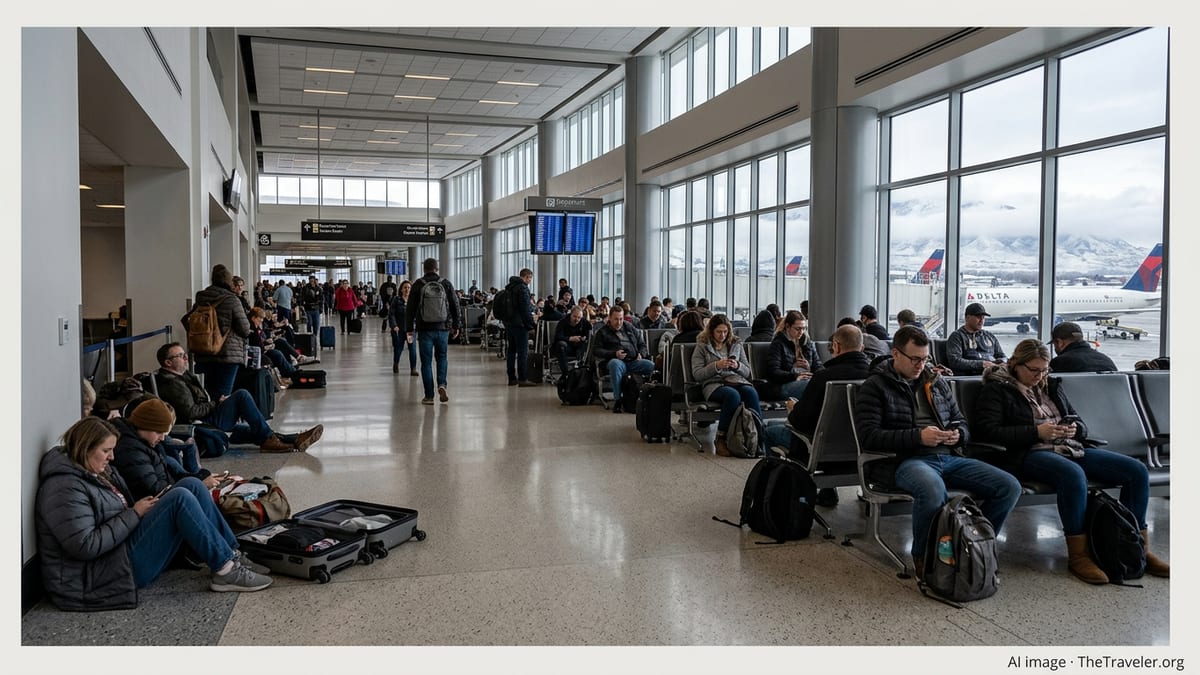
Travel at Salt Lake City International Airport faced major disruption after a wave of operational problems led to 122 delayed flights and 26 cancellations, stranding hundreds of passengers and complicating connections to major destinations across the United States.
Get the latest news straight to your inbox!
Operational Disruptions Ripple Across a Major Western Hub
Publicly available flight-tracking data and local coverage indicate that Salt Lake City International, one of the West’s key connecting hubs, experienced an unusually high volume of disruption as delays and cancellations mounted. In total, 122 flights were reported delayed and 26 were cancelled, affecting departures and arrivals throughout the day and into the evening.
The disruption affected a mix of mainline and regional services, with knock-on impacts across network schedules. As aircraft and crews fell out of position, later departures were pushed back, and several rotations were removed from the schedule altogether. The resulting congestion at gates and on taxiways added further strain to an already compressed operating window.
Salt Lake City International typically ranks among the country’s more reliable airports for on-time performance, which made the scale of the disruption particularly notable. Recent airport statistics show that Salt Lake City has maintained one of the lowest cancellation rates among major U.S. facilities, so a spike of this magnitude stands out against its usual operational profile.
Observers following the situation through aviation data platforms reported that the irregular operations extended into peak travel periods, affecting early-morning departures, midday bank flights, and evening connections. That broad coverage increased the likelihood that travelers would miss onward connections or arrive significantly later than planned.
Passengers Stranded and Connections to Major Cities Disrupted
The combination of 122 delayed flights and 26 cancellations left hundreds of passengers stranded in terminal concourses and at departure gates. With many flights operating late and others removed from the schedule, travelers heading to and from key destinations such as Denver, Los Angeles, Phoenix, Seattle, Chicago, Dallas, and Atlanta faced long waits and rebooking challenges.
Accounts shared on social media platforms described crowded gate areas, lengthy customer service queues, and rolling delay notifications on departure boards. Some travelers reported being rebooked on later same-day flights, while others were given itineraries extending into the following day as available seats on alternative services ran short.
Families traveling with children, business travelers on tight schedules, and passengers relying on tight connections were among those most affected. Travel plans carefully built around Salt Lake City’s role as a connecting hub unraveled as delays mounted, with some passengers missing events, meetings, and vacation start dates in cities across the country.
Reports also suggest that passengers connecting from smaller regional communities into Salt Lake City were particularly vulnerable. When a limited number of daily flights serve a given route, the cancellation of even a single leg can force travelers to wait many hours or, in some cases, overnight for the next available connection.
Weather, Airspace Congestion and System Strain Cited as Contributing Factors
Published coverage and recent discussions in aviation forums point to a combination of factors that can quickly cascade into significant disruption at a hub like Salt Lake City. Rapidly changing weather in northern Utah, including gusty winds and low-level wind shear, has previously been linked to holding patterns, runway configuration changes, and temporary reductions in arrival and departure rates.
When air traffic managers reduce the flow of aircraft for safety reasons, flights bound for Salt Lake City may be slowed, rerouted, or placed in airborne holding patterns. If conditions do not improve quickly enough, some flights may divert to alternate airports to refuel, while others are delayed at their origin to avoid ground congestion. Those changes can have lingering effects for hours after the underlying weather pattern moves on.
Airspace congestion and broader operational pressures in the national air travel system can amplify local challenges. If crews reach duty-time limits while waiting out weather or ground delays, flights may require new staffing. Mechanical inspections triggered by extended operations can also take aircraft temporarily out of service, tightening fleet availability and contributing to cancellations.
Salt Lake City International’s role as a key node for both domestic and regional traffic in the Intermountain West means that irregular operations there can reverberate across multiple airline networks. Delays in Salt Lake City can propagate to subsequent legs serving airports throughout the Mountain West, Pacific Northwest, Midwest, and beyond.
Guidance for Affected Travelers and Future Itineraries
Consumer travel advisories and airline customer service policies emphasize that passengers affected by delays or cancellations should monitor their airline’s mobile app or website, which typically reflects operational changes before airport departure boards. Same-day flight changes, standby options, and rerouting through alternate hubs may be available in certain cases, depending on fare rules and seat availability.
Travel industry guidance generally recommends that passengers with critical connections build additional time into their itineraries when flying through hub airports that are vulnerable to weather and airspace constraints. For Salt Lake City, this can be especially important during periods of active storm systems over the Great Basin and Rocky Mountain region, when rapid shifts in wind and visibility can affect runway operations.
Travelers with flexible schedules are often encouraged to consider early-morning departures, which statistically face fewer knock-on delays from earlier disruptions in the system. In addition, some consumer advocates suggest avoiding tight layovers when connecting through any major hub, particularly during peak holiday periods or seasons prone to storms.
In the wake of the latest disruptions at Salt Lake City International, passenger advocacy groups are reiterating general advice on documenting expenses and keeping records of delay notifications, as such information can be useful when seeking rebooking assistance or goodwill accommodations from travel providers.
Salt Lake City’s Reliability Record Tested by Irregular Operations
The episode underscores how even airports with strong on-time performance reputations can experience acute periods of stress. Historical data for Salt Lake City International highlights a track record of comparatively low cancellation rates and reliable operations, aided by extensive deicing infrastructure and experience managing winter weather.
Yet the concentration of 122 delays and 26 cancellations in a short period serves as a reminder that modern air travel relies on a tightly coupled system. A shift in weather patterns, an air traffic flow program, or a series of mechanical inspections can quickly ripple through that system, affecting travelers far beyond any single airport.
As carriers and airport operators continue to refine scheduling, staffing, and infrastructure plans, Salt Lake City International remains a vital gateway for the Intermountain West. The latest wave of delays and cancellations will likely factor into ongoing discussions about how to build additional resilience into the air travel network, especially at hubs that connect smaller communities to the broader national grid of flights.
For passengers, the disruptions at Salt Lake City offer another reminder of the importance of flexibility, contingency planning, and close monitoring of flight status information when navigating an increasingly complex and tightly scheduled air travel landscape.