

More news on this day
Hundreds of travelers were left stranded at Chicago O’Hare International Airport over the weekend after 447 flights were delayed and 11 canceled, disrupting busy domestic and international links for United Airlines, American Airlines, Delta Air Lines and other carriers serving key routes to New York, Los Angeles and beyond.
Get the latest news straight to your inbox!
Severe Disruption Across One of America’s Busiest Hubs
Chicago O’Hare, one of the country’s primary aviation gateways and a key connection point for transcontinental and transatlantic flights, experienced an unusually high volume of delays, with publicly available data indicating 447 flights held up and 11 cancellations recorded within a single day. The figures, drawn from flight tracking platforms and real-time Federal Aviation Administration reporting, point to a sharp spike in operational disruption compared with a typical spring weekend.
Reports indicate that the delays affected a broad mix of departures and arrivals rather than a narrow time window, creating rolling knock-on effects throughout the day. As aircraft and crews cycled through the network more slowly, later services saw compounded waiting times at gates and on taxiways.
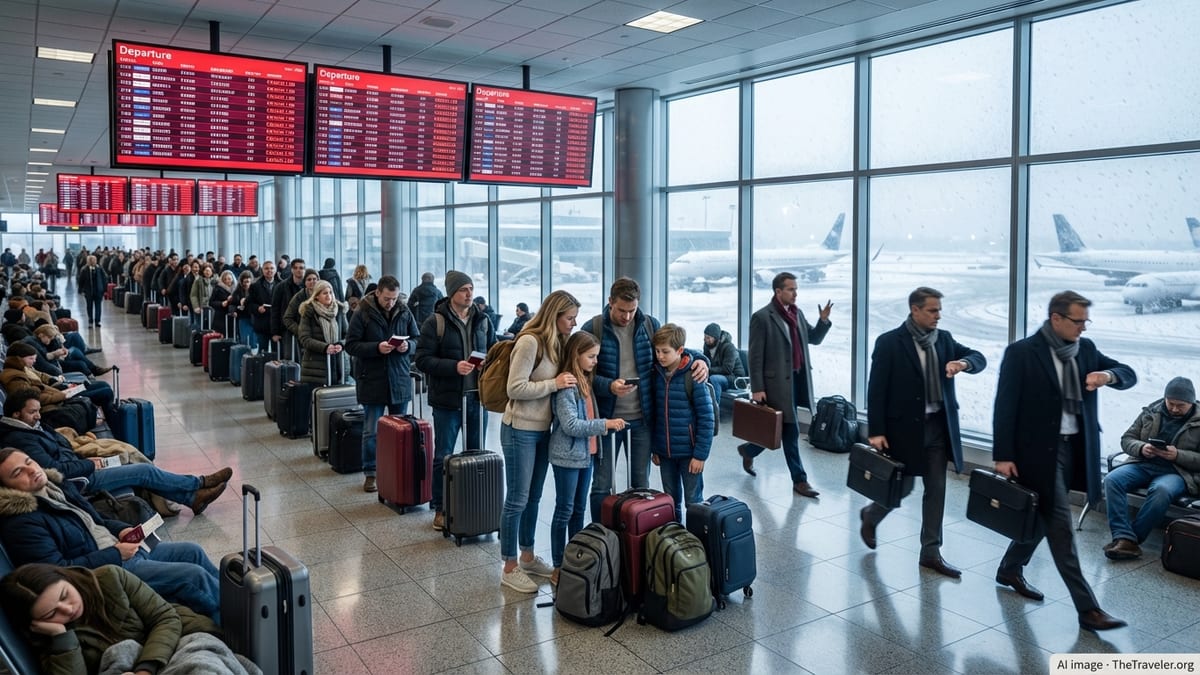
Terminal concourses that usually host a steady flow of boarding calls instead saw growing clusters of passengers waiting for updated departure times, with seats filled and travelers spilling into circulation areas. Many were forced to remain in the terminal for several extra hours as airlines reworked schedules and aircraft rotations.
While Chicago airports are no strangers to delay-prone weather in winter, the scale of the disruption at O’Hare comes during a broader period of strain on the U.S. aviation system, with recent holiday and Easter travel periods already marked by elevated levels of late departures and missed connections across multiple hubs.
United, American, Delta and Others Hit on Key Domestic Routes
The latest disruption proved especially visible because it involved several of the largest U.S. carriers that operate extensive schedules at O’Hare. United Airlines, which treats the airport as one of its most important hubs, saw a dense bank of flights to New York-area airports and to Los Angeles affected, according to route and status data compiled by flight information providers.
American Airlines services from Chicago to coastal cities also faced extended delays, particularly to New York and other East Coast destinations. Delta Air Lines, which maintains a smaller but strategically important presence at O’Hare, experienced interruptions across select domestic connections as aircraft arriving late into Chicago then departed behind schedule for their next legs.
Publicly available information on international operations shows that some long-haul flights bound for or arriving from major global centers, including Los Angeles connections that feed onward services to the Pacific and Latin America, were forced into later departure slots. The disruption at O’Hare consequently rippled outward into other airports already dealing with their own busy weekend schedules.
Operational analysts note that once a hub like O’Hare crosses a certain threshold of delay, each additional hold on the ground or in the air can magnify the problem. Aircraft and crew are tightly scheduled, and a late inbound flight can quickly cascade into multiple delayed outbound departures for the same plane and crew pairing.
Weather, Congestion and Structural Strain Behind the Numbers
Although precise causes for every delayed or canceled flight differ, recent patterns around Chicago highlight the sensitivity of the region’s air traffic system to weather and congestion. In recent days and weeks, thunderstorms and fast-moving storm cells have triggered ground stops and ground delay programs at O’Hare and nearby Midway, according to broadcast and online coverage of FAA advisories. When in effect, these programs reduce arrival rates and lengthen spacing between flights, immediately slowing operations.
The spring period has also overlapped with broader national pressure on air traffic control staffing and peak-hour scheduling at major hubs. Federal regulatory filings and public meeting notices have flagged Chicago O’Hare as one of the airports where summer 2026 demand and slot allocations risk exceeding comfortable operating capacity, prompting proposals to pare back peak-hour schedules to avoid chronic congestion.
Industry commentary suggests that a combination of tightly packed schedules, limited spare capacity, and an already busy travel weekend left little room to absorb the latest disruption. Once morning and midday flights from Chicago departed late, evening services inherited both aircraft and crew delays that could not be fully recovered before the end of the operating day.
Travel trend reports from recent holiday weekends show similar dynamics at work nationwide, with weather acting as the initial trigger but structural issues in airline and airport operations turning isolated storms into system-wide waves of delays and missed connections.
Impact on Passengers: Missed Connections and Overnight Stays
For travelers on the ground at O’Hare, the statistics translated into long queues, crowded seating areas and a rush for scarce rebooking options. Passengers on domestic routes to New York and Los Angeles faced reassignments to later flights, while those with onward international connections confronted the possibility of unexpected overnight stays and schedule changes stretching into the following day.
Standard industry practice places rebooking responsibility on airlines when flights are significantly delayed or canceled for reasons within their control, while weather-related disruptions traditionally offer fewer guarantees. In practice, however, travelers often experience a complex mix of causes, particularly when storms intersect with existing operational constraints such as crew availability and aircraft positioning.
Observers at the airport reported families resting on luggage near gate areas, business travelers working from improvised spots along concourse walls, and lines forming at customer service desks for multiple carriers. With 447 delayed flights recorded, even relatively short individual waits accumulated into significant crowding in food courts, restrooms and seating zones.
Travel guidance issued in previous disruption events encourages passengers in similar situations to monitor both their airline’s mobile application and real-time FAA or airport status boards, as gate changes, rolling delays and last-minute departure pushes are common once a hub is under strain.
What This Means for Upcoming Spring and Summer Travel
The O’Hare disruption comes as airlines and regulators prepare for a busy late spring and summer season, with projected passenger numbers near or above pre-2020 levels. Planning documents and recent notices indicate that capacity at key airports, including Chicago, will be closely managed in an effort to reduce the kind of cascading delays seen over the recent weekend.
Travel industry analysis suggests that passengers flying through Chicago in the coming weeks may face tighter connection windows and more cautionary messaging around potential delays when booking peak-time flights, particularly afternoon and evening departures that rely on already-busy inbound banks of aircraft.
Consumer advocates continue to emphasize the value of building buffer time into itineraries that pass through major hubs such as O’Hare, especially when connecting to international long-haul flights or time-sensitive events. Recommendations often include favoring earlier departures in the day, when schedules are less affected by accumulated delays, and keeping an eye on alternate routings through other hubs when booking.
For now, Chicago O’Hare remains fully operational, but the episode of 447 delayed and 11 canceled flights serves as a reminder that even well-established hubs can quickly become chokepoints when weather, staffing and aggressive scheduling collide. As airlines seek to capitalize on strong travel demand, balancing capacity and reliability at airports like O’Hare will remain a central challenge.