

More news on this day
At the height of Southwest Florida’s snowbird season, a cascading operational failure at Southwest Florida International Airport has stranded thousands of travelers, snarled flight schedules across multiple states and underscored the vulnerability of one of America’s busiest seasonal gateways.
Get the latest news straight to your inbox!
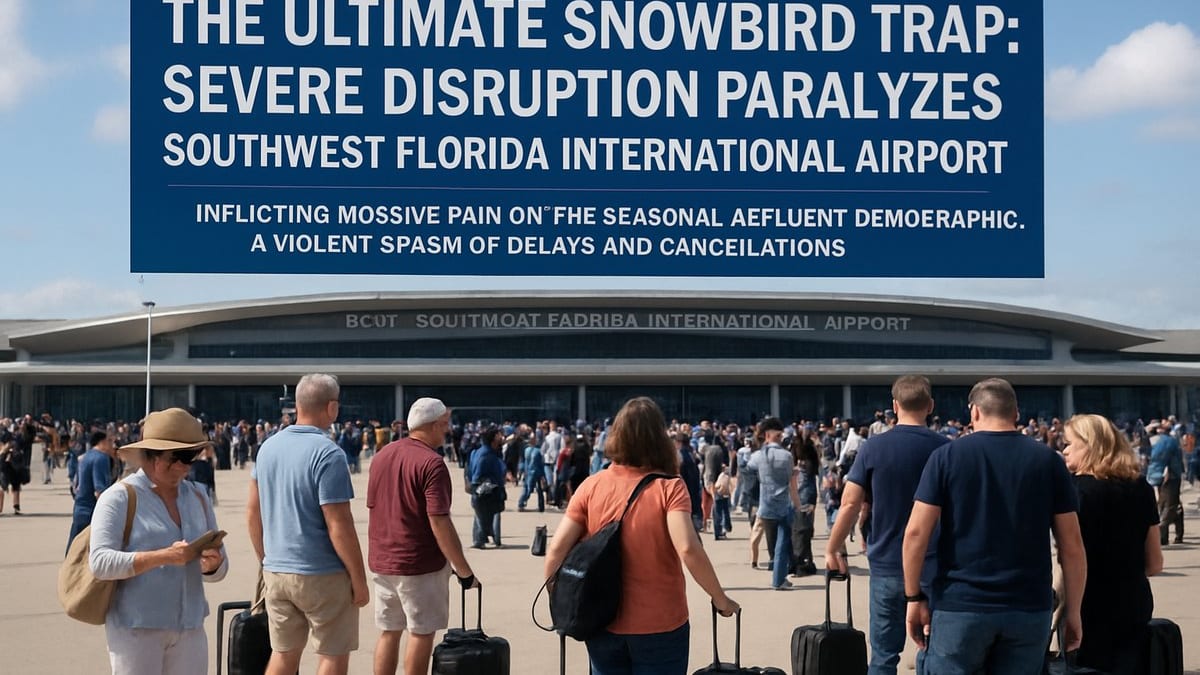
Peak-Season Hub Brought to a Standstill
Southwest Florida International Airport in Fort Myers ranks among the top 50 U.S. airports by passenger volume and handled more than 11 million travelers in 2025, according to airport statistics. March is typically one of its busiest months, driven by retirees and seasonal visitors fleeing northern winters. That volume turned into a liability when a severe disruption effectively paralyzed key parts of the operation, instantly overwhelming terminals, parking and ground transport.
Reports from airline trackers and passenger accounts describe an abrupt halt to normal operations, with departure boards flipping from “on time” to “delayed” or “canceled” within minutes. Flights that did depart often did so hours late, while arriving aircraft were held on the tarmac or diverted as ramp and gate capacity reached a breaking point.
The incident occurred against an already tense national backdrop, with March bringing a series of winter storms and systemwide airline disruptions across the United States. Industry data show that on some late-March days, more than 200 flights were canceled and several thousand delayed nationwide, leaving little slack in airline networks to absorb a localized breakdown at a busy regional hub like Fort Myers.
Publicly available operations feeds indicate that Southwest Florida International has continued to report periodic departure delays since the disruption, even as formal ground stops have lifted. The pattern suggests that the airport and its airline partners are now working through a backlog created during the worst of the paralysis.
Ripple Effects for Airlines and Connecting Hubs
While the failure was centered on Fort Myers, its effects radiated quickly across the route maps of major carriers serving the airport. Southwest Florida International functions largely as an origin-and-destination market for leisure travelers, but many of its flights plug into major national hubs including Atlanta, Charlotte, Dallas, Chicago and New York.
Airline performance summaries from late March show mounting delays at those hubs, with some carriers reporting hundreds of late operations in a single day as aircraft and crews missed their scheduled rotations. Fort Myers flights contributed to those statistics as aircraft arriving late from Florida triggered knock-on delays for their subsequent legs.
Regional operators feeding the big three legacy airlines were particularly exposed. Network maps indicate that several daily Fort Myers flights are operated by regional affiliates that cycle aircraft through multiple cities in a day. When one link in that chain seizes up, the consequences fan out far beyond the Gulf Coast, affecting travelers with no direct connection to Florida.
For snowbirds returning to northern homes, the timing was especially fraught. Many travelers book tightly planned itineraries home in late March and early April, hoping to arrive before lingering winter weather or early spring storms complicate driving conditions. The paralysis at Fort Myers forced widespread rebookings, overnight stays and, in some cases, multi-leg detours through distant hubs.
Security, Staffing and a System Under Strain
The operational meltdown at Southwest Florida International has unfolded amid broader stresses on aviation infrastructure, including a partial federal government shutdown that has affected security staffing at many U.S. airports. Coverage in regional outlets and national summaries indicates that some airports have recorded wait times exceeding three hours at screening checkpoints, with travelers missing flights despite arriving hours in advance.
Fort Myers has been something of an outlier in that environment. Local reporting and traveler discussions indicate that the airport relies on contracted security screening staff, which has helped keep checkpoint lines comparatively manageable even as federal Transportation Security Administration staffing has fluctuated elsewhere. In recent days, publicly available information has also described the deployment of Immigration and Customs Enforcement personnel to support screening operations at Southwest Florida International, making it the only airport in Florida reported to have this particular layer of supplemental staffing.
Despite this relative resilience at the checkpoint, the wider system around the airport is strained. Terminal concourses have been described as packed with delayed passengers, and anecdotal reports speak of travelers spending many hours waiting for rebooked flights as cancellations ripple through airline schedules. Ground transport providers, including rental car counters and ride-hailing pickup zones, have struggled to keep pace with sudden surges of stranded passengers seeking alternate ways out of the region.
The juxtaposition highlights how an airport can maintain reasonable security throughput while still experiencing severe disruption when airline, ramp or technical operations falter. The Fort Myers episode suggests that resilience in one part of the system may not be enough when broader national conditions, including volatile weather and constrained staffing, offer little margin for error.
Snowbird Economy Faces Unwelcome Stress Test
The breakdown at Southwest Florida International is more than an aviation story. It is a direct shock to the regional economy of Lee County and neighboring communities, where winter visitors are a central pillar of local business activity. Tourism data from county agencies show that visitor numbers spike in the first quarter of the year, with March typically seeing some of the highest hotel occupancy and restaurant traffic driven by snowbird demand.
With flights frozen or severely delayed, beach towns, golf resorts and rental communities across Southwest Florida have reported abrupt schedule changes and cancellations. Property managers and hotel operators face both early departures from frustrated guests and late arrivals from visitors stuck in other parts of the country, complicating staffing, housekeeping and revenue management plans calibrated to a predictable peak season.
For individual travelers, the disruption has brought unexpected costs. Reports from travel media and consumer advocates note that while airlines frequently point to weather or air traffic constraints to limit compensation, passengers still contend with added hotel nights, higher last-minute fares on alternate routes and nonrefundable losses on missed cruises, tours or tee times.
Local officials and tourism boards have long promoted Southwest Florida International as an efficient, less chaotic alternative to larger Florida gateways such as Miami and Orlando. The current paralysis challenges that marketing narrative and may prompt some snowbirds to diversify their travel plans in future seasons, shifting toward alternate airports or even different winter destinations if reliability concerns linger.
Lessons for Future Peak-Season Resilience
Aviation analysts monitoring the late-March disruption patterns across the United States have pointed to Fort Myers as a case study in the vulnerability of medium-sized leisure hubs. With fewer alternative flights than mega-hubs and intense seasonal peaks, airports like Southwest Florida International can suffer outsized impacts when a single operational failure coincides with a tight national airline schedule.
Industry commentary suggests several potential areas for improvement. These include enhanced redundancy for critical airport systems, more flexible gate and ramp management during irregular operations and stronger coordination with airlines on contingency scheduling for peak weeks when aircraft utilization is already stretched.
Consumer advocates, meanwhile, argue that the Fort Myers paralysis underscores the importance of transparent, real-time information for travelers. They point to federal and airline data tools that track airport status and delay patterns, while also noting that some platforms have lagged actual conditions by tens of minutes during recent disruptions, limiting their usefulness for on-the-spot decision-making.
For now, Southwest Florida International remains a vital lifeline for the region’s snowbird community, even as recovery from the latest disruption continues. The episode has laid bare how quickly that lifeline can be squeezed, turning a warm-weather escape into a cold dose of travel reality for thousands of passengers who expected the journey home to be routine.