

More news on this day
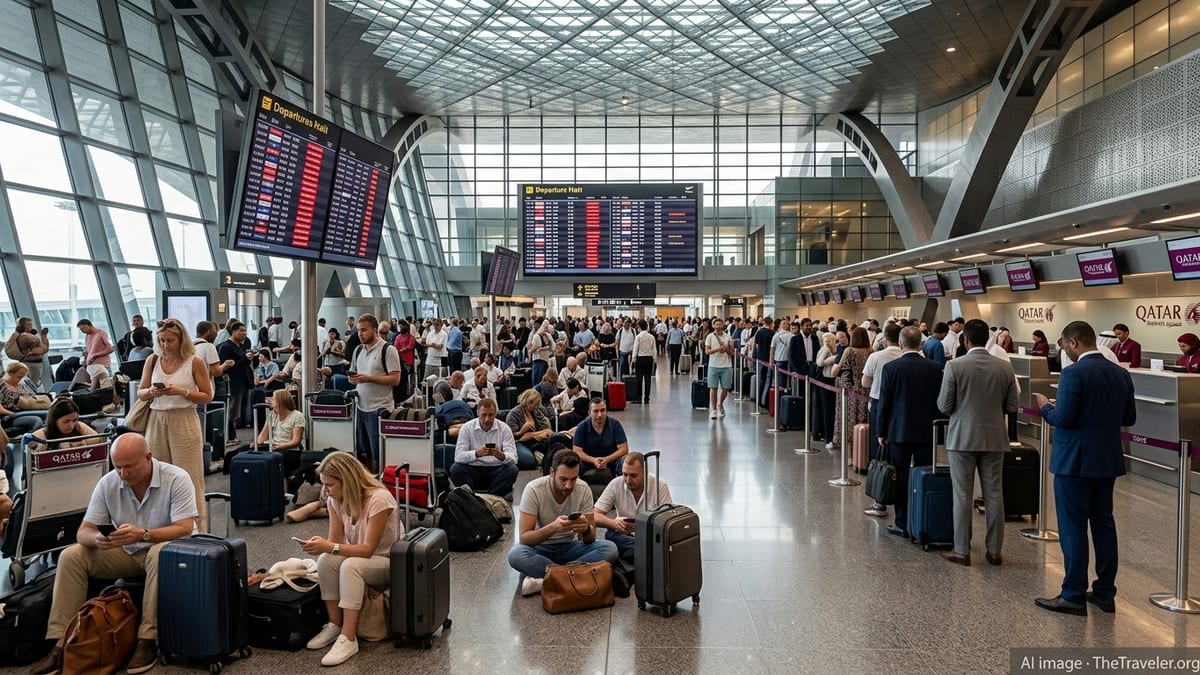
Hundreds of travelers transiting through Doha’s Hamad International Airport are facing prolonged disruption as scores of flights are cancelled or delayed, interrupting journeys on major carriers including Qatar Airways, Royal Jordanian, Virgin Australia, and other international airlines.
Get the latest news straight to your inbox!
Heavy Cancellations and Widespread Delays at Doha Hub
Operational data and regional media reports indicate that Hamad International Airport has cancelled at least 42 flights and delayed 61 more, leaving passengers stranded in terminals and nearby hotels. The disruptions are impacting both departures and arrivals, compounding the difficulties for travelers who rely on Doha as a key connection point between Europe, the Middle East, Asia, and Australia.
The wave of disruption follows a broader period of airspace instability across parts of the Middle East. Recent closures and restrictions in regional skies have forced airlines to modify or suspend services, with knock-on effects at major hubs. Hamad International, one of the region’s busiest transfer airports, has been particularly exposed to these shifts, leading to aircraft and crew imbalances that are still working through the system.
While some services are gradually resuming, the backlog created by multiple days of irregular operations means that the impact is persisting for passengers. Travelers arriving in Doha are in many cases unable to proceed to their final destinations as planned, with connection banks broken and rebooking options limited during peak hours.
Key Airlines Affected, From Flag Carriers to Long-Haul Operators
Publicly available schedules and tracking data show that the disruption has affected a wide range of airlines using Doha as a hub or key stopover point. Qatar Airways, the dominant carrier at Hamad International, has seen multiple departures scrubbed or retimed as it navigates aircraft repositioning and altered routings. This has had a cascading effect on connecting itineraries that rely on tight transfer windows at the airport.
Royal Jordanian is also among the airlines experiencing disruption, with services that typically connect Amman to European and Asian destinations via regional hubs affected by changing airspace conditions and operational constraints. Adjustments to its network, including services touching Athens and other European cities, are contributing to longer connection times and uncertain onward travel for passengers holding multi-leg tickets.
Long-haul operators such as Virgin Australia, which utilize Doha for connections between Australia and Europe, face particular challenges coordinating schedules across multiple time zones. When a single long-haul sector is delayed or cancelled, it can displace crews for subsequent rotations, leading to additional cancellations and extended layovers for passengers already en route.
European and Asian Gateways See Disrupted Links
The effects of the Doha disruptions are being felt in a number of key destination cities. Flights linking Hamad International with Athens and Berlin have experienced irregular operations, with cancellations and rolling delays forcing passengers to adjust hotel bookings, meetings, and onward connections across Europe.
In South Asia, services to Bandaranaike International Airport in Katunayake near Colombo have been affected, complicating travel plans for workers, tourists, and those visiting family. Public flight tracking and schedule information show altered departure times and, in some cases, cancelled sectors, particularly on itineraries that depend on precise arrival waves into Doha.
Routes to and from Dublin have also seen disruption, highlighting the breadth of the impact on Europe to Asia and Middle East corridors. With Dublin acting as a transatlantic gateway for some travelers, changes on Doha services can ripple onward to North American connections, adding another layer of complexity for those attempting to rebook.
Passengers Face Long Waits, Rebookings, and Uncertain Itineraries
Accounts compiled from news coverage and social media posts describe crowded transfer areas, long lines at customer service desks, and passengers attempting to rearrange their journeys on short notice. Many travelers are being rebooked on later flights or alternate routings via other Gulf and European hubs when capacity allows.
Hotel arrangements in Doha have become a pressing issue for those facing overnight or multi-day waits. Some passengers report being accommodated in airport-area hotels, while others search independently for rooms as availability tightens. Information from flight trackers and airline advisories indicates that irregular operations may continue while airlines work through aircraft and crew rotations.
Travelers with complex itineraries involving multiple carriers are experiencing additional challenges, as separate tickets and interline agreements can limit automatic rebooking options. Passengers are relying heavily on airline mobile apps, airport departure boards, and online flight trackers to monitor last-minute gate and schedule changes.
Outlook: Gradual Stabilization, But Continued Knock-On Effects
Industry analysts and aviation data suggest that while traffic through Doha is gradually resuming after the most acute phase of airspace disruption, a full return to normal operations may take several days. Even as more flights depart on time, earlier cancellations and delays have created a queue of displaced passengers whose travel needs must still be accommodated.
Airlines are expected to continue adjusting routings, departure times, and aircraft assignments as regional airspace conditions evolve. This may mean additional day-of-travel changes for routes linking Doha with European cities such as Athens, Berlin, and Dublin, as well as key Asian destinations including Katunayake and other South and Southeast Asian hubs.
Travel experts note that passengers scheduled to transit through Hamad International in the coming days should closely monitor their booking details and live flight information, arrive early for departures, and prepare for potential schedule changes. While the worst of the immediate disruption appears to have passed, the scale of cancellations and delays at Doha’s main airport means that residual instability across regional and long-haul networks is likely to persist in the short term.