

More news on this day
Hundreds of travelers were left camped out in terminals at Seeb International Airport in Muscat on March 3 as a fresh wave of delays and cancellations rippled through Oman’s main international gateway, disrupting regional and long-haul connections on Oman Air, SalamAir and several major Gulf carriers.
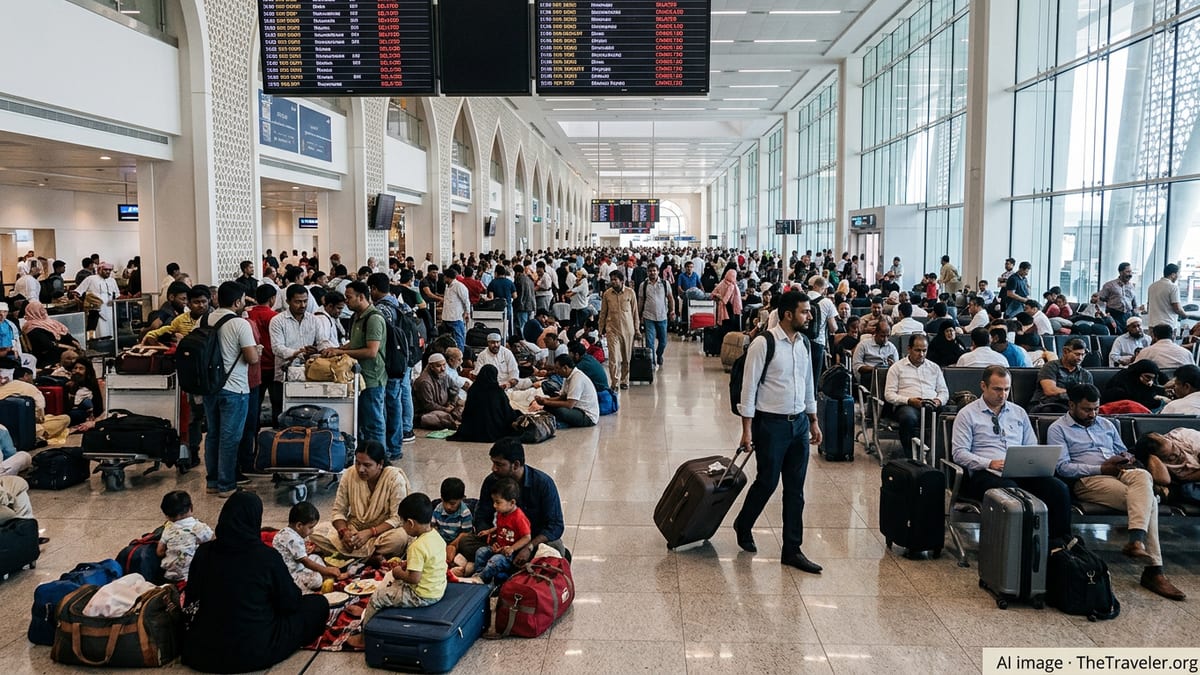
Seeb Airport Gridlocked as Cancellations Mount
Operational data from Seeb International Airport on March 3 showed a heavily disrupted schedule, with 37 flights delayed and at least 31 to 55 services canceled or suspended over a rolling 24-hour period. The turmoil affected departures and arrivals across the Gulf, the Indian subcontinent and select European destinations, leaving hundreds of passengers stranded or forced into lengthy re-bookings.
Airport seating areas and food courts quickly filled with passengers resting on trolleys and luggage, as families with young children and elderly travelers struggled to find updated information on departure boards. Many had already endured long-haul journeys into Muscat only to discover their onward connections were either significantly delayed or no longer operating.
Ground staff at Muscat reported heavy queues at airline service desks through much of the day as travelers sought rerouting options or refunds. While the airport itself remained open, the severe thinning of flight options meant that even confirmed re-bookings often involved waits of 24 hours or longer.
Oman Air and SalamAir Among Hardest Hit
Oman’s two homegrown carriers, Oman Air and SalamAir, suffered some of the most visible disruption. Oman Air confirmed that multiple flights to regional hubs including Dubai, Doha, Bahrain, Kuwait and Amman were suspended over the coming days, while warning that remaining services could face knock-on delays as crews and aircraft were repositioned.
SalamAir, which operates a dense network of short- and medium-haul routes from Muscat into the Gulf and India, also acknowledged temporary suspensions to destinations in Iran, Iraq and several Gulf states. Live departure boards on March 3 showed SalamAir services to Indian cities such as Jaipur running hours behind schedule, leaving transit passengers in Muscat racing to adjust hotel bookings and ground transport at their final destinations.
Both airlines said they were prioritizing re-accommodation for passengers on canceled flights, offering fee waivers for date changes and, in some cases, full refunds. However, limited spare capacity across the region meant that many travelers struggled to secure near-term alternatives, especially on popular corridors to the United Arab Emirates and India.
Regional Airspace Crisis Ripples Across Gulf Hubs
The disruption in Muscat did not occur in isolation. Airlines operating out of the Gulf have been grappling with widening airspace restrictions and operational challenges linked to escalating tensions in parts of the Middle East. Over recent days, carriers have announced large waves of cancellations on routes crossing sensitive corridors, forcing complex re-routing and squeezing available capacity on remaining services.
Oman Air publicly confirmed that all flights on select dates to and from major regional hubs such as Dubai, Doha and Bahrain, as well as to cities including Copenhagen and Baghdad, would be canceled for several days. Other Gulf carriers serving Muscat, including Emirates, flydubai, Qatar Airways and Gulf Air, have also trimmed schedules and warned of ongoing delays as they work around closures and congestion in neighboring airspace.
The resulting patchwork of suspensions has upended Muscat’s role as a reliable alternative hub for travelers seeking to bypass the region’s busiest airports. For many passengers at Seeb International Airport, particularly those connecting between South Asia and Europe or the wider Middle East, a normally smooth transit experience turned into an open-ended wait amid fast-changing flight information.
Transit Passengers and Gulf Workers Face Tough Choices
Transit travelers and migrant workers reliant on Gulf connections have borne the brunt of the disruption in Muscat. Many of those stranded overnight were passengers from India, Pakistan and Bangladesh heading to or from jobs across the Gulf, as well as leisure and business travelers attempting to connect to Europe or North Africa via Oman’s capital.
With hotel availability in Muscat tightening and some passengers lacking the necessary visas or budget for unplanned overnight stays, airport resting areas became makeshift waiting rooms. Families could be seen sharing power outlets to keep phones charged, while long lines formed at food outlets as delays stretched from hours into full days.
Travel agents reported a surge in last-minute enquiries from customers in Oman and neighboring countries looking to reroute via alternative hubs still operating at near-normal levels. However, higher fares, limited seat availability and the possibility of further sudden schedule changes meant that many opted to remain in Muscat and wait out the disruption, despite the uncertainty.
Airlines Urge Passengers to Stay Informed and Flexible
As the situation evolved through March 3, airlines operating at Seeb International Airport repeatedly urged passengers not to travel to the airport without a confirmed, operating booking and up-to-date flight status. Carriers advised customers to monitor official channels and mobile apps closely for real-time schedule changes and rebooking options.
Oman Air and SalamAir both highlighted customer-support hotlines and digital channels as the fastest way to secure new itineraries, while cautioning that call centers were facing exceptionally high volumes. Passengers holding tickets over the coming days were encouraged to consider voluntary changes, where permitted, to avoid peak disruption windows and to build in additional buffer time for connections.
Industry analysts noted that while some services through Muscat were gradually resuming, the combination of rolling airspace restrictions and aircraft displacement across the Gulf meant that irregular operations could persist for several days. For now, Seeb International Airport remains a vivid illustration of how quickly regional shocks can cascade across interconnected flight networks, leaving travelers around the world unexpectedly grounded in a key transit hub.