

More news on this day
Thousands of air travelers across China faced extensive disruption today as publicly available data on flight-tracking platforms indicated at least 267 cancellations and 1,674 delays, affecting busy corridors through Beijing, Shanghai, Chengdu, Shenzhen and other major hubs.
Get the latest news straight to your inbox!
Major Hubs From Beijing to Shenzhen Suffer New Wave of Disruptions
Flight-monitoring services and industry reports indicate that the latest wave of cancellations and delays is concentrated at China’s largest airports, including Beijing Capital, Beijing Daxing, Shanghai Pudong, Shanghai Hongqiao, Chengdu Tianfu and Shenzhen Baoan. The disruption has rippled across both domestic and regional routes, hitting peak-period departures and arrivals and leaving terminals crowded with stranded passengers.
Operational data compiled today points to a network-wide squeeze affecting leading Chinese carriers such as Air China, China Eastern Airlines, China Southern Airlines and Shenzhen Airlines, along with regional operators including Hainan Airlines and Sichuan Airlines. The pattern closely mirrors a severe episode reported on April 5, when coverage by travel industry outlets documented hundreds of cancellations and more than two thousand delays nationwide, underscoring how quickly congestion can cascade through China’s dense aviation system.
While some earlier incidents this month stemmed from thunderstorms and air-traffic-control bottlenecks along the eastern seaboard, today’s figures show that the knock-on effects have spread beyond a single weather cell or airport. With aircraft and crew now out of position across multiple cities, even routes operating under clear skies are experiencing rolling delays as airlines work through backlogs.
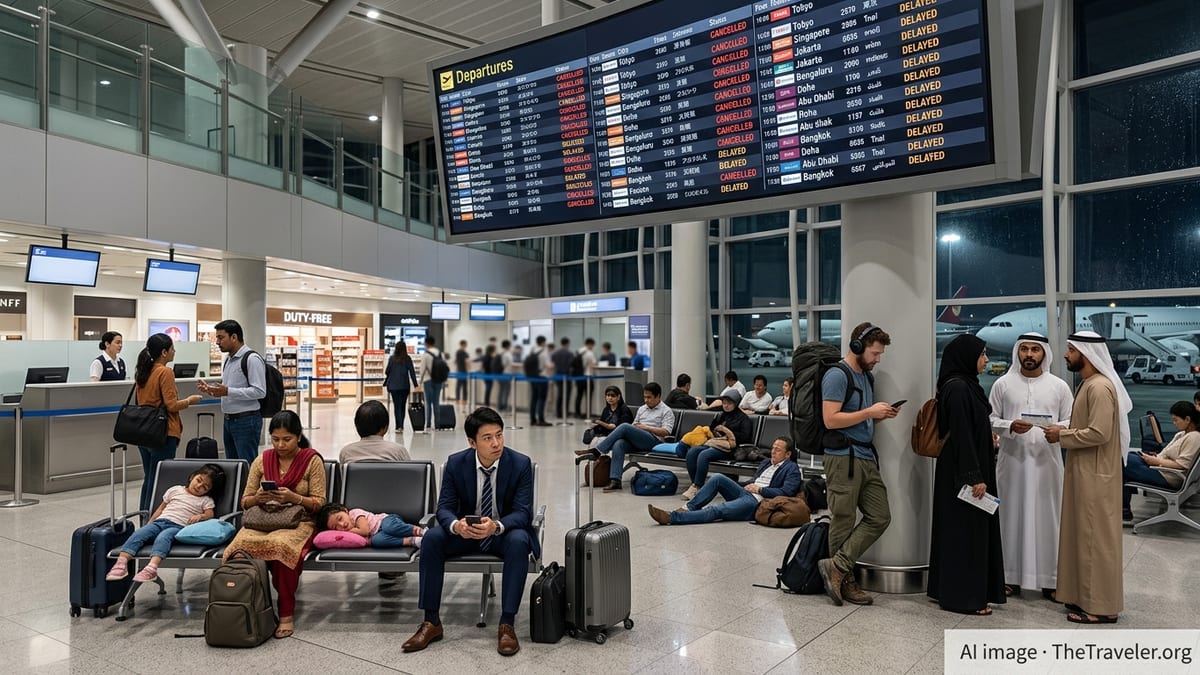
For travelers, the result is a patchwork of hold-ups across the day rather than a short, sharp shutdown. Terminals in Beijing and Shanghai are reporting crowded departure halls, with passengers facing a mix of multi-hour delays, last-minute gate changes and, in some cases, abrupt cancellations as airlines reshuffle fleets to protect later banked departures.
System Under Strain After Earlier Weather and ATC Shocks
Industry analysis in recent days has highlighted how earlier storms and air-traffic-control issues left China’s aviation network unusually fragile heading into this latest disruption. Recent coverage of events at Shanghai Pudong described a line of severe thunderstorms and an associated ATC outage that halted departures for several hours, forcing mass rescheduling and diversions and consuming much of the system’s spare capacity.
These operational shocks arrived on top of a broader period of elevated strain. Air-travel intelligence platforms previously tracked major Asia-Pacific disruption in March, when several hundred flights were canceled and more than two thousand delayed in a single day as weather, airspace constraints and tight aircraft rotations converged. Chinese carriers and airports featured prominently in those statistics, and today’s numbers suggest that recovery remains incomplete.
Analysts who track on-time performance note that large domestic networks with compressed turnaround times are particularly vulnerable when earlier delays are not fully absorbed before the next peak. In practice, this means that a storm over Shanghai or Chengdu earlier in the week can still produce missed connections and rolling gate changes days later, especially when aircraft were scheduled to operate multiple legs spanning different regions.
The current tally of 267 cancellations and 1,674 delays appears consistent with this pattern of accumulated strain rather than a single, isolated incident. With traffic volumes now at or above pre-pandemic levels on many Chinese domestic routes, the margin for error when weather or ATC constraints arise is extremely thin.
Travelers Face Long Queues, Rebookings and Patchy Information
For passengers moving through affected hubs today, the operational statistics translate into very practical challenges. Images and posts circulating on social media from Beijing, Shanghai and Shenzhen show lengthy check-in and customer-service lines, as travelers attempt to rebook missed connections or secure hotel vouchers after late-night cancellations.
Reports from recent disruption episodes in China suggest that communication quality can vary widely between carriers and airports. Some travelers describe relatively smooth handling, with automatic rebooking notifications pushed through airline apps and prompt updates to departure boards. Others report sparse or confusing information when flights shift from delayed to canceled status, particularly for those booked through third-party online travel agencies.
Consumer-rights organizations that monitor Asian aviation note that compensation and care standards differ from those in regions such as the European Union. While some Chinese airlines publish set thresholds for meal vouchers or partial refunds based on delay length, travelers often need to proactively request assistance at service desks or via customer-service hotlines, especially when disruptions arise from weather, air-traffic or other factors categorized as outside carrier control.
Given the scale of today’s disruption, experienced travelers in the region are advising others to rely on a combination of airline apps, airport displays and independent flight-tracking tools to verify the latest status. In previous incidents, discrepancies have occasionally appeared between different systems as schedules are reworked in real time.
Impact on Domestic Tourism, Business Travel and International Links
The immediate effect of hundreds of cancellations and more than a thousand delays is being felt most acutely on China’s busy domestic trunk routes, particularly flights linking Beijing, Shanghai, Guangzhou, Shenzhen, Chengdu and Xi’an. These corridors support a high volume of business travel alongside a resurgent leisure market, and today’s disruption is likely to ripple into missed meetings, shortened vacations and rearranged tour itineraries.
Published coverage of similar events earlier this month indicates that disruption at major Chinese hubs quickly spills into international operations. Aircraft scheduled to operate onward legs to destinations in Southeast Asia, the Middle East or Europe can be held back or swapped, forcing airlines to consolidate services or re-time departures. Even when international flights depart broadly on schedule, passengers originating from secondary Chinese cities may be unable to make their planned connections.
Tourism analysts point out that these rolling operational challenges arrive just as China is working to rebuild inbound tourism and business travel. Visa-easing measures, expanded air-service agreements and new long-haul routes have all been promoted in recent months. A series of high-visibility disruptions risks undermining that messaging, particularly among travelers who are highly sensitive to schedule reliability.
However, the pattern of delays dominating over outright cancellations in many Chinese cities also suggests that airlines are striving to preserve capacity where possible, even at the cost of extended ground time. For travelers, that may mean a higher likelihood of eventually reaching their destination, albeit significantly behind schedule.
What Travelers Can Do If Flying Through Chinese Hubs
For passengers booked on Air China, China Eastern, China Southern, Shenzhen Airlines or other Chinese carriers over the next several days, publicly available guidance from travel-advisory services emphasizes preparation and flexibility. Travelers are encouraged to monitor their flight status frequently in the 24 hours before departure, as schedules may be adjusted again while airlines work to normalize rotations.
Experts on disruption management in the aviation sector recommend building additional connection time into itineraries that route through Beijing, Shanghai, Chengdu or Shenzhen, especially if onward long-haul segments are involved. It may be prudent to avoid tight self-connects or last departures of the day where alternatives are limited, as missed final legs can translate into overnight stays at or near the airport.
Travel planners also suggest having a clear priority list when speaking with airline or agency staff during irregular operations, whether that is securing the earliest possible arrival, staying with a preferred carrier or maintaining through-checked baggage. In busy disruption scenarios, rebooking options can disappear quickly as aircraft fill up, so knowing which trade-offs are acceptable can help travelers make faster decisions.
With flight-tracking data indicating that China’s air network is likely to remain under pressure in the near term, travelers transiting the country’s major hubs are being advised to stay informed, leave extra time for connections and prepare for potential last-minute changes, even if their own flights are still listed as “on time” when they first arrive at the airport.