

More news on this day
Thousands of passengers across China and beyond are facing major disruptions after Qingdao Jiaodong International Airport reported at least 57 flight cancellations and 109 delays in its latest operating cycle, affecting a mix of domestic and international routes.
Carriers including Spring Airlines, China Eastern, IndiGo and several Chinese regional airlines have been hit hard, leaving travelers stranded in terminals, scrambling to rebook connections and bracing for extended waits as congestion ripples through the wider Asian air network.
More News
- Caribbean Travel to U.S. Upended by New Visa Freezes and Expanded Bans
- Mexico Restores E-Visas for Brazilians, Paving the Way for Borderless Tourism
- Philippine Airlines Joins Regional Carriers Powering Southeast Asia’s Tourism Boom
Severe Disruption at a Key Coastal Gateway
Qingdao Jiaodong International Airport, a major gateway on China’s eastern seaboard serving the port city of Qingdao in Shandong province, has emerged as one of the country’s most disrupted hubs in recent days. Operational data indicate that the airport has recorded 109 delayed flights and at least 57 outright cancellations over a concentrated period, placing significant strain on airlines, airport staff and passengers navigating one of the region’s busiest travel corridors.
The disruption comes at a time when air travel in Asia is already operating near peak capacity, with heavy winter schedules, growing tourism demand and dense domestic traffic combining to reduce flexibility within airline networks. At Qingdao, delays and cancellations have affected both arrivals and departures, creating knock-on effects for aircraft rotations and crew availability at other Chinese airports.
As aircraft miss their scheduled slots and crews exceed duty-hour limits, airlines have been forced to reshuffle fleets, cancel later legs and consolidate flights. This has left some travelers stuck in Qingdao overnight, while others have been stranded at secondary airports across China when their connecting Qingdao-bound or Qingdao-originating services were scrubbed or significantly delayed.
Airlines Caught in a Web of Cancellations and Delays
Low cost and full service carriers alike have felt the impact of Qingdao’s operational bottlenecks. Spring Airlines, one of China’s leading budget carriers, has seen disruption to its dense network of short-haul services, which typically rely on fast aircraft turnarounds and tight scheduling. When even a few flights from a hub like Qingdao fall out of sequence, the effects can cascade rapidly across multiple routes in the same day.
China Eastern Airlines, one of the country’s largest state-backed carriers and a key operator at Qingdao, has also faced schedule upheaval. As a major player on both domestic and regional routes, any irregular operations at Qingdao can affect its broader network, including flights feeding into Shanghai, Beijing and other tier-one cities, as well as regional international connections.
IndiGo, India’s largest airline by market share and an increasingly active operator on routes into and within China, has likewise been affected as delays in Qingdao and other Chinese hubs disrupt aircraft that operate multi-leg patterns across borders. Even when an IndiGo flight is not departing from Qingdao itself, delays there can reverberate through the aircraft’s prior or onward sectors, forcing retimings, missed connections and extended ground holds for passengers.
Passenger Experience: Long Queues, Missed Connections and Uncertain Timelines
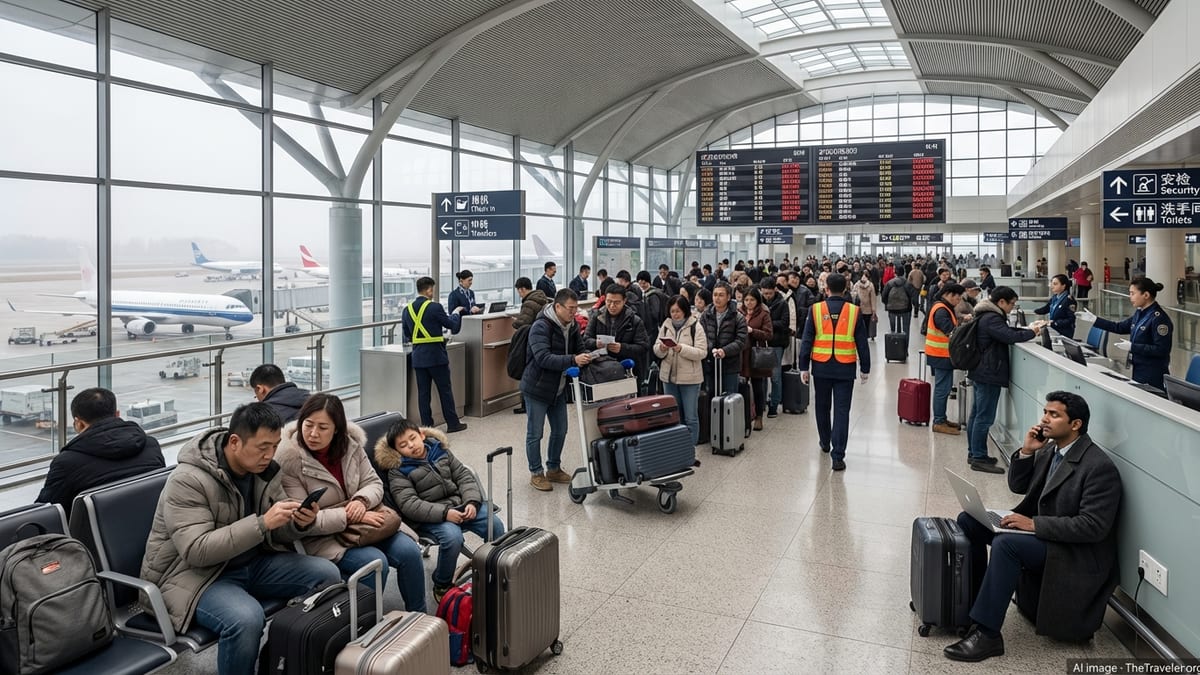
For travelers on the ground, the statistics translate into a familiar but deeply frustrating reality: long queues at check in and transfer desks, crowded boarding areas, and departure boards filled with red-highlighted “delayed” and “canceled” labels. With 57 cancellations and more than a hundred delays centered on a single airport, a significant share of the day’s traffic has been thrown off schedule, leaving passengers with limited immediate options.
Many travelers have been forced to wait hours for rebooking as airline call centers and airport customer service counters struggle to keep pace with demand. Families transiting through Qingdao on their way to other Chinese cities, or onward to destinations in Southeast and South Asia, have found themselves unexpectedly stuck, needing last-minute accommodation, meal vouchers and updated itineraries.
The strain is particularly acute for those without travel insurance or flexible tickets, as lower fare classes may not always offer easy rebooking options, especially when alternative flights are already heavily booked. Business travelers attempting to reach meetings in Shanghai, Beijing, Seoul or Delhi via Qingdao have reported scrambling to secure seats on trains or alternate flights from nearby airports when their original plans collapsed.
Weather, Congestion and Systemic Pressures in the Asian Skies
While the precise combination of causes at Qingdao varies from day to day, aviation analysts point to a familiar set of factors underpinning the current wave of disruptions: winter weather patterns, crowded airspace and the limited margin for error in today’s highly optimized airline operations. Heavy cloud, fog and low visibility conditions have been reported across parts of East Asia in early February, prompting tighter air traffic control restrictions and longer separation times between aircraft.
At the same time, the growth of domestic and regional traffic in China has continued to fill available capacity at key hubs. Even minor technical issues, ground-handling delays or crew-rotation problems can trigger wider knock-on effects when there is no slack in the schedule. With multiple Chinese airports reporting elevated levels of delays and cancellations this week, Qingdao’s difficulties are part of a broader pattern of strain across the region’s aviation system.
Operational challenges such as runway slots, ramp congestion and aircraft maintenance windows can all become more complex to manage when a large airport experiences a spike in delays. Once a backlog forms, clearing it can take many hours, especially if adverse weather persists or if aircraft and crews are not in the right place at the right time to operate later services.
Ripple Effects Across China and International Hubs
The disruption at Qingdao Jiaodong International Airport has not been contained within Shandong province. Because many of the affected flights are linked to larger domestic and regional networks, cancellations and delays have radiated outward to other major Chinese cities and international hubs. Airlines seeking to restore some stability have rerouted aircraft, combined lightly booked services and, in some cases, trimmed schedules to create buffer time for recovery.
Domestic travelers connecting through Qingdao to or from cities such as Changchun, Shanghai, Guangzhou, Chengdu and Xi’an have reported altered itineraries and missed onward segments. Travelers on international routes using Qingdao as a gateway or intermediate stop have likewise felt the impact in the form of extended layovers or last minute changes to departure times.
For airlines like Spring, China Eastern and IndiGo, which operate extensive networks across Asia, the result has been a complex juggling act. To minimize cancellations, carriers have sometimes chosen to delay multiple flights in order to keep aircraft and crews aligned with longer-term rotation plans. While this approach can reduce the total number of canceled services, it also prolongs the disruption for passengers already at the airport or en route.
How Airlines and Airport Authorities Are Responding
Airport authorities at Qingdao Jiaodong have moved to increase communication with passengers through public address announcements and updated flight information displays, urging travelers to check their flight status frequently and to maintain contact with their airlines. Ground staff have been deployed across terminals to guide passengers needing rebooking or assistance with baggage, transfers and accommodation.
Airlines have introduced a range of short term measures to manage the disruption, including fee waivers for itinerary changes, flexible rebooking policies and, in some cases, additional recovery flights once aircraft and crew become available. Passengers whose flights have been canceled have been advised to accept the earliest available alternative, even if it involves a different routing or longer journey time, given the high load factors on many routes.
Some carriers have also emphasized the importance of digital channels, encouraging passengers to use airline apps and websites to rebook or track real time updates rather than relying solely on airport counters. This approach can help reduce overcrowding at service desks while giving passengers more immediate visibility into their options during a fast moving disruption.
What Travelers Can Do If Their Flight Through Qingdao Is Affected
For passengers with upcoming travel touching Qingdao Jiaodong International Airport, preparation and flexibility are key. Travelers are advised to monitor their flight status closely in the 24 hours before departure and to allow extra time at the airport in case of longer security lines or check in queues. Those with critical connections, such as long haul international flights, may wish to consider earlier departure options or alternative routings if available.
Travel experts note that booking directly with airlines, rather than through multiple intermediaries, can sometimes speed up the rebooking process when disruptions occur. Having airline apps installed, with notifications enabled, can also provide an earlier warning of schedule changes, giving passengers more time to adapt their plans.
For those already stranded, it is important to clearly understand the carrier’s policies regarding accommodation, meals and compensation in the event of delays or cancellations. While regulations vary by jurisdiction and ticket type, airlines often provide at least basic support for passengers forced to remain overnight because of significant operational disruptions, particularly when those disruptions are within the airline’s control rather than caused solely by severe weather.
FAQ
Q1. What is happening at Qingdao Jiaodong International Airport right now?
Qingdao Jiaodong International Airport is experiencing a high volume of irregular operations, with at least 57 flights canceled and 109 delayed over a recent operating period, affecting both arrivals and departures and causing widespread disruption for travelers.
Q2. Which airlines are most affected by the disruptions?
Carriers with significant operations at Qingdao, including Spring Airlines and China Eastern, have been heavily impacted, while IndiGo and other regional airlines are experiencing knock on effects through interconnected routes and aircraft rotations.
Q3. Are the disruptions limited to domestic flights within China?
No. Although domestic routes make up a large share of the affected services, regional and international itineraries are also disrupted, particularly where Qingdao serves as a connection point or where aircraft and crews are shared across multiple countries.
Q4. What are the main causes of the cancellations and delays?
The disruptions stem from a combination of factors, including seasonal weather conditions, congestion in busy Chinese airspace, tight airline scheduling, and operational bottlenecks on the ground that make it difficult to recover quickly once backlogs develop.
Q5. How long are passengers being delayed on average?
Delay durations vary widely, from relatively short setbacks of under an hour to extended waits of several hours or more when connections are missed or flights are canceled and passengers must be rebooked on later services.
Q6. What should I do if my flight to or from Qingdao is canceled?
If your flight is canceled, you should immediately contact your airline via its app, website or customer service hotline, or approach its airport counter to arrange rebooking. Accepting the earliest available alternative, even with an altered routing, will improve your chances of reaching your destination sooner.
Q7. Will airlines provide hotel accommodation and meals if I am stranded?
Depending on the airline’s policies and the circumstances behind the disruption, many carriers will offer meal vouchers, hotel stays or transport for passengers facing overnight delays, particularly when the cause is within the airline’s control, such as crew or aircraft issues rather than extreme weather.
Q8. How can I minimize the risk of being stranded during this period?
To reduce risk, monitor your flight status closely, arrive early at the airport, keep your contact details updated with the airline, and consider building extra buffer time into your itinerary, especially if you have a critical connection or time sensitive appointment at your destination.
Q9. Are other airports in China and Asia also experiencing problems?
Yes. Several major airports across China and wider Asia have reported elevated levels of delays and cancellations in recent days, indicating broader pressure on regional aviation systems rather than an isolated issue confined solely to Qingdao.
Q10. Is it still safe to travel through Qingdao Jiaodong International Airport?
Yes. The current situation relates to schedule reliability and operational performance, not to aviation safety. Flights continue to operate under established safety standards, although passengers should be prepared for potential disruption and plan accordingly.