

More news on this day
Hundreds of passengers were left sleeping on terminal floors and queuing at customer service desks across Europe on March 5 as at least 1,092 flights were delayed and 273 cancelled, disrupting operations for KLM, easyJet, Lufthansa and several other major carriers at hubs including Amsterdam and Frankfurt.
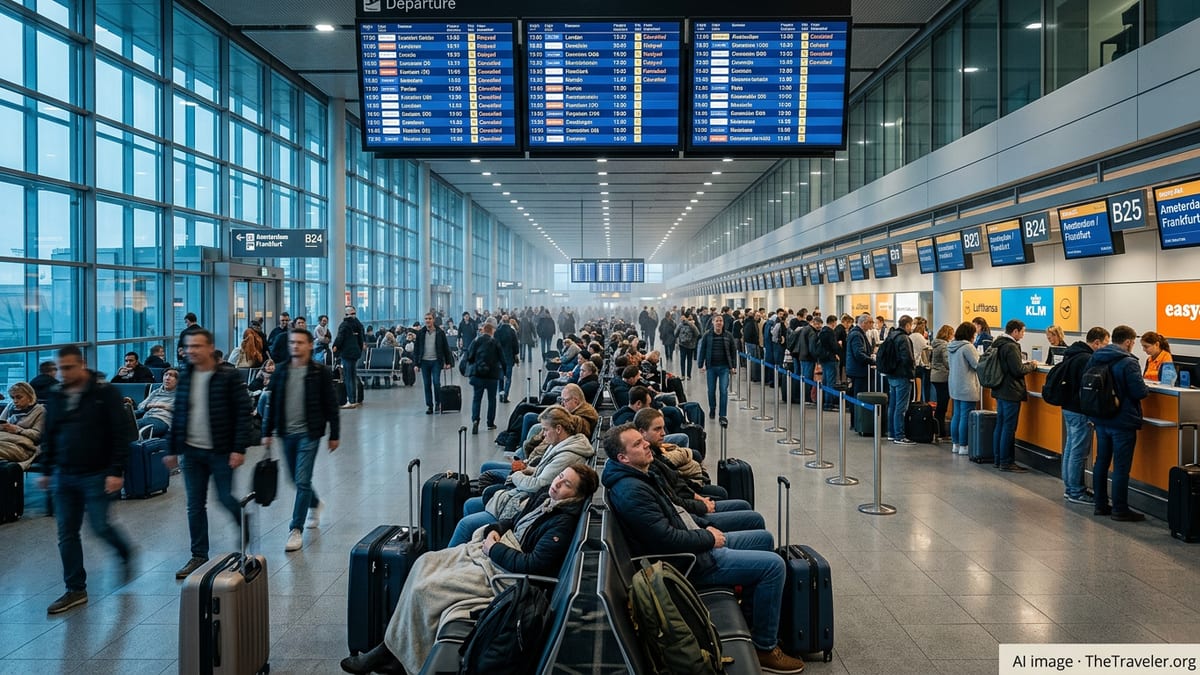
Amsterdam, Frankfurt and Other Hubs Buckle Under Pressure
Operational data from regional aviation tracking services on March 5 showed widespread disruption at key European gateways, with a combined total of 1,092 delays and 273 cancellations attributed to airports in the Netherlands, France, Italy, Germany and neighboring countries. Amsterdam Schiphol and Frankfurt Airport were among the hardest hit, as congested airspace, residual weather issues and network knock-on effects from Middle East route suspensions converged into another day of travel turmoil.
At Amsterdam, passengers reported departure boards lit up with red and yellow status alerts from early morning, with short haul European rotations bearing the brunt. KLM and its partners struggled to reposition aircraft and crew after several days of irregular operations, forcing the cancellation of multiple feeder services and lengthening delays for remaining flights.
Frankfurt experienced similar scenes, with Lufthansa and other Star Alliance carriers facing rolling delays as aircraft arriving late from elsewhere in Europe and the Middle East cascaded into missed slots and tight turnaround times. Long queues formed at rebooking counters, and airport staff were drafted in from other departments to manage growing crowds of stranded travelers.
Secondary hubs including Paris Charles de Gaulle, Milan Malpensa, Munich and Vienna also reported dozens of disrupted flights, further reducing the options for rerouting passengers and deepening the strain on Europe’s already stretched aviation network.
Airlines Confront Capacity Constraints and Safety Reroutes
While no single cause fully explains the March 5 disruption, airlines cited a combination of factors, including pressure on aircraft and crew availability, constrained airport capacity during peak waves, and continued rerouting around conflict-affected Middle Eastern airspace that lengthens flight times and complicates scheduling.
KLM, already operating a complex hub-and-spoke model at Amsterdam, has been forced to trim parts of its schedule in recent weeks while avoiding certain air corridors and recovering from earlier bouts of severe winter weather. Each additional constraint reduces the room for operational recovery when even a handful of early flights depart out of sequence or exceed permissible crew duty hours.
Low cost carriers such as easyJet, which rely on tight turnarounds to maintain profitability, also felt the impact. Delays at one airport quickly rippled across their point to point networks, leading to late arrivals and subsequent cancellations as crews timed out. Aviation analysts noted that when several European hubs encounter simultaneous disruption, spare capacity to absorb irregularities can evaporate within hours.
Lufthansa and other German carriers, meanwhile, are still adjusting their schedules after suspending or reducing services to parts of the Middle East due to security concerns. Longer routings, additional technical stops and last minute aircraft swaps have all fed into a fragile operating environment where even minor local weather disturbances can tip airports into prolonged delay cycles.
Passengers Face Long Queues, Patchy Communication and Limited Options
For travelers caught in the middle, the statistics translated into hours of uncertainty. At Amsterdam and Frankfurt, lines at transfer and ticketing desks stretched through terminal concourses as automated rebooking systems struggled to keep pace with the volume of disrupted itineraries. Several passengers reported spending the night on benches after local hotels filled up early in the day.
Families returning from school holidays and business travelers connecting to long haul services were among those most affected. With many transatlantic and intercontinental flights already operating near capacity, finding spare seats on alternative departures proved difficult, especially for larger groups seeking to travel together.
Communication varied significantly from carrier to carrier. Some passengers received early notifications through airline apps and were able to adjust their plans before reaching the airport, while others learned of cancellations only at check in. At several airports, departure boards lagged behind reality, showing flights as merely delayed long after airlines had decided to scrub them from the schedule.
Travel advisors urged passengers to monitor both airline channels and airport operational updates, and to consider rerouting through less congested hubs where feasible. However, with disruptions impacting a wide swath of Europe, alternative routings often involved lengthy detours or overnight stays, adding to the cost and stress of an already challenging travel day.
Regulatory Protections Offer Some Relief but Processes Are Slow
Under European Union passenger rights regulations, many of those whose flights were cancelled or severely delayed on March 5 may be entitled to compensation, meal vouchers, hotel accommodation and rebooking on the next available service. The specific entitlements depend on factors such as distance, length of delay and whether the disruption is considered within the airline’s control.
Consumer advocates noted that large scale events like this often generate a surge in claims that can take weeks or months to resolve. Passengers are advised to keep boarding passes, booking confirmations and receipts for any additional expenses such as meals, ground transportation and overnight stays, which may be reimbursable in eligible cases.
Airlines typically encourage customers to submit claims through their official online forms, but travelers facing language barriers or complex multi segment itineraries sometimes turn to specialized claims agencies. These intermediaries can simplify paperwork, although they generally retain a percentage of any compensation awarded as their fee.
Industry observers warned that while regulations provide important protections, they cannot fully offset the wider economic and personal impact of large scale aviation disruption. Missed meetings, lost vacation days and the emotional toll of prolonged uncertainty are rarely reflected in formal compensation schemes.
What Travelers Can Expect in the Coming Days
Operational experts cautioned that the March 5 disruptions are likely to echo through airline schedules for several days, as aircraft and crew are repositioned and backlogs of displaced passengers are cleared. Even travelers whose flights are currently listed as on time may experience last minute changes as airlines rebalance their networks.
Passengers scheduled to travel through Amsterdam, Frankfurt, Paris, Milan or other major European hubs in the coming days are being urged to build extra buffer time into their journeys, particularly if they have tight connections or onward rail and ferry links. Flexibility in routing and willingness to accept alternative airports nearby, such as Brussels or Düsseldorf for some itineraries, may increase the chances of reaching a destination on the intended date.
Airports and airlines have signaled that they are working to stabilize operations, with additional staffing at key customer service points and temporary schedule adjustments designed to create more slack in peak periods. However, with external pressures from geopolitical tensions and residual winter weather still in play, Europe’s aviation system is expected to remain vulnerable to fresh bouts of disruption.
For now, hundreds of travelers remain stranded in terminals across the continent, highlighting once again how quickly a complex global network can seize up when multiple stress factors collide, and underlining the importance for passengers of up to date information, contingency planning and awareness of their rights when journeys do not go as planned.