

More news on this day
Hundreds of passengers were stranded at Amman’s Queen Alia International Airport on Sunday after a fresh wave of regional airspace disruptions triggered 36 flight cancellations and 53 delays, snarling services operated by Royal Jordanian, FlyDubai, Qatar Airways and other major carriers on key routes to Dubai, Cairo, Istanbul and Riyadh.
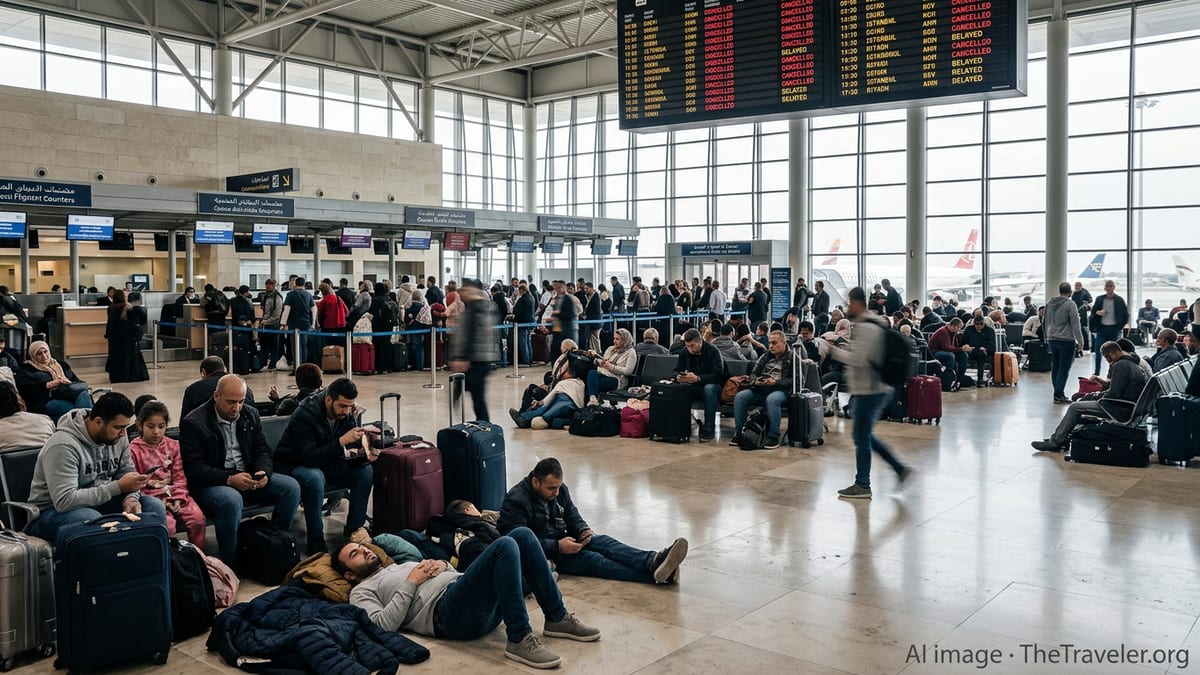
Long Queues and Frayed Tempers in Amman’s Main Terminal
By mid-morning on March 8, check in halls and transfer zones at Queen Alia International Airport were crowded with frustrated travellers clutching paper boarding passes and mobile phones as departure boards filled with rows of cancelled or significantly delayed flights. Airport staff set up ad hoc queuing lanes near airline desks as families, business travellers and tour groups waited for news of rebooking options that were often scarce.
Passengers described growing confusion as some airline apps continued to show flights as on time while airport screens updated to cancelled or delayed, prompting repeated trips between customer service counters and security checkpoints. Travellers connecting through Amman to onward destinations in the Gulf, Europe and Southeast Asia were particularly hard hit, with many forced to wait for hours landside while airlines assessed their ability to operate alternative routings.
With hotel availability in the Jordanian capital already tight due to earlier waves of regional flight disruption, some stranded passengers resorted to sleeping on terminal benches or stretched out on jackets near power outlets. Volunteers and airport concession staff reported increased demand for bottled water, snacks and charging points as delays extended into the afternoon.
Regional Tensions and Corridor Restrictions Ripple Across Networks
The latest disruption at Queen Alia comes against a backdrop of wider Middle East airspace constraints and rolling schedule changes as regulators and airlines adapt to shifting risk assessments. In recent days, carriers operating across the Gulf and Levant have repeatedly adjusted routings, cancelled rotations or limited services on short notice as conflict-related restrictions and corridor closures evolve.
Data from aviation analytics firms and airline advisories show that Jordan’s airspace, which briefly experienced a partial closure in early March, has remained under heightened operational scrutiny, affecting both overflights and point to point services into Amman. On Sunday, that translated into a concentration of short haul cancellations and long delays on high demand city pairs such as Amman to Dubai, Cairo, Istanbul and Riyadh, as carriers struggled to secure clear slots and stable routings.
Qatar Airways, FlyDubai and other Gulf based airlines have already thinned their schedules on some Middle Eastern sectors in recent days, while legacy carriers in Europe and Asia continue to monitor the viability of using regional hubs such as Amman for connections. Industry analysts warn that even when airspace formally reopens, knock on effects from aircraft and crew displacement can continue to cause sporadic cancellations for several days.
Flag Carrier Royal Jordanian Under Pressure
Royal Jordanian, which uses Queen Alia International Airport as its primary hub, faced some of the heaviest operational pressure on Sunday as it attempted to manage a complex mix of origin and transit passengers. The airline has been rebuilding its schedule since Jordanian authorities began easing earlier restrictions, but continued instability in surrounding air corridors has limited the pace of normalization.
Several Royal Jordanian departures and arrivals on core regional routes, including those linking Amman with key Gulf and North African cities, were among the 36 flights cancelled or significantly delayed. Passengers reported being offered rerouting via alternative gateways when possible, though limited seat availability on partner airlines meant that many were instead rebooked one or two days later.
The carrier has previously encouraged customers with non essential travel to monitor their bookings closely and make use of flexible rebooking waivers where applicable. However, Sunday’s scenes at Queen Alia highlighted the challenges of managing large numbers of disrupted itineraries at short notice, particularly when multiple airlines are adjusting their operations simultaneously.
Gulf and Regional Airlines Cut and Reshape Services
Beyond Royal Jordanian, low cost and full service carriers across the region adjusted schedules that feed into Amman. FlyDubai, a key operator on the Amman to Dubai corridor, saw multiple rotations disrupted just as demand for onward connections through the United Arab Emirates remained volatile. Travel agents in Amman reported a spike in last minute inquiries from passengers seeking to reroute through alternative hubs such as Istanbul or Cairo after learning of cancellations to Dubai.
Qatar Airways, which has been gradually reintroducing a limited number of services through Doha following earlier closures, also reduced or retimed certain flights touching Amman as it worked within constrained air corridors. Aviation experts note that each incremental change by a major hub carrier can cascade across regional networks, particularly when aircraft assigned to one sector are needed on another later in the day.
Other Middle Eastern airlines, including those based in Oman and Saudi Arabia, have issued their own advisories in recent days regarding suspended routes and temporary schedule cuts to and from Amman and neighbouring cities. Combined, these measures have complicated travel planning for passengers relying on multi segment itineraries, with some facing unexpected overnight stays or detours via third countries in order to reach their final destinations.
Passengers Face Uncertain Timelines and Limited Options
For stranded travellers at Queen Alia, the immediate concern on Sunday was simply how and when they would be able to continue their journeys. Many expressed frustration at receiving conflicting information from airline apps, airport displays and third party booking platforms, making it difficult to decide whether to remain airside, clear immigration or seek accommodation in the city.
Travel advisers recommend that passengers caught up in the current wave of disruptions keep boarding passes and receipts for meals or hotels, check eligibility for compensation under applicable regulations, and maintain regular contact with airlines via official channels rather than relying solely on automated alerts. Those with flexible travel plans are being urged to consider postponing non essential trips through the region until schedules stabilize.
As of Sunday evening in Amman, operations at Queen Alia International Airport were still described as heavily disrupted, with airlines warning that further cancellations and delays remained possible into the start of the week. For the hundreds of travellers camping out under the terminal’s high ceilings, the only certainty was that their journeys would be longer and more complicated than expected.