

More news on this day
Numerous flights at King Fahd International Airport in Dammam have been cancelled in recent days, stranding passengers and creating uncertainty for travelers across the wider Gulf region as airspace restrictions and schedule cuts ripple through Middle East aviation.
Get the latest news straight to your inbox!
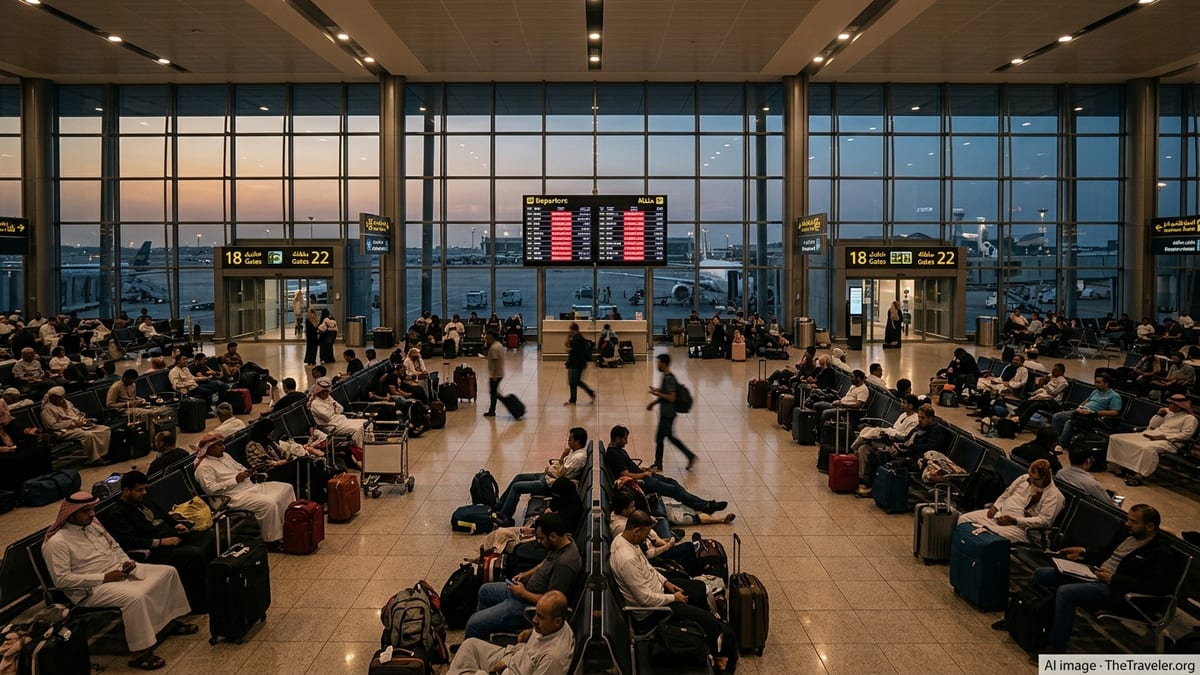
What Is Happening at King Fahd International Airport
Publicly available flight information and traveler reports indicate that King Fahd International Airport (DMM) is experiencing significant disruption, with a wave of cancellations and reduced schedules affecting both international and domestic services. While the airport remains open, many airlines have sharply curtailed operations at Dammam as they adjust to fast-changing airspace conditions and network constraints across the region.
Reports shared by travelers in mid-March 2026 point to repeated cancellations and last-minute timetable changes on routes such as Dammam to Jeddah and Dammam to Abu Dhabi. Some passengers describe flights being cancelled more than once after rescheduling, followed by new departure times that are again subject to change, underscoring how unstable operations currently are for anyone traveling via Dammam.
At the same time, there are indications that a small number of services continue to operate, including limited international connections and selected domestic flights. This mixed picture has created confusion, as some travelers are able to depart Dammam while others face multiple days of delays, cancellations, or the need to re-route through other airports.
Regional travel advisories describe the situation as part of a broader pattern of flight reductions and congestion affecting several Gulf hubs, with Saudi airports, including Dammam, handling diverted traffic and irregular operations while neighboring airspaces remain constrained.
Wider Middle East Airspace Disruption Behind the Cancellations
The situation at King Fahd International Airport is closely tied to wider disruption in Middle East airspace linked to the ongoing 2026 Iran conflict. Open-source reporting on the regional aviation picture describes extensive airspace closures, restricted corridors, and heightened congestion at key hubs following strikes and counterstrikes that began in late February 2026.
According to published coverage, multiple states in the region have partially closed or tightly controlled their skies at various points, leading airlines to cancel or re-route flights and, in some cases, temporarily ground fleets. With Bahrain’s airspace heavily restricted and Doha’s Hamad International Airport operating on a limited basis for evacuation and cargo flights, carriers have been forced to redesign networks that normally depend on dense Gulf-region connectivity.
As a result, Saudi Arabia has become one of the main remaining east–west corridors, placing additional pressure on airports including Dammam. Aviation and travel advisories describe severe congestion, constrained capacity, and a shortage of available aircraft and crews as planes and personnel are stranded at outstations or re-routed around closed airspace.
This broader regional context helps explain why passengers at King Fahd International Airport are seeing cancellations that may appear sudden or inconsistent, even when weather and local conditions in Dammam seem normal. The disruption is driven less by local issues and more by the knock-on effects of airspace closures, security considerations, and logistical challenges across multiple countries.
What Stranded Passengers in Dammam Are Experiencing
Travelers posting publicly about their journeys describe being stranded for extended periods, facing repeated cancellations and long waits for new itineraries. Some passengers in Dammam report that flights were first delayed, then cancelled outright, with rebooked departures later pushed back again as airlines reassessed their operations day by day.
Others note that airline booking systems show no availability on certain routes from Dammam until at least the start of April, suggesting that carriers have proactively withdrawn near-term capacity from the market. This has left many travelers unable to find immediate alternatives, even when they are willing to connect through different hubs or accept more complex routings.
There are also indications that a few airlines are operating limited “special assistance” or repatriation-style flights from Dammam to major cities such as London, Bangkok, or Mumbai. These flights appear to be focused on clearing backlogs of stranded passengers, with access managed through registration forms and waiting lists rather than open, regular ticket sales.
Within the airport, accounts from the wider Gulf region point to long queues at airline counters, crowded waiting areas, and passengers seeking information from staff who themselves are working with rapidly changing operational guidance. For travelers at King Fahd International Airport, this means it is often difficult to get firm answers about exactly when and how they will be able to depart.
Key Practical Advice for Travelers Using Dammam Right Now
Public travel advisories and airline updates emphasize that anyone planning to fly via Dammam in the current environment should be prepared for disruption, and should not assume that a confirmed booking guarantees travel on the original date and time. Schedules are being updated frequently, sometimes multiple times per day, as airlines react to changing airspace permissions and operational constraints.
Travel organizations recommend that passengers monitor their bookings closely through official airline channels and, when possible, use airline apps or websites to receive real-time notifications of changes. Because call centers and airport counters are facing heavy demand, online self-service tools may offer the quickest way to request refunds, vouchers, or alternative dates.
Travelers already in the Eastern Province who urgently need to leave the region may wish to consider alternative gateways if they are safely accessible, such as Riyadh or Jeddah, bearing in mind that these airports are also facing delays and capacity issues. In some cases, travelers in Bahrain have been advised by public discussion forums to drive across the causeway to reach flights from Dammam, though present disruption at DMM means this option may no longer provide the same level of relief it did earlier in the crisis.
Passengers are also encouraged by widely shared guidance to keep all documentation related to cancellations, including emails, messages, and booking references. These records may be important later when pursuing refunds, compensation where applicable, or insurance claims, particularly given the extraordinary nature of the regional situation.
How Long the Disruption Could Last
Forecasting the duration of the disruption at King Fahd International Airport is difficult, as it depends heavily on developments in the wider regional conflict and the pace at which airspace restrictions are eased. Analysts and risk-advisory firms tracking Middle East aviation note that operational uncertainty remains high, and that even when formal restrictions are relaxed, airlines may take time to reposition aircraft, rebuild schedules, and restore full capacity.
Recent travel advisories suggest that irregular operations, including cancellations and last-minute rerouting, are likely to persist across the Gulf at least through the coming weeks. For Dammam, this implies that passengers may continue to face limited options and short-notice changes well beyond the immediate days of the initial wave of cancellations.
Airlines serving Dammam are expected to prioritize safety and regulatory compliance as they gradually increase flights, which may mean that certain destinations or time slots return more quickly than others. In the meantime, travelers are being cautioned through public information channels to remain flexible with dates, maintain backup plans where possible, and allow extra time and resources for unexpected disruptions.
For now, King Fahd International Airport remains emblematic of how geopolitical events can rapidly reshape air travel across an entire region, leaving passengers at the intersection of complex operational decisions that can change from one day to the next.