

More news on this day
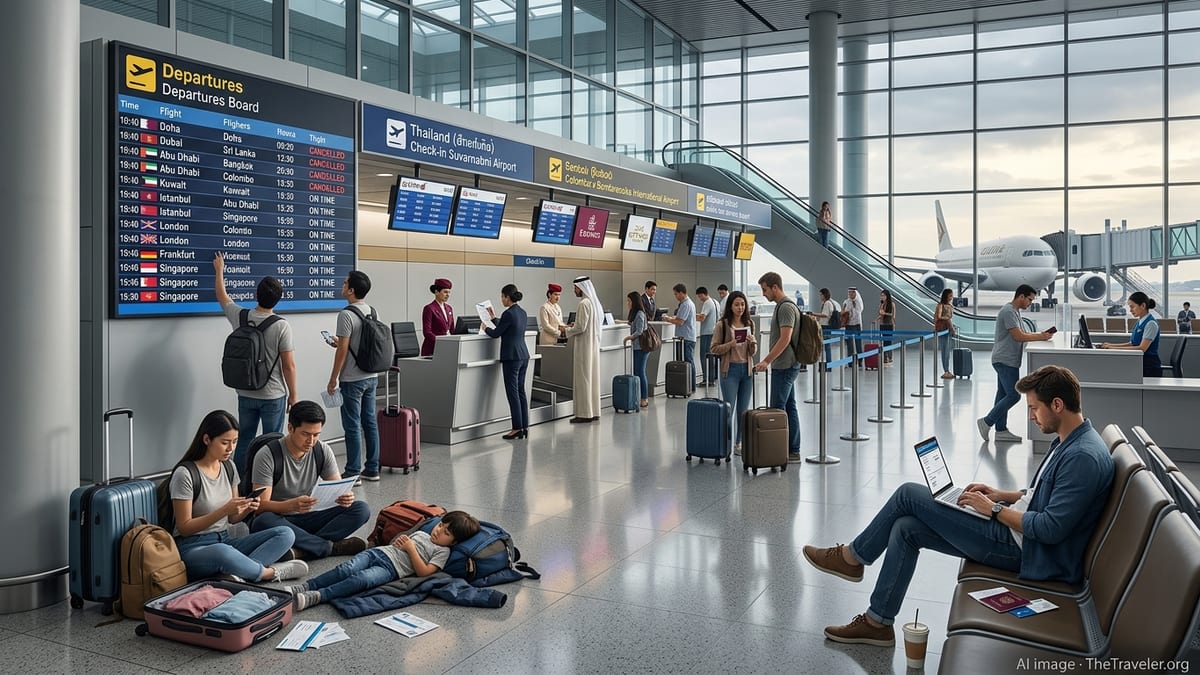
Hundreds of travelers in Thailand and Sri Lanka are grappling with unexpected airport stays, mounting costs, and limited rebooking options after a fresh wave of flight cancellations at Bangkok’s Suvarnabhumi Airport and Colombo’s Bandaranaike International Airport linked to wider disruptions in Middle Eastern airspace.
Get the latest news straight to your inbox!
Regional Conflict Ripples Into Southeast Asian Hubs
Published coverage across Asia indicates that the latest cancellations are part of a broader pattern of disruption triggered by the escalation of conflict in the Middle East, which has led to temporary airspace closures and significant schedule changes on key Gulf transit routes. Flights connecting Bangkok and Colombo to hubs such as Doha, Dubai, Abu Dhabi and Kuwait City have been among the hardest hit, as airlines reroute or ground services that would normally overfly affected areas.
Reports from Thailand describe passengers at Suvarnabhumi Airport discovering last-minute cancellations on services operated via Middle Eastern hubs, particularly on itineraries to Europe and North America. Many of these journeys rely on single‑ticket connections through Gulf airports, leaving passengers vulnerable when one leg of the itinerary is cut, even if flights at their immediate departure point appear to be operating.
In Sri Lanka, local news coverage has highlighted a series of cancellations by the national carrier on routes between Colombo and several Gulf destinations over recent weeks, following airspace restrictions and heightened security assessments along popular westbound corridors. While core regional operations from Colombo to South and Southeast Asia continue, the loss of multiple flights to the Middle East is contributing to a backlog of travelers seeking alternative ways home.
Aviation analysts note that the latest wave of cancellations comes on top of an already fragile global network still recalibrating after earlier conflicts and airspace closures. The result is that spare capacity on alternative routes is limited, especially during peak travel periods, which worsens the situation for those stranded at transit and origin airports.
Passengers at Suvarnabhumi Report Long Delays and Limited Options
At Bangkok’s Suvarnabhumi Airport, one of Southeast Asia’s busiest international gateways, travelers have described prolonged waits and repeated cancellations on itineraries routed through Middle Eastern hubs. Public posts from stranded passengers reference overnight stays in the terminal, difficulty reaching airline call centers, and confusion over which services are still operating.
Travelers attempting to reach Europe have been particularly affected. Accounts shared on travel forums suggest that some passengers originally booked via Doha, Dubai or Abu Dhabi are being rebooked days later on alternative carriers that route through East Asia or other non‑Gulf hubs, often with longer journeys and multiple stops. In some cases, only a limited number of seats are available, forcing passengers to remain in Bangkok for nearly a week while they wait for the next open departure.
Operational disruptions have not been limited to Gulf‑linked routes. In a recent incident, a long delay was reported on a Suvarnabhumi departure to Busan after a traffic accident involving cabin crew on their way to the airport, leaving more than 200 passengers facing an extended wait for a replacement team. While that case was unrelated to the Middle East conflict, it has contributed to an overall impression among travelers that schedules at the Bangkok hub are unstable and subject to sudden change.
Airport services such as hotels near the terminal and rail links into the city remain available, but many stranded passengers report that finding affordable last‑minute accommodation can be challenging, especially when large groups are affected at the same time. Some travelers have opted to seek help at downtown ticket offices when phone and online support channels prove difficult to access.
Colombo’s Bandaranaike Airport Feels the Strain of Cancellations
Bandaranaike International Airport, serving Colombo, has also seen significant disruption as airlines adjust to changing conditions on westbound routes. Sri Lankan media reports note that approximately 30 flights operated by the national carrier were cancelled over a short period following escalations in the Middle East, particularly on services linking Colombo with Dubai, Doha, Kuwait and Riyadh.
Publicly available information from Sri Lankan outlets describes scenes of uncertainty among passengers booked on these routes, with travelers stranded at Gulf airports as well as in Colombo while waiting for updated schedules. Several airlines have flagged ongoing airspace closures and security assessments as the main reason for suspending or heavily modifying services, resulting in missed connections and extended layovers for passengers attempting to transit between Asia, the Middle East and Europe.
Officials in Sri Lanka have indicated in earlier briefings that coordination with diplomatic missions is under way to support nationals stranded in affected Middle Eastern countries. However, for many passengers at Bandaranaike, the most immediate challenge remains securing a confirmed seat on any outbound flight that can bypass restricted airspace and still reach their intended destinations within a reasonable timeframe.
Industry observers point out that Colombo’s airport was in the midst of a steady recovery in traffic volumes through 2024 and early 2025. The latest disruptions risk slowing that recovery, as airlines weigh operational safety, insurance considerations and crew logistics against the strong demand for travel between Sri Lanka, the Gulf and destinations further west.
Rebooking, Refunds and Visa Concerns Add to Traveler Stress
For stranded passengers at both Suvarnabhumi and Bandaranaike, the practical difficulties extend far beyond delayed departure boards. Accounts shared publicly by travelers describe long waits in call center queues, inconsistent information between airline apps and airport desks, and uncertainty over whether accommodation and meal costs will be reimbursed when cancellations are attributed to broader security or airspace issues.
Some travelers report being offered rebooking several days later on alternative routes, but without coverage of interim hotel stays or local transport. Others describe being advised that normal refund rules still apply, even when multiple cancellations have affected the same ticket within a short span. This has led some passengers to hesitate before canceling on their own, worried that they may forfeit compensation while still lacking a viable replacement itinerary.
Visa and immigration rules add another layer of complexity. In Thailand, travelers whose permitted stay is nearing its end are seeking guidance on how to handle unplanned extensions while they wait for new flights. In Sri Lanka, similar questions are emerging for passengers who arrived on short‑term visas but now face longer‑than‑expected stays in or around Colombo. While some governments in the wider region have previously introduced special provisions for travelers stranded by flight disruptions, current policies vary by country and are not always well understood by those affected.
Consumer advocates monitoring the situation suggest that passengers carefully review airline travel advisories, keep written records of all communications, and retain receipts for essential expenses. They also recommend checking local immigration guidance in Thailand and Sri Lanka regarding emergency extensions or waivers related to documented flight cancellations, as these rules can change quickly in response to evolving events.
What Travelers Should Watch in the Coming Days
Airlines serving Bangkok and Colombo continue to adjust schedules on a rolling basis as they monitor security assessments and airspace notices across the Middle East. Industry data and regional press reports indicate that carriers are frequently updating timetables only a few days in advance, meaning that passengers with upcoming trips remain vulnerable to late‑breaking changes.
Travel specialists currently advise that passengers booked on itineraries transiting Gulf hubs pay close attention to messages from their airlines and check flight status repeatedly in the 24 to 48 hours before departure. Where possible, travelers may wish to consider alternative routings through other regions if they need higher certainty of travel, although such options can be more expensive and subject to their own capacity constraints.
At Suvarnabhumi and Bandaranaike, airport operations otherwise remain open, with core regional and domestic flights still running on many routes. Nonetheless, the concentration of cancellations on certain international services is enough to leave significant numbers of passengers in limbo, particularly those relying on complex multi‑stop itineraries.
With no clear timeline for full normalization of airspace use over affected parts of the Middle East, observers expect rolling disruptions to continue affecting Southeast Asian hubs in the short term. For now, travelers through Bangkok and Colombo are being urged by travel industry commentators to build flexibility into their plans, stay informed about fast‑moving developments, and be prepared for the possibility of extended stays if flight cancellations ripple through their chosen routes.