

More news on this day
Thousands of travelers across the Middle East and Europe are facing prolonged disruption after a new wave of flight cancellations and delays rippled through major hubs in the United Arab Emirates, Oman, Bahrain, Qatar, Kuwait and beyond, disrupting services for Gulf Air, Emirates, Flydubai, Air France, KLM and other carriers on routes linking cities such as Riyadh, Doha, Jeddah, Paris and Athens.
Get the latest news straight to your inbox!
Airspace Closures Trigger Fresh Wave of Disruptions
Publicly available aviation data and regional media reports indicate that at least 241 flights have been cancelled and a further 138 delayed across key Gulf and connecting European airports in recent days, as airspace restrictions continue to reshape traffic patterns. The latest figures come on top of thousands of earlier cancellations since late February, extending the ordeal for passengers already stranded or repeatedly rebooked.
Closures and restrictions in portions of Middle Eastern airspace have forced airlines to suspend or reroute services, particularly around the Gulf. Reports from aviation analytics providers show that traffic to and from the United Arab Emirates, Qatar, Bahrain, Kuwait and Oman remains significantly below normal levels, even as a limited number of flights gradually return.
According to published coverage in regional outlets, major hubs such as Dubai International and Abu Dhabi’s Zayed International in the UAE, Hamad International in Doha, and airports in Riyadh and Jeddah have all experienced severe disruption. The knock-on effects have extended far beyond the immediate region, affecting departures and arrivals in European gateways including Paris and Athens as airlines adjust schedules or cancel services outright.
The impact is being felt across both long-haul and regional networks, with cancellations affecting links between the Gulf and cities in Europe, Asia and Africa. In many cases, flights that do operate are subject to extended routings and longer flight times to avoid closed or restricted airspace corridors.
Major Carriers Scale Back Networks
Flag carriers and low-cost airlines based in the Gulf are among the most heavily affected. Emirates and Flydubai, both operating out of Dubai, have implemented rolling suspensions and limited resumptions of service as conditions change. Public statements and timetables reviewed by travel media show that, on several days since the start of March, only a fraction of their usual schedules operated, with a focus on select long-haul destinations and repatriation-style services.
In neighboring Qatar, published updates indicate that normal commercial operations at Doha have been significantly curtailed, with airlines prioritizing specific outbound routes where safe operating corridors are available. Bahrain’s Gulf Air has also adjusted its network, using alternative airports and routings to move stranded passengers where possible.
European carriers are similarly affected. Air France has suspended or reduced services on several Middle Eastern routes, including flights touching Gulf hubs and onward connections to cities such as Riyadh and Dubai, while maintaining limited services where airspace access and security conditions allow. KLM has rerouted aircraft away from certain regional corridors and has suspended flights to several destinations in the wider Middle East, impacting connections through Amsterdam for travelers bound for or returning from Gulf cities.
Industry coverage notes that airlines are constantly revising schedules, at times reinstating a small number of flights to key cities such as Paris, Athens, Riyadh, Jeddah and Doha, only to adjust them again as the regional situation evolves. This dynamic environment has made it challenging for passengers and travel agencies to rely on schedules more than a few days in advance.
Hub Airports Struggle With Backlogs and Rebookings
Major Gulf hubs that normally function as tightly timed connecting platforms have become sites of prolonged stays and rolling delays. Flight-tracking data and airport departure boards in Dubai, Doha, Riyadh and Jeddah show waves of cancellations interspersed with small clusters of operating flights, often designated for specific destinations or time-limited corridors.
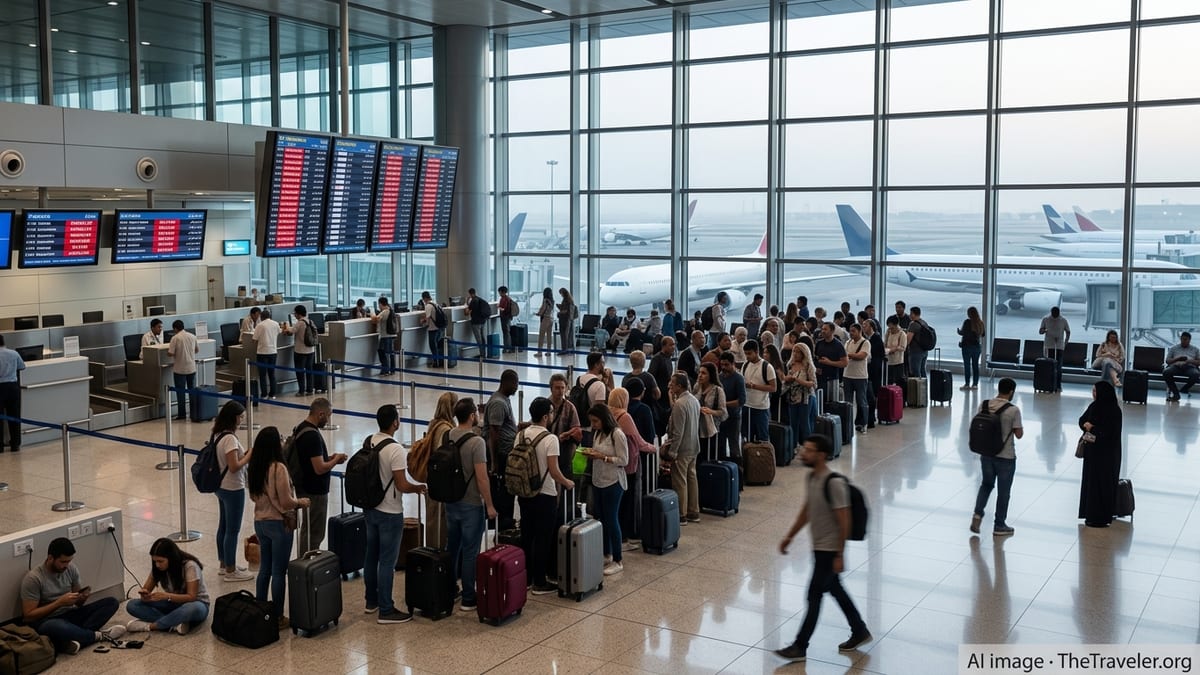
With 241 cancellations and 138 delays attributed to the most recent phase of disruption alone, backlogs are building across multiple airports. Published reports describe terminal areas crowded with passengers waiting for news of rebookings, alongside quieter concourses near shuttered boarding gates where entire banks of flights have been taken off the schedule.
Operational constraints extend beyond airspace closures. Airlines are facing crew and aircraft positioning challenges after several days of suspended operations in early March, and efforts to restart even partial schedules have been complicated by the need to move aircraft out of affected regions. In some cases, carriers have turned to nearby airports in Saudi Arabia or Oman as alternative points of departure to help alleviate congestion at the primary Gulf hubs.
European airports are seeing the knock-on effects. At Paris Charles de Gaulle and Athens International, the cancellation or delay of Gulf-bound flights has led to disrupted connections for travelers arriving from North America, Africa and other parts of Europe, many of whom were relying on Gulf hubs as transfer points to South Asia and Australasia.
Passengers Face Uncertainty and Limited Alternatives
For passengers, the ongoing disruption has translated into a mix of uncertainty, extended layovers and rapidly changing itineraries. Travel forums and social media posts reviewed by TheTraveler.org describe travelers whose journeys through Dubai or Doha to destinations such as Jeddah, Riyadh, Athens and Paris have been cancelled with little notice, forcing them to seek hotel accommodation or remain in transit areas while awaiting new flights.
Some airlines have introduced limited repatriation-style flights, particularly from Dubai and Doha, to clear the most urgent backlogs. Flight lists circulating on public forums show carefully selected routes operating from Gulf hubs to major cities in Europe, North America and Asia, often for one or two days at a time before schedules are revised. Seats on these services appear to be in high demand, with priority often given to travelers whose earlier flights were cancelled.
Rebooking options are constrained by the scale of the disruption. With multiple airlines adjusting or suspending operations across similar corridors, shifting passengers from one carrier to another can be difficult, especially on peak routes linking the Gulf to South Asia or Europe. Publicly available guidance from several airlines stresses that only passengers with confirmed bookings on operating flights should proceed to the airport, while others are advised to wait for rebooking notices.
Travel insurance coverage and flexible ticket policies have become critical for many affected travelers. Industry analyses suggest that passengers with changeable or refundable fares have had more success rearranging their journeys, while those on the lowest-cost tickets face longer waits and fewer alternatives, particularly when trying to avoid routings through the most disrupted hubs.
What Travelers Should Expect in the Coming Days
Aviation analysts quoted in regional business coverage suggest that while limited services are likely to increase gradually as conditions permit, the residual effects of this disruption could persist for days or even weeks on certain routes. Aircraft and crew rotations will need time to normalize, and airlines may prioritize high-demand or strategically important destinations such as Riyadh, Jeddah, Doha, Paris and major South Asian cities before restoring full networks.
Travel advisories from governments and airlines continue to emphasize the need for flexibility. Passengers with itineraries involving Gulf hubs in the near term are being encouraged, via published guidance, to monitor their booking status frequently, allow extra time for connections, and be prepared for last-minute schedule changes or rerouting via alternate airports in the Middle East or Europe.
Experts tracking the situation note that the Gulf’s role as a global connector amplifies the impact of any airspace disruption. With carriers such as Emirates, Qatar Airways, Gulf Air and Flydubai serving as key links between continents, even a partial shutdown can reverberate across global travel patterns, affecting travelers far removed from the immediate region.
For now, the 241 cancellations and 138 delays recorded in the latest phase of this crisis represent only a snapshot of a wider and evolving challenge. As airlines incrementally rebuild their schedules, travelers planning to transit through the Gulf are likely to face a complex and shifting landscape, underscoring the importance of real-time information, flexible planning and close attention to airline and airport updates.