

More news on this day
Hundreds of flights to and from Germany were abruptly canceled this week as Lufthansa, Qatar Airways and several partner carriers slashed services, unleashing severe disruption for passengers traveling between German hubs and major cities including Amsterdam, Berlin, Barcelona, Dublin, Milan, Paris, New York, Chicago, Miami, Tokyo and Doha.
Get the latest news straight to your inbox!
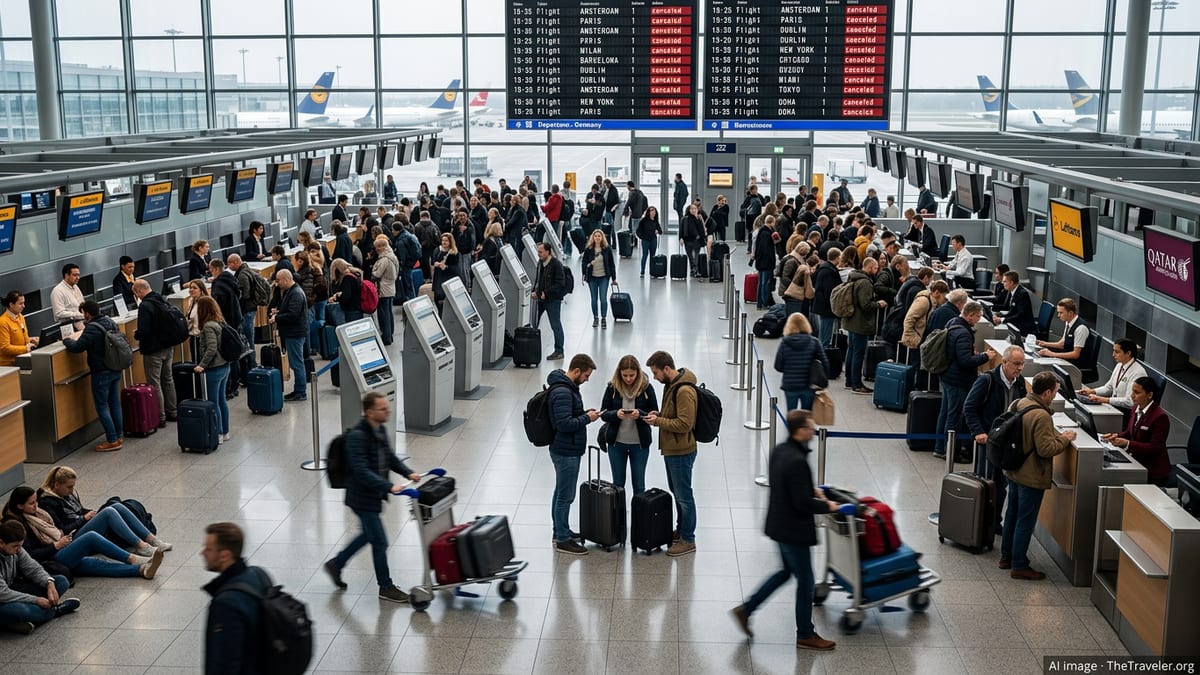
Strikes, Airspace Closures and Operational Strains Converge
The latest disruption reflects a convergence of crises hitting European and Gulf aviation in March 2026. In Germany, Lufthansa’s recent strike-related schedule reductions, combined with ongoing operational adjustments, have already led to the cancellation of hundreds of flights across Frankfurt, Munich and Berlin. At the same time, a separate crisis in the Gulf region has forced Qatar Airways to suspend most scheduled services after Qatari airspace was closed, triggering cascading cancellations on routes linking Doha with Europe, North America and Asia.
Industry analysts say the result is an unusually sharp shock to connectivity for travelers who rely on Germany and Doha as key transit hubs. With Lufthansa trimming German and intra-European services and Qatar Airways operating only a limited relief schedule, itineraries that would normally connect seamlessly between cities such as Amsterdam, Paris, Milan or Barcelona and long haul destinations like New York, Chicago, Miami and Tokyo have instead fractured into multiple broken segments or been scrapped entirely.
A mix of labor disputes, political tensions and airspace restrictions lies behind the turmoil. While Lufthansa has focused on managing the fallout from industrial action and restructuring, Qatar Airways is operating under temporary exemptions that permit only a narrow corridor of repatriation-style flights. Travel agents report that even experienced frequent flyers are struggling to keep pace with rapidly changing schedules and last minute cancellations.
Key Routes Affected From Frankfurt, Munich and Berlin
Germany’s primary gateways are bearing the brunt of the immediate chaos. At Frankfurt and Munich, Lufthansa has canceled a significant number of intra-European services that typically feed long haul departures, including flights to Amsterdam, Paris, Brussels and other nearby hubs, forcing passengers to rebook via alternative carriers or routings. Travelers bound for Barcelona, Dublin and Milan report same-day cancellations at short notice, leaving departure boards filled with gaps where dense shuttle-style frequencies once stood.
Berlin, which has grown in importance as a secondary hub, is also seeing sharp cuts. Some passengers with Berlin connections to North America via Frankfurt or Munich have found both legs of their journeys canceled, severing links to cities such as New York, Chicago and Miami. Others heading from German cities to key European capitals have been offered rail alternatives or overnight hotel stays as airlines scramble to comply with passenger rights obligations while managing limited capacity.
The disruption is not confined to point-to-point travel. Germany’s role as a transfer node means that cancellations radiate outward: a single scrapped Amsterdam or Paris feeder flight can unravel onward itineraries to the United States or Asia. With schedules already tight due to earlier capacity reductions, there is little slack left to absorb such widespread changes, making same-day rebooking particularly difficult during busy travel periods.
Qatar Airways’ Limited Schedule Leaves Long Haul Gaps
Compounding the situation in Germany is the ongoing suspension of most Qatar Airways services after the closure of Qatari airspace. The carrier has announced only a carefully controlled, short-term list of flights to and from Doha, focusing on a narrow set of destinations and dates in mid March to move stranded passengers. While some services linking Doha to Amsterdam, Milan, Paris, Miami and New York are being temporarily restored, these relief flights are far fewer than the airline’s usual global schedule and do not represent a full resumption of operations.
Passengers booked on Germany–Doha–Asia or Germany–Doha–Africa itineraries face particular uncertainty. Many report receiving cancellation notices for upcoming segments between Amsterdam or Berlin and Doha, with limited clarity on when or if their full itineraries will be reprotected on other airlines. Some are being rerouted through alternative Middle Eastern or European hubs, while others are opting to cancel entirely and seek refunds under the flexible policies introduced in response to the crisis.
Travel forums and social media are filled with accounts from travelers holding tickets to or from Doha who have watched their flights disappear from schedules in recent days. Even those with confirmed seats on the new limited Doha services caution that sudden changes remain possible until the wider airspace situation stabilizes and Qatar Airways is able to publish a more predictable timetable.
Transatlantic and Asian Connections Under Acute Pressure
The knock-on effects are especially acute on transatlantic and Asia-bound routes that rely on German and Gulf hubs for connectivity. Airlines serving New York, Chicago and Miami from Europe are seeing surging demand from passengers who were originally scheduled to cross the Atlantic with Lufthansa or Qatar Airways but are now forced to patch together new routings. In many cases, only higher fare buckets remain, leaving travelers with the choice of paying substantially more or postponing trips.
Flows between Europe and Asia are equally strained. Travelers from Germany, the Netherlands, France and Ireland bound for destinations in Japan, Southeast Asia and the Indian subcontinent report longer, more complex routings that bypass Doha entirely. Tokyo-bound passengers in particular are facing missed connections and forced overnight stays after cancellations on feeder legs from cities like Berlin, Amsterdam or Barcelona.
With aircraft utilization already high toward the end of the winter season, major carriers on both sides of the Atlantic have limited flexibility to add capacity at short notice, making it harder to accommodate the thousands of passengers affected by more than 300 cancellations. For many, that means accepting extended layovers, indirect itineraries via secondary hubs, or travel dates that are several days later than originally planned.
What Travelers Can Do If Their Flight Is Canceled
Consumer advocates urge affected travelers to act quickly and methodically if they discover their flight has been canceled. The first step is to confirm the status of each segment directly with the operating carrier’s app or customer service channels, as itinerary changes issued by travel agents or third party booking sites may lag behind real time operational decisions. Passengers whose flights originate in or pass through the European Union are typically entitled to rebooking or refunds and, in many cases, additional compensation when cancellations are not caused by extraordinary external events.
In the current disruption, Lufthansa is generally offering free rebooking on alternative dates or routes within its own group network where seats are available, and in some cases is facilitating rail tickets on domestic German routes when air services are withdrawn. Qatar Airways, meanwhile, has adopted temporary policies that permit date changes or refunds for customers whose journeys fall within the affected period, though options may be constrained by the limited number of flights currently allowed to operate to and from Doha.
Travel experts recommend that passengers keep receipts for hotels, meals and ground transport incurred as a direct result of cancellations, as these costs may be recoverable later under applicable regulations or airline goodwill policies. They also stress the importance of monitoring flight information repeatedly in the days and hours before departure, as schedules remain volatile and additional cancellations or last minute restorations of service are possible while airlines adjust to fast moving operational and political developments.