

More news on this day
Hundreds of passengers were left stranded on Tuesday as conflict-driven airspace restrictions across the Middle East triggered the cancellation of 66 flights and delays to a further 107 services operated by El Al, Emirates and FlyDubai, disrupting travel through Israel, the United Arab Emirates, the United Kingdom, Hong Kong, France, Thailand and several other destinations.
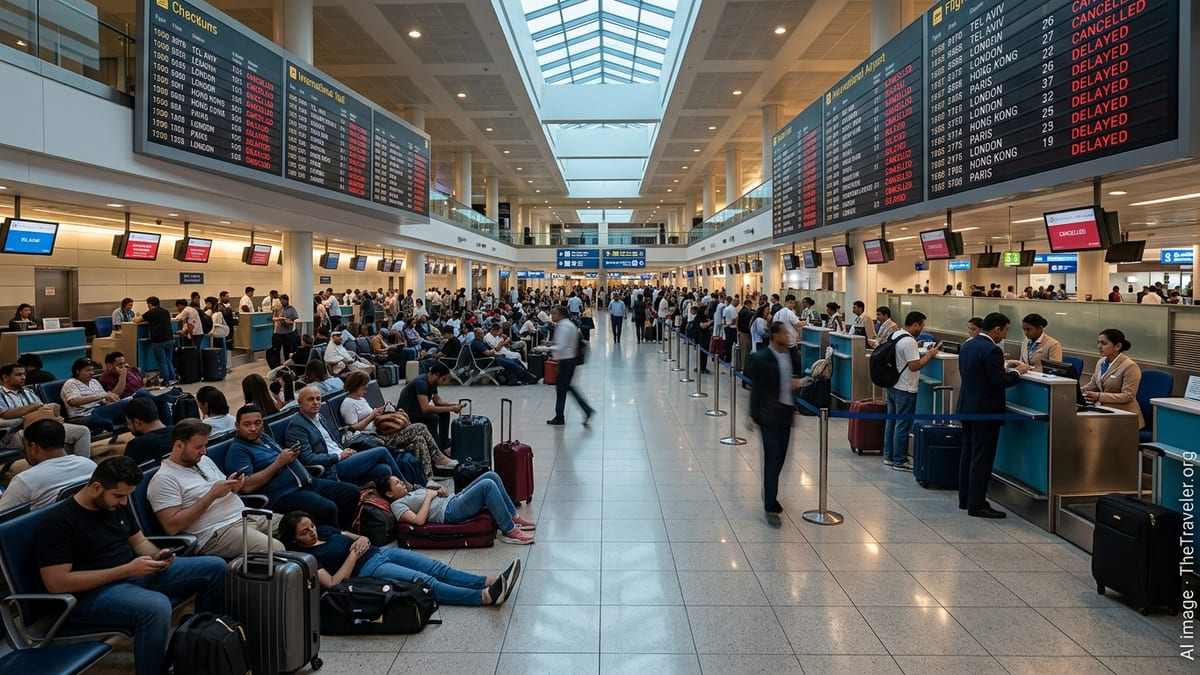
Middle East Conflict Spurs Fresh Wave of Cancellations
The latest disruption comes amid an ongoing aviation crisis sparked by the Iran war and associated airspace closures that have repeatedly upended flight schedules across the Gulf and wider region since late February 2026. Authorities in several Middle Eastern states continue to limit or reroute commercial traffic for security reasons, forcing airlines to trim operations, consolidate services and prioritize repatriation flights.
On March 10, operational data from regional hubs showed that El Al, Emirates and FlyDubai were among the carriers hardest hit, with a combined 66 flights cancelled and 107 delayed in a single day. While these figures represent only a fraction of the thousands of flights disrupted since the start of the crisis, they underscore how quickly routine travel plans can unravel whenever airspace corridors are tightened or closed.
Airports in Israel and the United Arab Emirates remain at the heart of the disruption. Ben Gurion Airport outside Tel Aviv continues to operate under tight security and intermittent restrictions, while Dubai International Airport and other UAE gateways are working through significant backlogs of passengers whose journeys were halted mid-route as the crisis escalated.
Airlines have stressed that the situation is highly fluid, with schedules being adjusted on an hourly basis in response to military activity, regulatory decisions and the gradual reopening of some flight corridors. Passengers are being urged to assume that previously confirmed itineraries may change with little notice.
Stranded Passengers Face Long Waits in Multiple Countries
Although the core of the crisis lies in Middle Eastern airspace, its impact has rippled far beyond the region. Travellers connecting through hubs such as Dubai and Tel Aviv have found themselves stranded not only in the Gulf but in distant cities where onward legs were scrubbed at short notice. On Tuesday, delays and cancellations linked to El Al, Emirates and FlyDubai operations were felt as far afield as the United Kingdom, Hong Kong, France and Thailand.
In London, passengers waiting to board outbound services to Dubai and Tel Aviv reported repeated gate changes, rolling delay notices and, in some cases, last-minute cancellations as aircraft and crew were repositioned. Similar scenes played out in Paris and Bangkok, where travellers who had planned straightforward connections to the Middle East and beyond suddenly faced unplanned stopovers, overnight stays and the prospect of rebooking onto scarce alternative flights.
In Hong Kong, where Middle East carriers normally serve as vital connectors to Europe and Africa, the reduced schedules left long-haul itineraries in disarray. Airport staff spent much of the day re-accommodating transit passengers whose tickets routed them through the affected hubs, while airline call centres struggled to keep pace with rebooking requests and refund queries.
For many travellers, the most challenging aspect has been the lack of certainty. With security conditions and airspace permissions evolving quickly, airlines have been unable to offer firm guarantees on when normal operations will resume, leading some passengers to seek entirely different routings via unaffected hubs or to postpone trips altogether.
El Al, Emirates and FlyDubai Battle Operational Headwinds
The three carriers at the centre of Tuesday’s figures each face a distinct set of operational challenges shaped by their home bases and network structures. Israel’s El Al, operating from Tel Aviv, is navigating heightened security concerns and intermittent restrictions on departures and arrivals. The airline has had to cut and consolidate select regional and long-haul services, affecting connections to European gateways and onward links to Asia.
Emirates, the Dubai-based long-haul giant, has been gradually rebuilding its schedule after a period of near-total suspension of regular commercial flights as airspace across parts of the Gulf was closed. In recent days it has restored a growing number of routes and laid on additional services to key markets such as the United Kingdom and Europe. Even so, aircraft and crews remain out of position and demand for seats from stranded travellers remains high, making further last-minute changes likely.
FlyDubai, the UAE’s major low-cost carrier, is contending with similar pressures on a predominantly short and medium haul network spanning the Middle East, South Asia and parts of Europe. Operational data on Tuesday showed multiple cancellations and scores of delays as the airline worked within restricted corridors and slot allocations. For budget-conscious travellers who rely on FlyDubai to connect from secondary cities into larger hubs, the disruption has been particularly acute.
All three airlines have activated flexible rebooking and waiver policies, allowing affected passengers to change dates or destinations without standard penalty fees, subject to seat availability. However, those measures have done little to shorten queues at airport service desks, where travellers continue to seek clearer answers about when they can realistically expect to fly.
Ripple Effects Across Global Aviation Networks
The scale and duration of the Middle East airspace restrictions have produced knock-on effects far beyond the region. With major hubs in the Gulf operating below capacity and routes over parts of Iran and neighbouring states either closed or heavily regulated, airlines worldwide have been forced to reroute flights, extend block times and, in some instances, suspend services entirely.
For carriers in Europe and Asia, this has translated into longer flight times on certain routes, increased fuel costs and tighter aircraft utilization. Some airlines have opted to add unscheduled refuelling stops or to pivot demand through alternative hubs in Saudi Arabia, Oman or Turkey, where feasible. Others have temporarily cut frequencies to Middle Eastern destinations, focusing instead on repatriation and essential travel.
The disruption has also affected cargo flows, with freight capacity reduced on key east–west corridors that typically rely on belly space in passenger aircraft operating through Dubai and other Gulf gateways. Logistics firms have warned of delays to shipments and potential price rises for urgent air freight as available space tightens.
Aviation analysts note that while airlines are increasingly adept at managing short-lived disruptions such as storms or localized security alerts, the current crisis is testing the resilience of global networks over a sustained period. As carriers juggle crew duty limits, aircraft maintenance windows and shifting regulatory constraints, they are being forced to make rapid trade-offs between maintaining connectivity and safeguarding safety and compliance.
What Travellers Can Expect in the Coming Days
Despite the severe disruption, there are signs that airlines and aviation authorities are slowly moving toward more stable operations. Several Gulf states have begun to partially reopen controlled sections of their airspace, and Emirates and FlyDubai have both signalled an intention to ramp up flights as conditions allow. El Al is likewise working to restore more of its scheduled services, particularly on key European routes.
In practical terms, travellers booked with El Al, Emirates or FlyDubai over the next week should prepare for the possibility of schedule changes, even if their flights currently appear confirmed. Industry guidance strongly advises passengers not to travel to the airport until they have received direct confirmation from their airline that their specific flight is operating as planned.
Those with urgent travel needs are being encouraged to explore alternative routings via less-affected hubs, although seat availability remains constrained on many of these options. Travel agents report that demand for routings that bypass the most heavily restricted airspace remains strong, especially on journeys linking Europe and Asia that would normally rely heavily on Gulf connectors.
For now, the hundreds of passengers stranded across Israel, the UAE and onward destinations in the United Kingdom, Hong Kong, France, Thailand and beyond remain at the mercy of a complex and fast-moving security situation. Until regional airspace fully stabilizes, even incremental progress in restoring flight schedules is likely to be uneven, leaving many travellers to navigate a patchwork of cancellations, delays and partial solutions as they attempt to reach their destinations.