

More news on this day
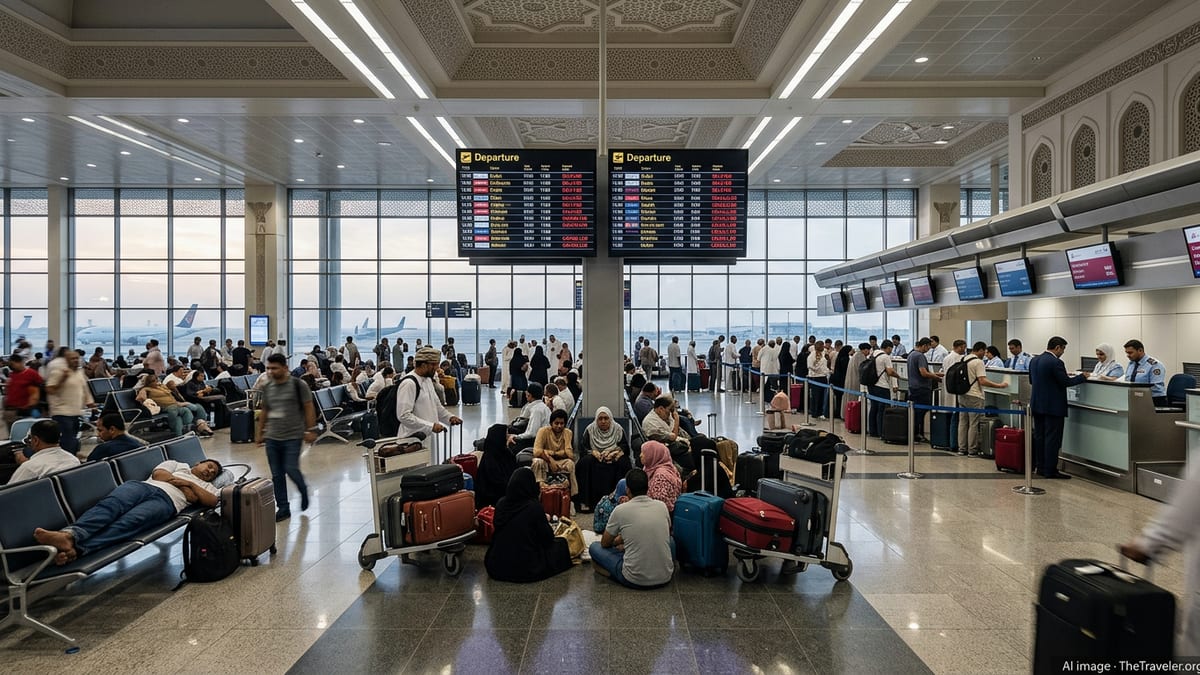
Hundreds of travelers at Muscat’s Seeb International Airport in Oman faced mounting chaos on March 8 as at least 70 flights were delayed and 24 cancelled, disrupting operations for Oman Air, SalamAir, FlyDubai, Qatar Airways and other carriers on key routes to Dubai, Riyadh, Doha, Bahrain and beyond.
Gulf Airspace Closures Ripple Into Muscat
The disruption in Muscat comes amid a wider regional aviation crisis triggered by partial airspace closures across parts of the Gulf, forcing airlines to reroute or suspend services. While Oman’s airspace remains technically open, carriers using Muscat as a hub or diversion point are contending with complex detours, shifting permissions and rapidly changing safety assessments.
Oman Air has already announced multi-day cancellations on regional routes, including all services between Muscat and Dubai, Bahrain, Doha, Dammam, Kuwait, Copenhagen, Baghdad and Khasab over the coming week, citing ongoing airspace restrictions and operational challenges. Other regional and international airlines have followed suit, trimming schedules or grounding select services into Muscat.
For passengers inside Seeb International Airport, the cumulative effect has been visible on departure boards showing long strings of delayed services and an expanding list of cancellations. By Sunday afternoon, at least 70 flights were reported delayed out of Muscat, with 24 cancelled outright, as airlines recalibrated their operations in response to the evolving situation.
The disruption is hitting both point to point travel and major connecting itineraries, as Muscat has become a key diversion and staging airport since airspace over parts of the Gulf narrowed earlier this month.
Passengers Stranded Overnight as Queues Stretch Across Terminal
Inside the terminal, travelers described scenes of mounting frustration as check in lines snaked around barriers, security queues swelled and families camped on the floor near departure gates. With short haul flights to nearby Gulf destinations such as Dubai, Doha and Bahrain among the worst affected, many passengers expecting brief hops instead faced overnight stays and uncertain rebooking options.
Airport seating quickly filled and some passengers resorted to resting on luggage carts or along corridor walls as they waited for new flight information. Announcements over the public address system struggled to keep pace with rolling schedule changes, and ground staff from multiple airlines were repeatedly surrounded by confused travelers seeking clarity on connections, accommodation and refunds.
Several passengers arriving from Asia and Europe on long haul services found their onward connections to Riyadh, Jeddah, Dubai and other Gulf cities cancelled after landing in Muscat, leaving them unexpectedly stranded. With hotel availability in the Omani capital increasingly tight, some travelers reported being offered airport floor space and meal vouchers rather than full overnight accommodation.
Despite the pressure, airport authorities kept essential services running, with additional staff deployed across security and customer service counters. However, the sheer volume of disrupted itineraries meant that waiting times for rebooking and baggage inquiries stretched into several hours for many passengers.
Oman Air, SalamAir and Gulf Carriers Forced to Retrench
National carrier Oman Air has borne the brunt of the turmoil, issuing a series of advisories detailing wave after wave of cancellations on its regional network. The airline has confirmed that all flights to and from key Gulf cities, including Dubai, Doha, Bahrain and Kuwait, will be suspended over several days, urging passengers to monitor their bookings closely and expect extended travel times.
Low cost carrier SalamAir has also seen its operations repeatedly disrupted, after earlier suspending international services for a 24 hour period and continuing to adjust its schedule in response to the changing airspace picture. The airline has warned that onward connections via Muscat may no longer be guaranteed, even for passengers holding through tickets.
Beyond Omani carriers, other regional airlines using Muscat as a diversion or secondary hub have struggled to maintain stable schedules. Qatar Airways has operated limited services in and out of Muscat as it reroutes around closed airspace, while FlyDubai and other Gulf low cost operators have intermittently suspended or delayed flights, contributing to the congestion and uncertainty in the terminal.
Industry observers say the patchwork of restrictions across different Gulf states has created a challenging operational environment, with airlines forced to make last minute decisions about whether to operate, reroute or cancel particular rotations based on the latest safety and regulatory guidance.
Key Routes to Dubai, Doha, Riyadh and Bahrain Hit Hard
Routes linking Muscat with major Gulf business and transit hubs have seen the heaviest disruption, especially flights to Dubai, Doha, Riyadh and Bahrain. Many of these sectors typically operate multiple times per day and are heavily relied upon by business travelers, expatriate workers and tourists connecting to long haul services.
With Dubai’s own operations constrained by regional airspace issues, point to point traffic between Muscat and the emirate has been squeezed on both ends, resulting in clusters of cancellations and knock on delays. Similar patterns have been seen on Muscat’s services to Doha, where Qatar’s airspace restrictions have rippled through schedules, and to Bahrain, which has emerged as an alternative transit point for some rerouted journeys.
The impact on Riyadh and other Saudi destinations has been compounded by network-wide adjustments by Saudi carriers, which have temporarily suspended or limited flights on several Gulf routes. As a result, passengers who would ordinarily use Muscat for short Gulf hops before continuing to Europe, Asia or Africa have found themselves forced to rebook via more distant hubs or postpone travel altogether.
Travel agents in Muscat reported a surge in last minute inquiries from customers seeking overland alternatives to reach open airports in neighboring countries, though options remain limited and subject to the same fluid security calculations driving the airspace closures.
Authorities Urge Passengers to Check Status and Expect Further Disruption
Omani aviation authorities and airline executives have urged passengers traveling over the coming days to check their flight status repeatedly before heading to the airport and to build in extra time for formalities if travel is still confirmed. They have warned that short notice changes remain likely as the regional situation evolves.
Airlines are offering a range of flexible options, including fee waivers for date changes and, in some cases, full refunds for affected flights, though the speed of processing varies and call centers are experiencing high wait times. Some carriers are prioritizing rebooking for travelers on essential journeys, such as those with imminent visa deadlines or critical family emergencies.
At Seeb International Airport, operators are working to balance the need to keep traffic moving with crowd management and passenger welfare. Additional staff have been stationed at information desks to guide travelers toward airline counters, while airport announcements emphasize the importance of remaining near departure gates once flights are confirmed, in case windows of opportunity open to operate new sectors through available corridors.
With no clear timeline yet for a full return to normal schedules across the Gulf, both airlines and passengers in Muscat are bracing for several more days of disruption. For now, the scene at Seeb International Airport remains one of uncertainty, as departure boards continue to flicker between delayed, cancelled and the occasional on time flight that manages to depart into a crowded and constrained regional sky.