

More news on this day
Hundreds of passengers were left stranded across Saudi Arabia’s largest airports today as a fresh wave of cancellations and delays linked to the widening Gulf airspace crisis disrupted flight operations in Riyadh, Jeddah, Medina and Dammam, snarling schedules for carriers including Saudia, Air France, Flynas, IndiGo, Qatar Airways and Gulf Air.
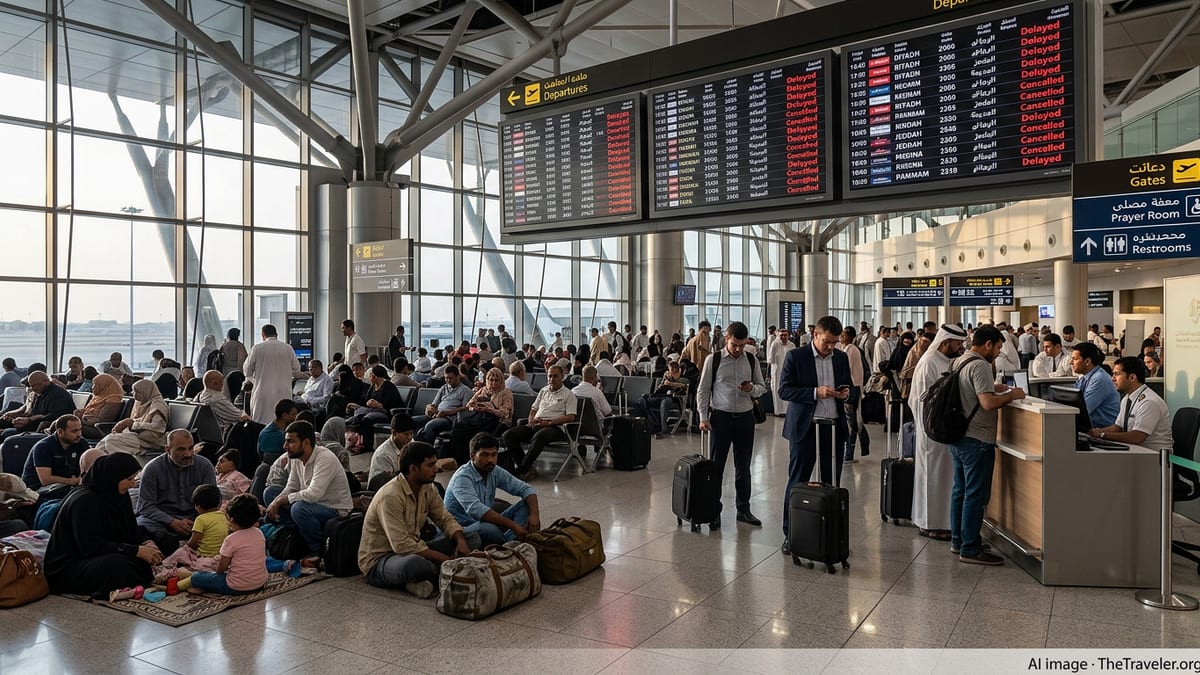
Saudi Hubs Buckle Under Regional Airspace Crisis
Saudi Arabia’s role as a critical transit and origin point for Gulf and South Asian travellers has turned today’s disruption into a cascading aviation crisis. With sections of regional airspace restricted amid ongoing Gulf tensions, airlines have been forced to reroute, thin out schedules or suspend certain routes altogether, concentrating pressure on the kingdom’s main hubs.
At Riyadh’s King Khalid International Airport and Jeddah’s King Abdulaziz International Airport, departure boards showed long columns of cancelled or heavily delayed flights throughout the day. Flight-tracking data and airport advisories pointed to a total of 171 cancellations and 464 delays across the four major airports, hitting both international and domestic services and leaving passengers lining terminal corridors with suitcases and carry-ons.
The pressure was especially acute on routes linking Saudi Arabia with other Gulf states and onward connections to Europe and Asia. Airlines cut frequencies or scrubbed departures altogether, with some carriers focusing on operating a smaller number of flights on time rather than running late services that could compound crew and connection issues later in the week.
Saudi airport authorities in Riyadh and Jeddah issued repeated alerts urging travellers to check the status of their flights before heading to the terminals, warning that schedules remained highly fluid and that more changes were possible at short notice as the regional situation evolved.
Passengers Face Long Waits, Confusion and Limited Options
For many passengers, the disruption translated into hours of uncertainty on the ground. Families travelling for Umrah, business travellers and overseas workers returning to jobs in the Gulf reported waiting in check in halls and near departure gates with limited information on revised timings or rebooking options.
In Jeddah and Medina, where religious traffic is especially strong at this time of year, travellers described crowded seating areas and long queues at airline service desks. Some reported being given hotel vouchers and meal coupons, while others said they were advised to return home or to their accommodation and await updates via text message or app notifications.
Passengers bound for destinations served by Saudia, Flynas and IndiGo were among the hardest hit, with multiple services to regional cities and South Asian gateways delayed or cancelled. Flyers on Qatar Airways and Gulf Air also reported missed connections and last minute schedule changes as those carriers adjusted their operations around constrained air corridors and downstream disruptions at their home hubs.
Travel agents in Riyadh and Dammam said alternative routings were increasingly difficult to find, as neighbouring Gulf hubs also grappled with cancellations and heavy demand from stranded travellers. Some agents reported that premium cabins sold out rapidly on remaining flights, leaving economy passengers facing waits of several days to secure confirmed seats.
Airlines Juggle Safety, Scheduling and Customer Care
Airlines caught in the disruption have walked a tightrope between operational safety, schedule reliability and customer service. Saudia, the kingdom’s flag carrier, has already extended suspensions on several regional routes and warned that onward flights could continue to be affected as the airspace situation develops. The airline has urged passengers to rely on official channels and booking tools, rather than turning up at airports without confirmed flight information.
Foreign carriers, including Air France and Qatar Airways, have adjusted their Saudi schedules as part of wider network changes in response to the Gulf crisis. In some cases, airlines opted to cancel entire rotations rather than operate heavily delayed flights that would push crew beyond duty limits or cause extensive misconnection problems at their main hubs later in the day.
Low-cost operators such as Flynas have faced their own set of challenges, with tighter aircraft utilisation and fewer spare planes available to recover the schedule once disruptions set in. Industry analysts note that budget carriers are particularly vulnerable in tightly constrained airspace scenarios, where even small delays can quickly propagate through an entire day’s flying program.
Customer advocates have urged airlines to communicate clearly and proactively with affected travellers, offering fee-free rebooking, refunds where required, and adequate welfare support for those stranded at airports. While some carriers have activated special waiver policies, the uneven application of these measures has added to passenger frustration.
Government Missions and Airports Step Up Assistance
With growing numbers of foreign nationals caught in the disruption, several governments have moved to support their citizens transiting through Saudi airports. Pakistani authorities, for example, have set up 24/7 helplines and deployed additional staff to Riyadh and Jeddah to assist their nationals, many of whom are Umrah pilgrims and migrant workers trying to return to or leave the kingdom amid the turmoil.
Consular teams have reportedly helped coordinate emergency accommodation, clarified airline policies, and relayed information between stranded travellers and their families back home. Similar efforts have been observed from other South Asian missions, which have been inundated with calls from concerned relatives seeking updates on delayed or unreachable passengers.
On the ground, airport operators in Riyadh, Jeddah, Medina and Dammam have boosted staffing at information counters and security checkpoints to manage crowd flows and reduce bottlenecks. Public announcements have emphasised that passengers should arrive earlier than usual, keep contact details updated in their bookings and monitor airline apps for last minute changes.
Retailers and concession operators inside terminals reported a sharp spike in demand for bottled water, snacks, phone chargers and basic travel amenities as waiting times stretched into the evening. Some lounges and prayer areas were opened to non-eligible passengers temporarily in an effort to relieve congestion in public seating zones.
Uncertain Outlook for Travellers Planning Upcoming Trips
Travel planners and aviation analysts caution that while individual days of disruption can sometimes be absorbed relatively quickly, the current pattern of rolling flight changes across the Gulf suggests that uncertainty may persist in the short term. Saudi Arabia’s airports, which had previously been seen as comparatively resilient alternatives during earlier phases of the regional crisis, are now contending with their own heavy operational strain.
For travellers with upcoming departures from Riyadh, Jeddah, Medina or Dammam, experts recommend building in additional flexibility, including fully refundable fares where possible, longer connection windows and comprehensive travel insurance that covers disruption and missed onward flights. Those whose journeys are not time sensitive are being advised to consider postponing or rerouting via less affected corridors.
Airlines are expected to continue fine tuning schedules day by day as they balance safety considerations with demand patterns. While carriers hope that extra capacity and repositioned aircraft will ease some of the backlog over the coming days, much depends on how quickly regional airspace constraints stabilise and whether further security-related disruptions emerge.
For now, the scenes playing out in Saudi Arabia’s main airports underscore just how swiftly regional tensions can reverberate through a globalised aviation network, touching not only headline carriers but also the everyday journeys of families, pilgrims and workers who rely on these hubs to stay connected.