

More news on this day
Thousands of travelers were left stranded across the Dominican Republic on Monday as sweeping schedule disruptions rippled through Punta Cana, Las Américas, and Cibao international airports, with dozens of flights delayed or canceled on busy U.S., Mexican, and Caribbean routes operated by Aeromexico, Viva Aerobus, Interjet and major American carriers.
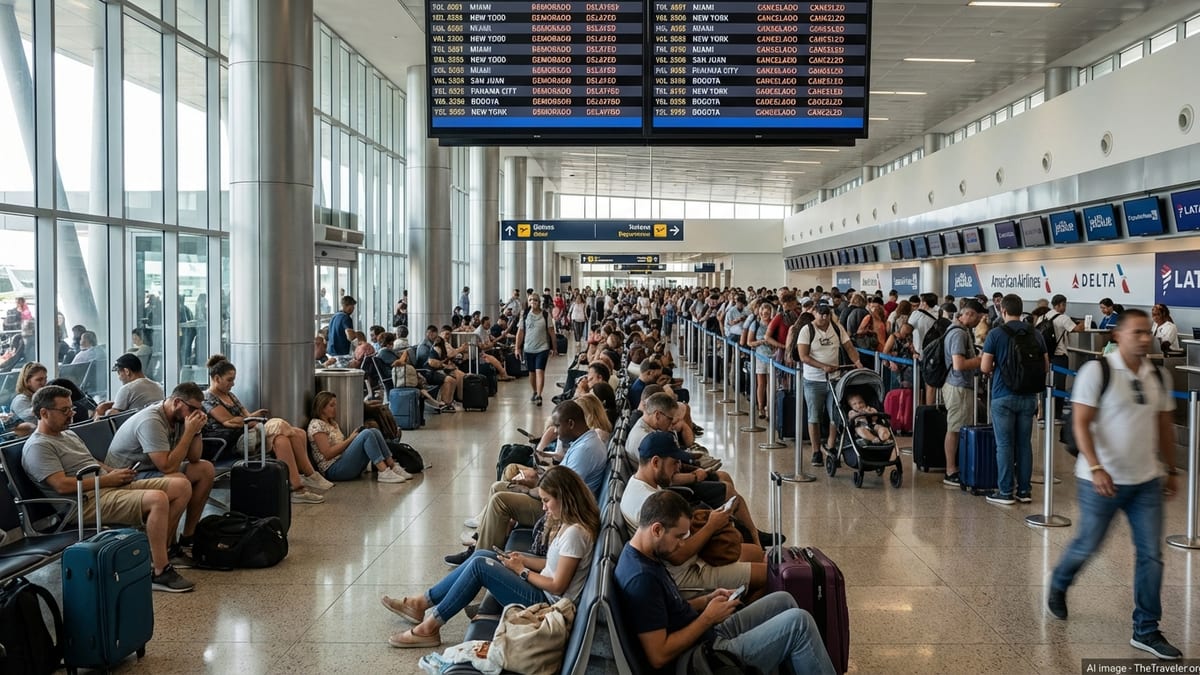
Dominican Republic’s Three Busiest Gateways Brought to a Standstill
The disruption hit the Dominican Republic’s primary international hubs at the height of the winter tourism season, snarling operations at Punta Cana International Airport on the country’s eastern tourism corridor, Las Américas International Airport serving Santo Domingo, and Cibao International Airport in Santiago de los Caballeros. Together, the three gateways handle the vast majority of the country’s international traffic, connecting beach resorts and major cities with North America, Mexico, and the wider Caribbean.
On Monday, airport departure and arrival boards showed a wave of cascading schedule changes. Around 45 flights were reported delayed and at least 95 canceled across the three airports over a 24-hour period, according to aggregated airport and airline tracking data. While not all delays and cancellations were attributed to a single cause, the cumulative effect was a severe capacity crunch that left large numbers of passengers in limbo.
Terminal interiors that typically hum with high-season leisure traffic instead filled with restless lines of stranded passengers queued at check-in counters and airline service desks. Ground staff at all three airports struggled to rebook passengers as equipment, crews, and available seats grew scarce, particularly on heavily trafficked routes to major U.S. hubs and Mexican resort cities.
The disruption struck just weeks after Dominican authorities reported record passenger volumes in 2025, underscoring how quickly regional shocks can reverberate through an aviation network that has grown increasingly reliant on high-frequency links with North America and Mexico for both tourism and diaspora travel.
Spillover from Mexico’s Aviation Turmoil Hits Caribbean Connections
A major driver behind the Dominican Republic’s latest travel chaos appears to be the spillover from severe disruptions across Mexico’s leading tourism and transit hubs, where airlines have been forced to slash operations following a sudden spike in cartel-related violence and security restrictions. Over the weekend and into Monday, Cancún International Airport and Mexico City’s main international gateway recorded a combined total of more than 60 delayed flights and nearly 30 cancellations as carriers pulled back, triggering bottlenecks across their wider networks.
Mexican carriers Aeromexico, Viva Aerobus, and Interjet, which operate dense schedules linking Mexican cities and resort destinations with Caribbean islands and U.S. gateways, were among those forced to retime, reroute, or cancel services. The knock-on effect pushed disruption into connecting markets, including the Dominican Republic, where many passengers rely on one-stop itineraries via Cancún or Mexico City to reach Punta Cana, Santo Domingo, and Santiago.
As aircraft and crews were diverted or held back in Mexico, multiple cross-border rotations into the Dominican Republic were either delayed for several hours or scrubbed entirely. Some flights that did operate arrived significantly behind schedule, throwing departure slots and crew rosters at Dominican airports out of sequence and contributing to a rolling wave of late departures.
Aviation analysts noted that Mexican hubs have grown into crucial connecting points for Caribbean-bound travelers in recent years, particularly for price-sensitive leisure passengers using low-cost carriers. When those hubs experience stress, they warned, ripple effects quickly reach destinations like the Dominican Republic, which may have limited surplus capacity to absorb sudden spikes in rebooking demand.
Weather and U.S. Hub Disruptions Compound the Crisis
At the same time, a powerful winter storm system affecting parts of the northeastern United States added an additional layer of complexity. Airlines serving key Dominican Republic routes reported widespread operational challenges at major U.S. hubs, with thousands of flights nationwide delayed or canceled due to snow, strong winds, and reduced visibility.
Boston, New York, Philadelphia, and other northeastern airports that serve as critical gateways for Dominican-bound traffic were particularly hard hit. These cities are home to large Dominican diaspora communities and act as primary feeder markets for flights into Las Américas and Cibao, as well as seasonal services into Punta Cana. As departures from U.S. hubs were scrubbed or rescheduled, return legs into the Caribbean were disrupted in turn, exacerbating seat shortages for outbound travelers from the Dominican Republic trying to reach the United States.
Major U.S. carriers, including American Airlines, Delta Air Lines, JetBlue, United Airlines, and Spirit Airlines, implemented rolling schedule adjustments. While the majority of their Dominican Republic services remained technically scheduled, aircraft availability and crew duty limits forced tactical cancellations and lengthy delays on select flights to and from Santo Domingo, Santiago, and Punta Cana.
For many passengers on the ground in the Dominican Republic, the specific cause of their delay mattered less than its duration. With both Mexico-linked services and U.S. northeast routes under pressure simultaneously, options for rebooking were sharply constrained, leading to multi-day disruptions for some travelers and pushing airports’ passenger handling capacities to the limit.
Punta Cana: Tourist Hotspot Buckles Under High-Season Demand
Among the hardest-hit locations was Punta Cana International Airport, the country’s busiest air gateway and a magnet for international tourists traveling to resort complexes along the eastern coastline. High-season volumes meant that even a modest proportion of delayed and canceled flights could rapidly translate into thousands of stranded passengers spread across terminals and nearby hotels.
Inbound services from North America, Europe, and other Caribbean destinations arrived off-schedule or not at all, forcing hotels and tour operators to adjust arrivals, airport transfers, and excursion bookings with little advance notice. Outbound travelers, many at the end of tightly scheduled vacation packages, confronted the prospect of missed workdays and unexpected out-of-pocket expenses as they scrambled to adjust itineraries.
Airlines operating into Punta Cana deployed a mix of mitigation strategies, including consolidating lightly booked flights, upgauging aircraft when available to recover stranded passengers, and issuing change-fee waivers and flexible rebooking options. Nonetheless, finite aircraft and crew resources limited how quickly they could clear the backlog, especially while regional disruptions continued to evolve in Mexico and the United States.
Airport officials in Punta Cana worked with ground handlers and security teams to manage crowding within terminals, opening additional seating zones and urging passengers to remain in contact with their airlines via mobile apps and text alerts. Public announcements emphasized that the airport itself remained open and that security conditions were normal, despite visible frustration among travelers.
Las Américas and Cibao Struggle to Move Diaspora Traffic
Las Américas International Airport, which serves the capital Santo Domingo and acts as a primary gateway for business and government travelers, also experienced significant disruption. Several flights linking the city with major U.S. hubs and Caribbean capitals were delayed or canceled, affecting both local residents and international passengers using Santo Domingo as a transfer point.
JetBlue, Delta, United, American, and regional carriers all reported schedule adjustments at Las Américas as they balanced aircraft rotations and responded to capacity constraints emanating from U.S. and Mexican hubs. On some routes, especially those feeding into the northeastern United States, airlines recorded multiple cancellations within a single day, leaving departure boards dotted with red alerts throughout the afternoon and evening.
Cibao International Airport in Santiago de los Caballeros, a vital link for the country’s northern region and its extensive diaspora community abroad, faced similar challenges. High reliance on direct flights to cities like New York and Boston meant that any disruption at U.S. gateways had an immediate impact on Santiago-bound services. Several daily frequencies were either delayed for hours or removed from schedules entirely.
Families awaiting relatives from the United States, as well as workers returning from seasonal jobs, found themselves navigating shifting arrival times and last-minute cancellations. Airline agents at Cibao reported heavy demand for scarce seats on remaining flights, with many passengers accepting indirect routings and overnight layovers to reach their destinations.
Passengers Face Long Lines, Scarce Information, and Extra Costs
Across all three airports, passengers reported enduring lengthy lines at check-in counters, customer service desks, and immigration control as airlines attempted to rebook disrupted travelers while continuing to process those whose flights remained on schedule. Limited staffing during off-peak hours compounded bottlenecks when large batches of passengers sought assistance at once.
Communication proved to be another key friction point. While some travelers received timely updates through airline apps and email alerts, others said they learned about cancellations only after arriving at the airport or waiting at the gate. In multi-airport disruptions that span international borders, information flows can easily lag behind rapidly changing operational decisions made in airline control centers.
Stranded passengers also faced mounting ancillary costs, including unexpected hotel stays, meals, airport transport, and rebooked ground connections. Although many airlines offered vouchers or partial reimbursements, coverage varied by carrier and ticket type, and not all travelers qualified for compensation under existing policies or regional consumer-protection rules.
Travel agents and tour operators fielded a surge of calls from affected customers seeking clarification on their rights and options. Industry observers noted that the episode highlighted, once again, the importance of flexible booking conditions and comprehensive travel insurance amid an era of increasingly frequent, high-impact operational shocks to global aviation.
Airlines and Authorities Race to Normalize Operations
By late Monday, carriers serving the Dominican Republic were working to stabilize their schedules, even as conditions remained fluid in Mexico and the U.S. northeast. Some airlines added recovery flights or swapped in larger aircraft on core routes to move stranded passengers more quickly once weather and security constraints eased.
Airport operators in Punta Cana, Santo Domingo, and Santiago coordinated closely with air traffic control, ground services, and security agencies to prioritize movements that would yield the biggest gains in relieving terminal congestion. They also issued public advisories urging passengers to arrive earlier than usual, check flight status frequently, and be prepared for potential gate or timing changes throughout the day.
Aviation experts stressed that the complex web of disruptions underscored the interconnected nature of modern air travel, in which instability at a handful of key hubs can swiftly affect distant destinations that appear, on the surface, to be far removed from the original flashpoints. For Caribbean nations like the Dominican Republic, which depend heavily on reliable air links for tourism and trade, building resilience into airport and airline operations will remain a central priority.
In the short term, however, officials and airline managers acknowledged that the focus would remain on clearing backlogs and restoring passenger confidence. With more winter weather forecast for parts of North America and security conditions in Mexico still under close review, travelers planning trips to and from the Dominican Republic have been urged to monitor their itineraries closely and maintain flexible plans as operations gradually normalize.