

More news on this day
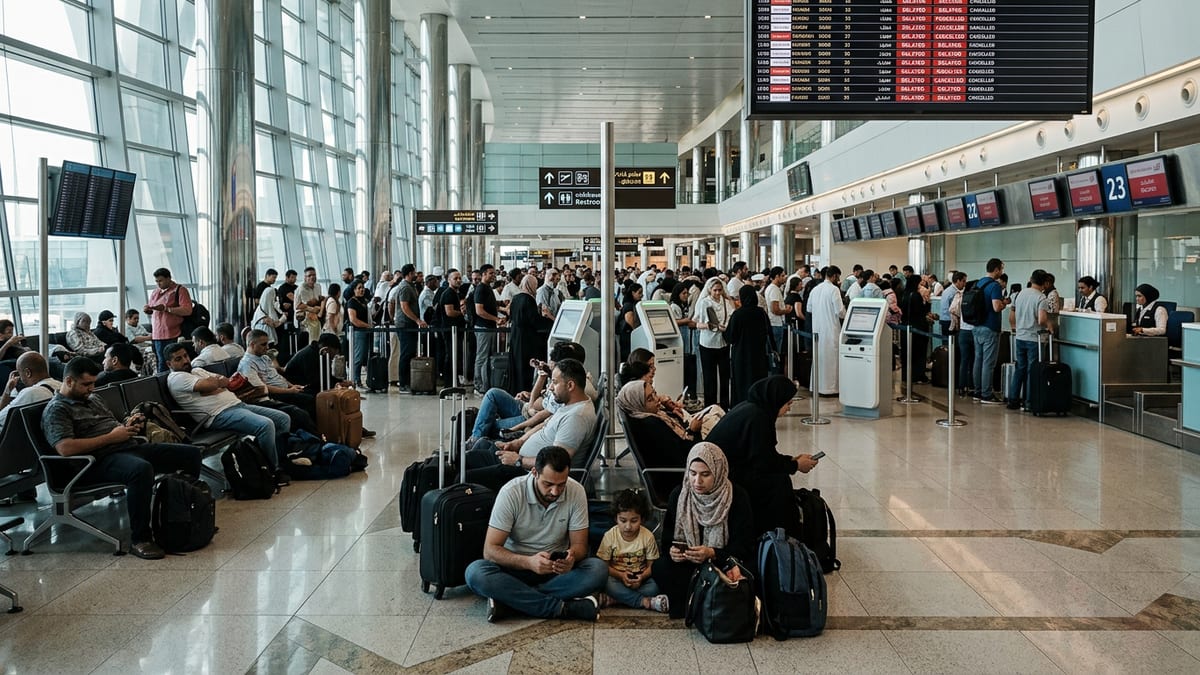
Thousands of air travelers across the Middle East remain stranded after a cascading wave of delays and cancellations hit key hubs in Saudi Arabia, the United Arab Emirates, Qatar, Egypt, Turkey, Israel and beyond, disrupting more than 2,100 flights in a matter of days and snarling global travel networks.
Get the latest news straight to your inbox!
Airspace Restrictions Ripple Across a Tense Region
Recent airspace restrictions linked to escalating regional tensions have severely disrupted commercial aviation across the Middle East, according to flight tracking data and industry notices. Publicly available information shows that airspace in multiple states, including the United Arab Emirates, Qatar, Israel, Iraq and parts of the Gulf, has faced temporary closures or tight operating constraints, forcing airlines to reroute, delay or cancel services at short notice.
Operations at major hubs such as Doha, Dubai, Riyadh, Jeddah and Abu Dhabi have come under particular strain as carriers attempt to balance safety advisories with heavy passenger demand at the tail end of the winter travel season. Network airlines that normally use Gulf hubs as connection points for traffic between Europe, Asia and Africa have been compelled to ground aircraft or operate limited schedules, leading to bottlenecks that quickly spread to neighboring airports.
Regional carriers are especially exposed because their business models depend on dense schedules and quick aircraft turnarounds. When airspace restrictions are imposed, even for a limited number of hours, schedules can quickly unravel, leaving crews and aircraft out of position and passengers facing missed connections across several continents.
Qatar Airways, Saudia, Emirates and Flydubai Cut Deep Into Schedules
Across the Gulf and wider Middle East, publicly available timetables and tracking platforms indicate that airlines including Qatar Airways, Saudia, Emirates, Flydubai and other regional operators have delayed at least 1,335 flights and cancelled around 818 over a short period. The disruptions span both short haul services within the region and long haul routes linking the Middle East to Europe, North America, Africa and Asia.
Qatar Airways has faced particularly acute challenges at Hamad International Airport in Doha, where airspace limitations and security considerations have forced widespread schedule reductions. Published aviation alerts describe suspended or heavily curtailed operations on some regional routes, as well as a reliance on ad hoc repatriation flights to move stranded travelers once safe corridors are confirmed.
In Saudi Arabia, Saudia has had to adjust services at key gateways such as Jeddah and Riyadh as connecting traffic flows through Gulf airspace became less predictable. In the United Arab Emirates, Emirates and Flydubai have operated a mix of cancellations, rolling delays and reduced frequencies, with some flights temporarily prioritized for repatriation and essential travel. The combined impact has been to thin out what is normally one of the world’s most frequent and reliable flight networks.
Other carriers based in Turkey, Jordan, Egypt and Lebanon have also trimmed schedules or suspended flights to affected airspace, adding to the overall tally of disrupted operations. International airlines from Europe and Asia that typically overfly the region have rerouted or paused certain services, contributing to the overall reduction in capacity available to stranded passengers.
Key Hubs From Cairo to Muscat Struggle With Overflow
Major airports across the Eastern Mediterranean and Gulf have become temporary holding points for travelers whose journeys suddenly stalled. In Egypt, Cairo International Airport has reported crowded terminals as passengers arriving from Africa and Europe discover that onward Middle East connections are delayed or cancelled. Reports from the ground describe long queues at airline service desks and packed seating areas as travelers wait for rebooking options.
In Jordan, Amman’s Queen Alia International Airport has seen disruptions on routes connecting to Gulf states and Israel, complicating travel plans for both regional residents and international visitors using the city as a transit point. Beirut’s Rafic Hariri International Airport has also been affected, with reduced connectivity to Gulf hubs and Turkey limiting options for passengers seeking alternative routings.
Farther east, Muscat International Airport in Oman has played an important role as a diversion and transit point when flights are unable to reach their planned destinations in Qatar or the Gulf. Some passengers have reported extended unplanned stays in Muscat and other secondary hubs while waiting for airlines to secure new routings through available airspace. These improvised patterns of movement have strained local airport resources that were not initially configured for such prolonged disruptions.
Additional pressure has been felt at airports in Israel, the United Arab Emirates and Turkey as incoming flights outpace the number of departures airlines can safely operate. Terminal congestion, stretched ground handling and limited hotel availability near key hubs have all compounded the inconvenience for stranded travelers.
Passengers Face Long Delays, Confusing Guidance and Limited Options
For passengers caught in the middle of the crisis, the most immediate impact has been prolonged waiting times and uncertain itineraries. Accounts shared on social media and travel forums describe families sleeping in terminal seating, business travelers missing critical meetings and tourists struggling to extend visas or rearrange accommodation when return flights suddenly disappear from departure boards.
Publicly available airline notices outline a range of policies that typically include free date changes, rebooking onto alternative routes where possible, and refund options for flights cancelled as a direct result of the disruptions. However, in practice, high call volumes at contact centers and long lines at airport ticket desks have made it difficult for some travelers to access these remedies quickly.
The scale of the disruption has also limited the availability of alternative seats. With hundreds of flights removed from schedules and many remaining services heavily overbooked, passengers have sometimes had to accept routings that involve multiple stops, overnight layovers or travel dates several days later than originally planned. Even when seats exist on unaffected airlines, fare differences and complex ticketing rules can make last minute switches costly.
In several countries, consumer advocates have urged travelers to document all out of pocket expenses related to accommodation, meals and ground transport while stranded. They also recommend that passengers keep written records of airline communications and policy updates, which may be needed later for insurance claims or refund requests.
Slow Recovery Expected as Airlines Rebuild Networks
Aviation analysts caution that even if airspace restrictions are gradually eased, the recovery of full schedules across the Middle East is likely to be uneven. Airlines will need time to reposition aircraft and crews, reestablish regular rotations and assess demand patterns that may have shifted as travelers rerouted or postponed trips during the disruption.
Industry commentary suggests that the first priority for many carriers will be clearing the backlog of stranded passengers through additional sections, larger aircraft on key routes and dedicated repatriation flights. Only after that wave of travel has passed are airlines expected to focus on restoring the broader network of frequencies and destinations that existed before the current crisis.
Travel experts note that the disruption highlights the vulnerability of global aviation to sudden shocks in strategically important regions. The skies over the Middle East link major continents, and any extended constraint on those corridors can quickly reverberate through airports as far apart as London, Mumbai and Johannesburg. As airlines, airports and passengers across Cairo, Amman, Beirut, Muscat and other hubs continue to navigate the fallout, timetable stability is likely to remain fragile in the days ahead.