

More news on this day
Hundreds of travelers at Chongqing Jiangbei International Airport in southwest China faced major disruption as at least 108 flights were reported delayed and eight canceled, affecting busy routes to major destinations including Beijing, Shanghai, Guangzhou, and Hong Kong.
Get the latest news straight to your inbox!
Major Disruption at a Key Southwest China Hub
The disruption at Chongqing Jiangbei International Airport, one of western China’s busiest aviation hubs, rippled across the country’s air travel network. Publicly available flight-tracking dashboards and local media summaries for the day indicate a sharp spike in delays on both domestic and regional services, with departures to several of China’s largest cities particularly affected.
Operational data show that more than one hundred flights experienced extended waiting times at the gate or on the tarmac, with additional knock-on delays for connecting services. With eight flights canceled outright, passengers bound for key commercial and tourism centers such as Beijing, Shanghai, Guangzhou, and Hong Kong faced last-minute rebookings, missed connections, and unscheduled overnight stays.
Chongqing Jiangbei serves as a critical connector between China’s interior and coastal economic hubs, handling a high volume of business travelers, students, and tourists. Any large-scale disruption at this airport tends to send immediate shockwaves through airline schedules, particularly on trunk routes linking the city to the Beijing–Tianjin–Hebei region, the Yangtze River Delta, and the Pearl River Delta.
Reports from Chinese-language news outlets and aviation tracking platforms suggest that congestion grew steadily through the day as delays compounded, with departure boards showing extended queues of late-running flights and revised estimated times.
Travelers to Beijing, Shanghai, Guangzhou, and Hong Kong Most Affected
The heaviest impact was felt on flights from Chongqing to China’s major first-tier cities, which normally see high daily frequencies and relatively short journey times. Services to Beijing and Shanghai, used heavily by business travelers and those connecting to long-haul international routes, recorded some of the most notable disruptions, with multiple flights departing far behind schedule or being consolidated.
Guangzhou- and Shenzhen-bound flights from Chongqing are also important links into the manufacturing and logistics centers of the Pearl River Delta. Delays on these services can quickly affect cargo movements as well as passenger itineraries, especially for travelers relying on tight connections across southern China.
Hong Kong routes added another layer of complexity. These flights are often timed to connect with onward long-haul services to Europe, North America, and Southeast Asia. When departure times from Chongqing slip by several hours, travelers risk missing onward flights, forcing airlines to rebook passengers via alternative hubs or offer hotel accommodation where necessary.
According to publicly visible booking and schedule information, some carriers responded by shifting passengers to later departures on the same day or the following morning, while others encouraged affected travelers to modify their plans via mobile apps and customer-service channels.
Potential Causes and Operational Strain
As of the latest publicly available reports, there was no single definitive cause cited for the wave of delays and cancellations. In China’s tightly coordinated aviation system, such disruption can stem from a combination of factors, including adverse weather in one or more cities, temporary airspace restrictions, aircraft rotation issues, or technical checks on individual aircraft.
Airports in China regularly experience delays when weather systems move across the country’s east coast or central regions, as knock-on congestion spreads through the network. Even if conditions in Chongqing remain acceptable for flying, disruptions at major hubs such as Beijing, Shanghai, or Guangzhou can cascade into late arrivals and subsequent late departures from Jiangbei.
Operational resilience can also be tested when several delayed flights converge within the same time window. Ground-handling teams, security screening, and airport transport systems are all placed under additional strain when more passengers than usual are waiting in the terminal or attempting to rebook missed connections.
While Chongqing Jiangbei has expanded significantly in recent years, including the opening of newer terminal facilities, the sudden compression of delayed departures into peak periods heightens congestion in check-in halls, security lanes, and boarding areas, as described in open airport planning documents and regional aviation analyses.
Passenger Experience: Long Queues and Changing Itineraries
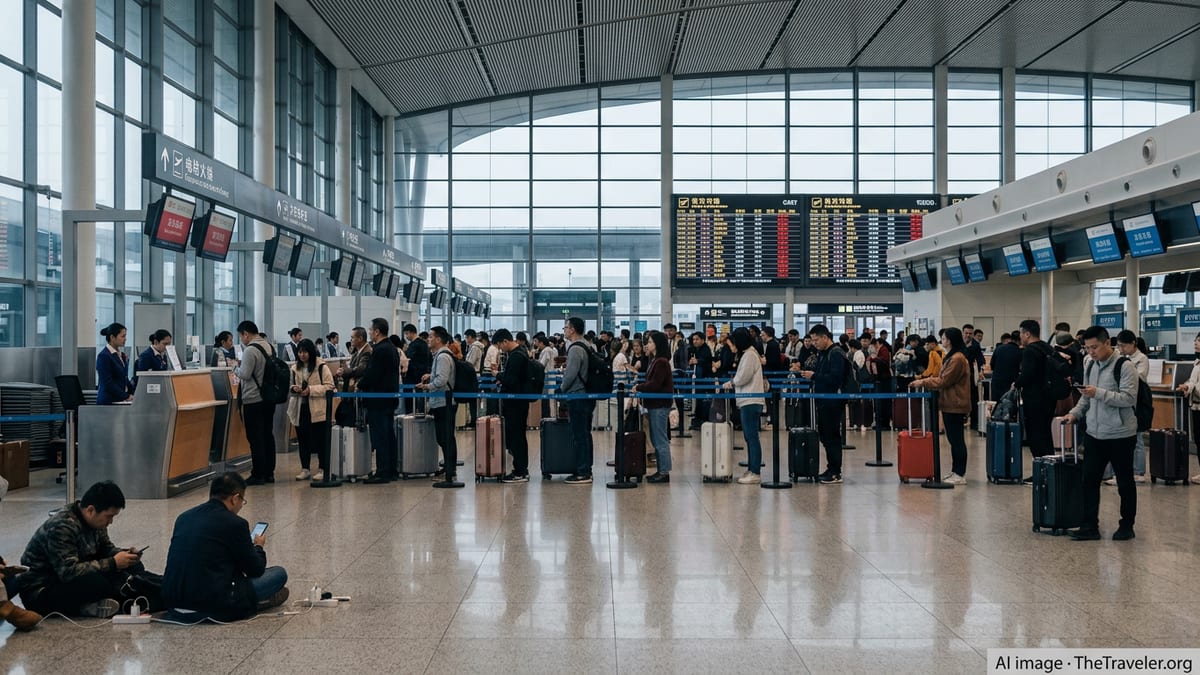
Travelers passing through Chongqing Jiangbei during the disruption encountered long queues at airline counters and self-service kiosks, as rebooking demand surged. Social media posts and trip reports shared publicly described crowded departure halls, with many passengers closely monitoring screens for updated departure times.
Some passengers heading to Beijing, Shanghai, Guangzhou, and Hong Kong reportedly faced missed same-day meetings, tour departures, or onward international flights. For travelers without flexible tickets, the need to adjust hotel bookings and ground transport at short notice added extra cost and complexity to their journeys.
In similar past events at major Chinese airports, airlines have typically responded by issuing voluntary change waivers, allowing passengers on affected flights to switch dates or times without additional change fees, subject to availability. Publicly accessible fare rules and advisories suggest that comparable measures are likely in place when disruptions reach the scale seen at Chongqing Jiangbei during this incident.
Airport services such as lounges, food outlets, and seating areas also come under pressure during extended delays. For travelers facing several hours of waiting, access to charging points, Wi-Fi, and basic amenities becomes particularly important, especially for families and elderly passengers.
What Travelers Should Know When Flying Through Chongqing
The latest disruption highlights the importance for travelers using Chongqing Jiangbei International Airport to build extra time into itineraries involving tight connections, especially when flying on to or from major hubs like Beijing Capital, Beijing Daxing, Shanghai Pudong, Guangzhou Baiyun, or Hong Kong International.
Travel planning resources and frequent-flyer guidance commonly recommend that passengers in China monitor their flights closely via airline apps and flight-tracking tools on the day of travel. Enabling notifications and checking terminal and gate assignments before leaving for the airport can provide early warning of potential problems.
For those connecting onward to long-haul international flights in Beijing, Shanghai, Guangzhou, or Hong Kong, a longer layover can provide a buffer against delays propagating from Chongqing. Travel advisers often suggest at least several hours of connection time in China’s largest hubs, with additional margin during peak travel seasons or periods of unstable weather.
While large-scale disruption on the scale of 108 delayed flights and eight cancellations is not an everyday occurrence at Chongqing Jiangbei, the event serves as a reminder that even well-developed aviation hubs remain vulnerable to sudden operational challenges. Travelers planning trips through the region in the coming weeks are likely to keep a close eye on performance metrics and any new advisories affecting China’s busy domestic and regional air corridors.